| OCR Text |
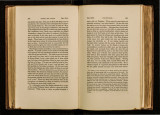
Show 390 PASSAGE OF CORDILLERA. March, 1835. fore likewise the republics of Chile and Mendoza. To the eastward, a mountainous and elevated region separates it from the second range (called the Portillo) overlooking the Pampas. The streams from the intermediate tract find a passage a little way to the southward through this second line. I will here give a very brief sketch of the geological structure of these mountains : first, .of the Peuquenes, or western line ; for the constitution of the two ranges is totally different. The lowest stratified rock is a dull red or purple claystone porphyry, of many varieties, alternating with conglomerates, and breccia composed of a similar substance : this formation attains a thickness· of more than a mile. Above it there is a grand mass of gypsum, which alternates, passes into, and is replaced by, red sandstone, conglomerates, and black calcareous clay-slate. I hardly dare venture to guess the thickness of this second division ; but I have already said some of the beds of gypsum alone attain a thickness of at least two thousand feet. Even at the very crest of the Peuquenes, at the height of 13,210 feet, and above it, the black clay-slate contained numerous marine remains, amongst which a gryphrea is the most abundant, likewise shells, resembling turritellre, terebratulre, and an ammonite. It is an old story, but not the less wonderful, to hear of shells, which formerly were crawling about at the bottom of the sea, being now elevated nearly fourteen thousand feet above its level. The formation probably is of the age of the central parts of the secondary series of Europe. These great piles of strata have been penetrated, upheaved, and overturned, in the most extraordinary manner, by masses of injected rock, equalling mountains in size. On the bare sides of the hills, complicated dikes, and wedges of variously-coloured porphyries and other stones, are seen traversing the strata in every possible form and direction ; proving also by their intersections, successive periods of violence. The rock which composes the axis of these great March, 1835. GEOLOGY. 391 lines. of dislocation, at a distance very closely resembles gramte, but on e.xamination, it is found rarely to contain any quartz; and mstead of ordinary felspar, albite. The metamorphic action has been very great, as might have been expected from the close proximity of such grand masses of rock, which were injected when in a liquefied state fro:n heat. When it is known, first, that the stratified porphyries have flowed as streams of submarine lava under an. enormous pres sur~, an~ . that the mechanical beds separatmg ~hem owe thmr ongm to explosions from the same submarme craters; secondly, that the whole mass in the lo":er part has generally been so completely fused into one sohd rock by metamorphic action, that the lines of division can only be traced with much difficulty; and thirdly, that masses of porphyry, undistinguishable by their mineraloO'ical ~~aracters from the two first kinds, have been subsequ:ntly InJected ;-the extreme complication of the whole will readily be believed. We now come to the second range, which is of even greater altitude than the first. Its nucleus in the section s~en in crossing the Portillo pass, consists of magnificent pmnacles of coarsely-crystallized red granite. On the eastern flank, a few patches of mica slate still adhere to the unstratified mass; and at the foot a stream of basaltic lava has burst forth at some remote period,-perhaps when the sea c?vered the wide surface of the Pampas. On the western Side of the axis, between the two ranges, laminated fine sand~ tone has been p~netrated by immense granitic dikes proceedmg from the central mass, and has thus been converted into gra?ular quartz rock. The sandstone is covered by other sedimentary deposits, and these again by a coarse conglomerat~, the vast thickness of which I will not attempt even to estimate. All these coarse mechanical beds dip from the red granite directly towards the Peuquenes range, as if they passed beneath it ; though such is not the case. On. examining the pebbles composing this conglomerate (whiCh, to my surprise, betrayed no signs of metamorphic |