| OCR Text |
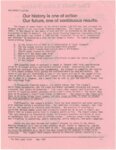
Show PRESIDENT'S LETTER Our history is one of action. ----~ Our future, one of contiriuous resuHs. . The L&ague of Women Voters of the United States (LWV-US) has just released the 47-paffe report of the Long Range Planning Committee.. This report, entitled uBeyond 1984, is the result of two years of work and will be presented at the National Convention in May 1n Detroit. The Long Range Planning Contnittee {including LWV-SL member, Roi ~lcGee) was fanned in 1982 and was instructed "to be bold, imaginative, and thoroughu in developing a plan for the League's future. The report addresses seven planning issues: A. h the League out of date as an organization of 1oca1 leagues? D. Should state league$ be retained? B. C~n the League achieve sustained membership growth? C. How can a multi-issued organization make a difference? • . . E. Where wf 11 the money come from? F. C1n we function without paper? . G. Is the national level organized effectively to meet the future needs of the League? Each J)lanning issue fs explored in depth in "Beyond 1984" with consideration given to in-League surveys and current national trends. Conclusions are then reached and strategic directions reconnended. Any attempt to sunmarize the results of this rei,ort without fully giving the rationale would be very misleading. For those of you who are interested, a copy of the report will be fn the League Office. (And an article about the report will appear 1n the Spring National VOTER; I urge you to rea<1 it.) However, now I would like to look at just two specific issues from the Long R~nge Plan. In discussing Planni.ng Issue C, the report states that "the League•s multi-issu~ perspective, and its study and member agreement processes are present strengths that should be preserved. n (The report does suggest modifications in the process of reaching member agreement which I won't touch on here.) The report then goes on to propose a significant change in emphasis: "The Leasue of the future will have to be doing thinr about issues not Just stu _ the next 9~neratfon o mem ers. in "tfieiii ,n Order to attract • • Traditionally, the League's primary focus has been education and voter service, with advocacy taking a secondary role. The committee concludes, however, that from now on, the emphasis on advocacy must increase. The practice of arriving at posf ti ons through memer study and discussion should not be an end in f tsel f I but The report states that ~h,oul d 1ea<:1 to a more active ro1e 1n changing pub 1i c po 1icy 'l the term &dvocacy fs intended to convey the broadest possible definition of tools or techniques that can be used to achieve change.•• Advocacy ranges from lobbying and litigation to monitoring, public education, policy analysis, and medi·a campaigns~ Anyone who has read through out League's program (as given in the Annual Meeting Ha~dbook) will realize that advocacy on all fronts 1s impossible, and the conw,1ittee Points out that limits must be set: "The League at each level will have to focus its energies on a few of the many issue!_ on its 2rogram in order to be effective.'• They suggest that Leagues de~elop an advocacy agenda. selecting a few The Salt Lake VOTER May 1984 |