| OCR Text |
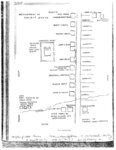
Show I . j-.~ 414 HISTORY OF SANPETE C OUNTY spending their valuable time (they were, after all, primarily miners), materials, and money building a large fort (as had been done at great cost in Manti and Ephraim), they erected a small adobe fort which contained only enough room for a meetinghouse and places to sleep at night. During the day they lived in their houses outside of the fort. Here again their town building was unorthodox by Mormon standards. They erected more than a dozen log houses in a single row rather than on lots in blocks. Across the road from each house was a corral for the animals belonging to each family. This pattern of houses and corrals elosely spaced along a road was no doubt the way they had built mining towns in their homeland of Wales. This anomalous Welsh-Mormon town was not to last, however. With the houses and animals outside the little fort, they were vulnerable to Indian raids. Ip. 1866 the people of Coalbed felt compelled to Qismantie their cabins and move the entire community to the fort in Moroni for protection. There they stayed until 1868 when th;Y returned to their abandoned townsite. In rebuilding Coalbed the second time, they followed t~aditional Mormon town planning precepts, copying what had seen in Moroni. The community was renamed 'Yales in 1869 when it received a post office. In 1873, after a patent was granted to the Wales Township, a townsite of twenty-six blocks (five north-south and four east-west) was laid out. As in Moroni, each block had five acres and four lots. Family leaders drew for lots, each receiving an irrigated lot and a dry lot. With town growth now proceeding with typical Mormon orderliness, the colonists were no longer satisfied with log cabin homes. Peter Christensen built a brick kiln south of town, resulting in the many fine red brick dwellings in Wales. Peter C. "Miller" Anderson built a grist mill and a boarding house and hotel for newcomers. As Utah Territory's need for coal increased, mining activity intensified in Wales. The original miners sold the mines to a mining company which constructed twelve coke ovens, crushing, and washing machines. Thanks to funding raised in England by Simon Bamberger, a new mining company was capitalized about 1875. It arranged for the first railroad to be brought into the county from Nephi to the old mines, as well as a new mine in Pete's Canyon. At one time, 200 men THECOMMUN were emplo: short-lived 1 Eventu, quality coal mines were l farm . Two i improveme; 1898. After 1910, the hal modest gro\ started in thl Like San ious organiz. 1868 Wales ( Wales in con John E. Rees and Relief S( mid-1870s. f 1946. It rep I Primary buill time the wa CommonHo ber schoolho schoolhouse \ where transpc their funds an in 1904. An 01 to the federal were noticeab 1950. Due to its center. Still, il being the co-o vacant store, a the Wales CO-l cooperative est years before ell |