| OCR Text |
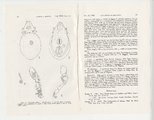
Show Reprint from the Great Basin Naturalist Volume XXII October 15, 1962 Nos. 1-3 A NEW SPECIES OF EREMAEUS FROM THE WESTERN UNITED STATES (ACARINA: ORIBATEI, EREMAEIDAE)1 HAROLD G. HIGGINS2 Preliminary studies on the genus Eremaeus of North America have shown that this group of mites has a wide ecological range with many species, A rather robust species with deep pits which appear spotted under low magnification, has been found in mountainous eflrleas of Western United States. A description of this new species 0 lows. Eremaeus stiktos, n. sp. DIAGNOSIS: Color dee reddish-brown; bod and legs more deeply pitted than any known species; pseu ostigmatic organs shorter than distance between pseudostigmata; body hairs short and weak; femus of all legs with a double, ventral keel. DESCRIPTION: Color deep reddish-brown; propodosoma slightly wider than long, about one-third as long as hysterosoma; rostrum rounded; rostral hairs short and projected anteriorly for about onehalf their length over the rostrum; lamellae short, rather smooth with roughened medial borders, separated from each other a distance equivalent to their lengths, usually with about six longitudinal rows of large pits between lamellae; lamellar hairs located on antero- lateral margins of propodosoma and extended down over rostrum by about one-third their lengths; interlamellar hairs extremely short, about one-third as long as distance across pseudostigmata, insertions prominent, located posterior to lamellae at level of pseudostigmata; pseudostigmata heavy, cup-shaped, directed antero-laterally; pseudostigmatic organs short, slightly longer than lamellae, with short, rounded setose head and short pedicle as shown in figures 1 and 3; tectOpedia I long, directed anteriorly, with roughened edges; tecto- pedia II sho‘rter than tectOpedia I and directed antero-laterally; exobothridial hair slender and located antero-laterally to pseudostigmata. Hysterosoma oval and slightly vaulted; dorsal hairs short, weak and often hidden by the deep, oval pits that cover the body. Hysterosoma and dorsal hairs as seen in figure 1, nine pairs visible in holo- type specimen. Camerostome egg-shaped in outline with two pairs of medially placed hairs; apodemata I a short transverse bar with lateral extensions divided; the anterior part arching in front of tectopedia II; apodemata III weak, not extending to middle line; apodemata IV coalesced with sclero‘tized margin of genital aperature; ventral plate 1. 2. Research supported by National Science Foundation. Department of Zoology, University of Utah, Salt Lake City. 89 |