| OCR Text |
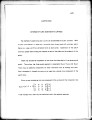
Show "■'■"'•'■" ■•"W»WIW^i^WWiPliBP«WBI>«*P»IPWl»»Iwwi^fpppp4p<p||pB||W)(pWpp^ 12 square 2' by 2' needs fl'+A0 subdivisions; a square 2" by 2" needs J£4 subdivisions. This is a geometric series equivalent to (4"-l)/3 which is approximately 4n/3. The area of the square is 2'" or 4". Therefore, the ratio of number of subdivisions to area is about 1/3. This analysis is most accurate for nearly square patches. For curved patches arj skewed orientations the ratio may be somswhat larger. THE SAMPLING PROBLEM There are some problems encountered when using sample points. The most obvious is the "staircase-effect" or "jaggies" seen on the silhouettes of objects. In addition, a patch might be so small that it doesn't cover any sample-point, causing it to disappear. The latter problem can be solved by assigning a patch to the nearest ssuiple-point if it doesn't cover any sample-point. The problems of sampling are inherent with the use of a raster display. Chapter seven will discuss the problems further as well as a means to alleviate them. APPLICATION The subdivision algorit im presented above was first applied to bicubic patches. Bicubic patches are convenient on several counts: they are widely used, they can be compactly specified in several different ways (see Appendix A), they can be easily joined with first derivative continuity at the boundaries and they can be subdivided very easily. The next two chapters will present a method for fast subdivision of such patches. It should be emphasized at this point however that the subdivision algorithm is by no means limited to bicubic patches but can be applied to other Kinds of surfaces. ■UMi _ -- |