| OCR Text |
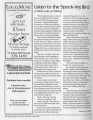
Show More Contradance discussions from the computer network What follows is a (gently) edited discussion recently held in the Usenet rec.folk-dance newsgroup, a computer online service. Many experienced dance musicians and callers partici-pated, and provided some useful tips. . Three main questions were addressed: F1rst, what is the necessary instrumentation for a contra dance band? Second, What tunes are absolutely required? Third, How much can a band expect to be paid? I've tried to give accurate credit for authors where possible; the > symbol at the beginning of a line means that the writer is quoting someone else's statement; paragraphs separate the messages. Because the entire transcript is quite lengthy, I have divided it into several sections, which will find their way into the JAM periodically for your reading pleasure. ( ... and they said computers were useless to musicians!) -Rick Ebling From: Greg Sandell > 1. What is the necessary minimum instrumentation? Fiddle & guitar or fiddle & piano will do it; bass player not necessary (although delightful). If you are new to playing this kind of music, try to find at least one "strong player" (good solid rhythm ... either a melody instrument or a backup instrument) to play in the band. Adding mandolin or banjo to this mix will work. Avoid at all costs having both a piano and guitar player in the same band unless one of them is a very quiet player or if both of them are practically sleeping together. :-) Except for when the two have a really strong musical partnership, these two instruments will fight each other. Avoid putting a dulcimer player in your band (ask your local experienced musician for why, I don't want to touch that hot topic). > 2. What tunes would be absolutely required? Hard to answer this. On the one hand you have tunes that callers may want to hear for specific dances like Rory O'More, Chorus Jig, Petronella, Levi Jackson Rag, which use tunes of the same title. On the other hand you may want to know a "core" set of tunes that insure that you'll be able to play with any random contradance musician who may join your band or sit in with you. A few tunes that come to mind for me (and this is a tiny subset) are: You Married My Daughter But You Didn't, Kesh Jig, Coleraine, Drowsy Maggie, Morrison's Jig, Merry Blacksmith, Spootiskerry, Redwing. Of course this is affected by regional tastes ... here in California I'm finding that not many people have heard Spootiskerry. A good way to learn the "basic tunes" is to get some of the classic recordings (and sorry, I have no idea which are still in print and which are not): Swallowtail's first two albums, the Kaynor's first (only?) album, Yankee lnginuity's first album. (and sorry again for being no help with titles here.) > 3. How much can a band expect to take home from a dance? If the dance is a paying dance, you should never allow the gas expenditures to exceed the payment, in my book. Apart from this, each musician should get ca. $30 minimum, I think. On the other hand, if you are in a small town (Grass Valley, CA?), they might not be charging enough at the door or get enough attendance to support that. .. Most dances pay a flat fee for the band (fewer players = more money per), but in Chicago (and maybe some other places) they pay a flat fee for each musician. > 5. Any other advice is welcome. Have you been to any of the big dance festivals, or dance camps or dance weekends? There's nothing like the catalyst of a major event like Netta, Port Town send, Sugar Hill or Ashokan (did I cover enough of the country here? :-)to galvanize you into wanting to learn as quickly as possible and learning the "spirir of contradance playing. Form your tunes into "sets" of tunes (two or three) that make nice contrasts and progressions. Try combining tunes in different keys ... staying in G or D can be as boring as staying on the same tune. Try choosing sets of tunes where the last tune is really upbeat, often major key. (The classic closing "upbeat tune" is Joys of Quebec.) And now one of the biggest things that will affect whether you get hired again: band togetherness and participation in the dance. Here are the rules: 1 ) Start a dance right when the caller says she/he is ready. If there is a lag between teaching and actual dancing you ruin whatever continuity she has created, and make her look bad as a caller. Start picking your next tune as soon as the previous dance is over. 2) Starting off with a clear, unmistakable "four potatoes" and having everyone come in crisply. 3) Watch the caller carefully; all of you should be ready to end crisply at his signal. Someone in the band should take the responsibility of shouting ''OUT!" (as loud as necessary, don't be shy) about 8-16 measures before the ending. Footnote: never tolerate a caller who: (a) tells you to end at some time other than the end of the second "B" (except for southern squares, where this is quite acceptable); (b) gives you less than 16 measures (i.e. a whole "B" section) warning that the dance is ending. [Regular violators of these two rules do not belong on the stage!] Good luck! EXCELLENT PORTRAITURE • AFFORDABLE • CONVENIENT If I sparked some interest, please contact me for more information. CALL ARTIST: SAM COLLETT (801) 363-3202 Moving? Change of address? Be sure to notify us. When you don't, we won't know where to find you! Remember, the lAMA is a nonprofit organization, and has no extra money to spend needlessly. So please inform us of your address change. You can send it to our P.O. Box, or drop it off at Acoustic Music, Intermountain Guitar & Banjo, or Local Music. Thanks for your support. Intermountain Acoustic Musician, June 1993 13 |