| OCR Text |
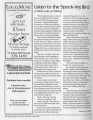
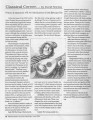
Show Classical Corner ... by David Norton strange beastie indeed. Julian Bream History & repertoire VIII: An Introduction to the Baroque Era calls it 11 a Rolls-Royce ukelele," which is not too far from the mark: the European sailors of the seventeenth century brought their guitars with them, and the modern uke is a direct descendant of the baroque guitar. Strung in five courses, this instrument employed a re-entrant tuning of, a-d-G-b-e. Thus, the lowest string was in the middle of the instrument, and scale passages were typically fingered as right-hand arpeggios, in a technique known as campanella (bell- In the first years of the 17th Century Anno Domini, the prevailing musical styles underwent a significant change. Most importantly, the old systems of musical modes-Dorian, Ionian, Mixolydian, and so forth-were virtually completely phased out in "serious" music, although they remained a powerful force in folk styles. In its place came equal-tempered tuning and the major /minor scale systems which we still use today . . The techniques of composition also shifted. Ornamentation, which had been used sparingly during the Renaissance, became an integral part of the musical structure. This passion for filigree and frippery was not limited to music: the visual arts of painting and sculpture also became highly ornate. In fact, the very word "baroque" is a corruption of a Portuguese word, barrocco, meaning II an irregularly shaped pearl." Needless to say, the period was not thusly labelled until some years after the fact! Along with these new-fangled compositional wrinkles, the plucked instruments experienced some important changes in physical structure and in tuning. As early as 1612, John Dowland was complaining bitterly about "new lute styles" and "new music" and "no respect for the old masters," with the same fervor that our parents disliked Elvis, or perhaps some of our · contemporaries put down heavy metal: "That ain't music-it's jest a mess a' hootin' an' a' hollerin'!" Some discussion seems in order, as we will be looking a Baroque styles for the rest of '93 and into '94. First, the primary plucked instruments: Lute: Still the King of Instruments. But, like many a king, gaining weight in its old age. The lute of Capirola and da Milano had six courses (doubled strings; a twelve-string guitar is properly called a six-course guitar). Early Dowland is written for seven course, late Dowland for nine course. It should be mentioned that all the added courses were in the bass register. The first French Baroque like). This sort of tuning is found · ··--· - ··--------· -~ still in the Bolivian charango, a lute music is for 11 courses. Finally, the lute suites of J. S. Bach require a fourteen courses (28 string!) monster lute. At that point, no one wanted the bother of tuning it, and the lute died a quiet death, awaiting a 20th Century resurrection. Archlutes: Also known variously as chitarrones and theorbos, with subtle ; small five-course guitar made from the carapace of an armadillothere's one on the wall at Acoustic Music for anyone curious about it. Most guitar music of the baroque is strummed, rather than plucked, and serves primarily as vocal accompaniment. Harpsichord: What, pray tell, is a fretted instrument column doing talking about a keyboard instrument? Simple: first, the harpsichord is a plucked instrument, despite the presence of a keyboard. Second, there is an enormous amount of harpsichord music which has been transcribed for modern classical guitarists. In fact, given the rather bizarre tunings encountered in lutes and guitars of this era, harpsichord music often falls more naturally and convincingly on our modern instruments than that written for more direct ancestors. Next month we will look at the French lute literature and how it has influenced 1990s steel-string guitar play-differences in body size. These were ing. designed for use in vocal accompani-ment, and are characterized by very long necks. We'll explore these in more detail when we look at Italian music in a later issue. Guitar: The baroque guitar is a 12 Intermountain Acoustic Musician, June 1993 |