| OCR Text |
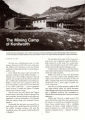
Show BY GEORGE E. LONG In the northeastern portion of Utah and ex-tending a little into Colorado lies a large basin, walled in on the north by the high Uinta Moun-tains and on the south by the Book Cliff Mountains. This area, called the Uinta Basin, is very rich in natural resources, one of which, found only within its confines, is the rare mineral Gilsonite. Gilsonite is a black, glossy, and quite brittle material. Almost 100 percent pure hydrocarbon, it is found in vertical veins varying in width h mle ss than an inch to upwards of 20 feet The depth varies considerably, exceeding 1,000 feet in places. These veins run for miles in an east- west direction through Duchesne and Uintah counties, usually ending near the Utah- Colorado line. Around the turn of the century this newly found mineral, named after Samuel H. Gilson, one of its early promoters, was fast finding a place in the industries of our country. Its use in many manu-facturing processes was multiplying, and the demand for it was becoming greater each year. Expansion was a must Thus the Gilsonite industry faced its number one problem - transportation from the remote Uinta Basin to the railroad. During the early years of development most of the mining of Gilsonite occurred near present- day Gusher, Utah, then known as " The Strip." The ore was hauled by freight wagons through rough Nine Mile Canyon to the railroad at Price, Utah, nearly 100 miles away. Other problems also plagued the Gilsonite mining industry - cave- ins and explo-sions. The St Louis Mine near Gusher, for example, had caught fire and exploded twice by 1902. Its walls in places were in danger of caving in due to the poor texture of the rock formation. Men lost their lives because of these hazards. By 1903 the Gilsonite company had decided to build its own railroad from Mack, Colorado, to its large Black Dragon vein some 55 miles to the northwest just over the Bookcliff Moluntains. This ore body was the closest to an existing railroad. The new rail line would provide many years of uninterrupted shpping of ore hom the mine. The only hitch in th~ psl an was the mountain itself. The only feasible place to cross this obstruction was at 8,437- foot Baxter Pass, but this would mean grades of 7.5 percent and 65- degree curves, a situation practically unheard of in the history of railroading. There would be mile after mile of these sharp curves and steep grades. It is doubthl that there would be a level sbetch of more than a few rods on the entire track Nonetheless, the line was surveyed and construction soon began. Two shay engines negotiating Moro Castle curve, the sharpest on the line. This was part of a five- mile stretch of relentless 7.5 percent grade on the south side of the Book Cliffs. All photographs courtesy of author. Taking into consideration the rough terrain and the means of building such a project in those days, the job was finished in almost record time. By fall 1904 the rails had reached their destination at the Black Dragon Mine, and the shipping of the rare product began. What a feeling these men must have experienced as they made their first hip over the new Uintah Railway. Geared- type Shay loco-motives were used on the steep grades and sharp curves Rod- type engines were used on either side of the pass where the cwes would permit The towns of Atchee, Dragon, and Mack, and the coal mining camp Carbonera sustained the railroad and its workers. Mack was the jumping off point from the Denver and Rio Grande standard-gauge line a few miles west of Grand Junction, Colorado. Atchee, named after a Ute Indian chiet was built at the foot of Baxter Pass on its south side. The excellent mechanics and repair shops main-tained the rolling stock throughout its lifetime and always had standby equipment ready to help the Wns over the big hill. They constructed much of the rolling stock, even assembling one of the Shay-type locomotives there. Hardly a challenge arose that they could not handle. Carbonera was a coal mining camp located between Atchee and Mack Its mine furnished fuel for the trains Dragon was the end of the line for a number of years. From there the stage and bight lines made their way into the Uinta Basin towns of Vernal, Fort Duchesne, and Roosevelt Dragon was located one mile from the Black Dragon Mine and camp, at the junction of Dragon and Evacuation canyons One of the finest hotels in eastern Utah was built at Dragon, together with freight and mine offices, railroad depot, barber shop, stores, schools, saloons, warehouses, and even a library. Before long, business was booming. Stagecoaches oper-ated on regularly scheduled runs, and bight out-fits left almost daily. Mail began coming into the basin over this route, and a telephone system was installed. As far as the Uinta Basin and the Gilson-ite industry were concerned, history was being made. Problems on the Pass Life on the railroad was always exciting. The people involved never lacked for work or things to do. Mother Nature with her storms and floods and Baxter Pass with its steep grades, sharp curves, and slides constantly threatened the line. Accidents happened on occasion, sometimes at the cost of lives, but with the determined courage of those who operated it, the Uintah Railway proved to be a success. This part of the country is known for sudden storms and raging floods down the canyons. Evac-uation Wash, which the railway line followed and crossed several times, drained the entire north slope of Baxter Pass. Many times storms washed out bridges or severely weakened them Salt Wash on the south side of the pass threatened the line almost as much. Baxter Pass was known for hard winters, driving wind, deep snow, and slide danger. Huge earth slides on the south slope of the pass created the biggest problem of all. For nearly a half- mile the mountain was unstable and slowly moving, requiring that the rails be relined from time to time. Finally, the mountainside gave way completely in 1929. The big slide of that year caused the longest shutdown of the railroad during its history. Large steam shovels were brought in to clear the track During the winter, storms often covered the road over the pass with huge drifts of snow, Rotary snow plows could not be used on the Uintah because of the sharp curves, so as many as Atchee, Colo'rado;- 190.5, atthe souhern foot of Baxter Pass. Maintenance personnel tier6 kept railroad equipment operating. three engines coupled together plowed out the drifts to try to get the railroad cars through. In many cases, the drifts were higher than the rail cars. On one occasion an engine left, after it had stalled for the night on Baxter Pass, was completely buried by snow the next morning. W. A Banks of Vernal remembered times when the deep snow and large drifts could not be pushed aside, especially through narrow or winding cuts. The snow had to be pushed directly ahead which was sometimes more than the engines could do even hooked together. When this happened, men from Atchee, Carbo-nera, and Dragon would be called on to help shovel it out by hand. Everyone pitched in to get the train through, for they were all very much dependent on each other. Through the years people talked about ex-tending the Uintah Railway line to Vernal, the m Watson, Utah, ca. 191 3. This small town did a lot of business as a stage and freight terminus and a sheepshearing center. county seat, 65 miles away. That plan never mate-rialized, but the rails were extended down Evacua-tion Canyon in 1911 to the site of Watson and then southwest a few more miles to the Gilsonite mining camp of Rainbow- a total of about 15 miles. When the rails approached closer to Vernal rumors began to fly with more intensity than ever. One was that the rails would be made standard- gauge and that Baxter Pass would be tunneled to allow that The entire area for miles around was heavily laden with oil shale, and in some cases small plants were erected to process it But oil shale was developed no further until recent years. The Rainbow district became the main source of Gilsonite for approximately the next 25 years. Soon the freight, stage, and telephone offices were moved from Dragon to Watson. Though small in size, Watson did a tremendous amount of business. Wagons and later trucks moved in and out, hauling Gilsonite, livestock, wool, hight, mail, and pas-sengers. Thousands of sheep were sheared each year at the big shearing plant in Watson, and the wool was shipped over Baxter Pass by rail. The late L. 0. Jacobsen and W. A Banks operated a fleet of trucks to haul large amounts of Gilsonite from outlying mines into Watson One of many open- cut Gilsonite mines in the Rainbow district Paint and varnish are among the many manufactured products made with Gilsonite. Dragon, Utah, 1905, was a new town when this photograph was taken. Many more buildings, including a fine hotel, were yet to come. Community Life Residents of communities along the Uintah Railway, isolated as they were from larger towns, had to create much of their own amusement Par-ties, dances, socials, hiking, horseback riding, ball games, and other activities filled their leisure time. Mr. Banks remembered that because of the nar-rowness of the canyon the wagon road went through the center of the baseball diamond He said the players had to be very careful not to step into a rut and twist an ankle, and he also recalled times when the game was held up while a wagon traveled across the playing field During the hot summer months many people rode the train to such cool and scenic spots as Lake McAndrews or Columbine on Baxter Pass to enjoy the day. Some-times on holidays they would make up a special train just for recreation and head for the mountain areas. Occasionally, residents would hitch a ride behind the train on a push car, or go- devil, as some called them After disconnecting at the chosen destination, they could at the end of their excursion coast all the way back fmm the pass area to Dragon using the push car brakes as needed In the early days of Dragon's history outlaws hquented the area. Elza Lay, a close associate of Butch Cassidy, stayed there, as did several other men who rode with the Wild Bunch Because of its isolation the town also harbored is share of boot-leggers during pmhibition It was not a lawless town, however, and anyone getting too far out of line was dealt with accordingly. The people were honest, hard- working citizens for the most part ME Banks was a deputy sheriff in Dragon for many Yea New Eugines Basically the Uintah Railway was self- sup-porting with its own machine shops, its own coal mine for fuel, and its own commodity - Gilsonite. The bain also hauled wool, livestock, mail, other Mallet No. 50 and cars loaded with Gilsonite leave the Thimble Rock mine at Rainbow headed for Baxter Pass and Mack. Colorado. height, and passengers, but Gilsonite was its main source of income and kept it going When other means of transportation came on the scene the railroad's profits began to drop. In order to con-tinue profitably the railroad's management de-cided to put more efficient, powerful locomotives into service. So, during the late twenties, the com-pany purchased two mallet- type engines espe-cially built to traverse Baxter Pass. These engines could pull many more cars, and a special pivoting action enabled them to negotiate the sharp curves. They were the largest and most powerful narrow-gauge locomotives ever built These mallets, No. 50 and No. 51, were indeed the pride of the Uintah Railway. After they made their last run for the URin 1939 they were used for many years by other rail lines in the Pacific Northwest and Central America. The two engines were truly something to behold By the close of 1938 it was apparent that the Uintah Railway could not survive. Even her famous mallets could not keep her operating profitably. Large trucks and paved highways had spelled her doom. By June of the following year the railway was abandoned and the equipment was scrapped or sold to the highest bidder. Today all that remains of the Uintah Railway network are a couple of trestles, the railroad bed ( now used as a road), the walls of the large machine shop at Atchee, one dilapidated building at Dragon, the yawning mouth of its once- famous mine, and the tiny cemetery nearby almost overgrown with sagebrush. Countless rusty nails, railroad spikes, and pieces of tin, board, brick, and glass litter the ground. Similar mementos at Watson and Rain-bow also let visitors know of the once- bustling communities that existed there. Baxter Pass in its formidable way remains much the same as it did years ago when the first shay chugged its way over the crest toward Dragon The end of the railroad did not mean the end of the Gilsonite industry. It went on to bigger things In fact, it can well be said that Gilsonite has been the top industry for the basin since 1900, with perhaps the exception of oil in the past few years. The Gilsonite industry payroll has been important to the basin towns Several years after the dekise of the Uintah Railway the company shipped huge amounts of Gilsonite by pipeline over almost the same route traveled by the famous railroad, over Baxter Pass to the refinery near Fruita, Colorado. Charles Neal, a long- time producer of Gilsonite, sent his trucks over the old railroad bed to ship out the precious and rare product This story would not be complete without giv-ing full credit to the people who operated the Uintah Railway. Theirs was not an easy job. Rail-roaders working on a narrow- gauge line deserve a place of honor in the annals of railroading. A nar-row- gauge line was not a toy - quite the con-trary. True, it was smaller, but that was the point A narrow- gauge could go places a standard line could never go. Without the narrow- gauge lines and the brave, dedicated people who ran them, the development of our great West would have been slowed considerably. The narrow- gauge truly rates its place in the historical record along with the covered wagon, the steamboat, the pony express, and the telegraph Some have claimed that the Uintah Railway had the steepest grades and sharpest curves of any comparable line in the world. It also rated high as to the number of hstles and bridges But two things are certain- the UR had the largest and most powerful locomotives ever built for a narrow-gauge railroad and she hauled a unique cargo, Gilsonite. Mallet No. 51 takes on water at Dragon, Utah. 6 |