| OCR Text |
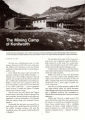
Show BY GEORGE E. LONG In the northeastern portion of Utah and ex-tending a little into Colorado lies a large basin, walled in on the north by the high Uinta Moun-tains and on the south by the Book Cliff Mountains. This area, called the Uinta Basin, is very rich in natural resources, one of which, found only within its confines, is the rare mineral Gilsonite. Gilsonite is a black, glossy, and quite brittle material. Almost 100 percent pure hydrocarbon, it is found in vertical veins varying in width h mle ss than an inch to upwards of 20 feet The depth varies considerably, exceeding 1,000 feet in places. These veins run for miles in an east- west direction through Duchesne and Uintah counties, usually ending near the Utah- Colorado line. Around the turn of the century this newly found mineral, named after Samuel H. Gilson, one of its early promoters, was fast finding a place in the industries of our country. Its use in many manu-facturing processes was multiplying, and the demand for it was becoming greater each year. Expansion was a must Thus the Gilsonite industry faced its number one problem - transportation from the remote Uinta Basin to the railroad. During the early years of development most of the mining of Gilsonite occurred near present- day Gusher, Utah, then known as " The Strip." The ore was hauled by freight wagons through rough Nine Mile Canyon to the railroad at Price, Utah, nearly 100 miles away. Other problems also plagued the Gilsonite mining industry - cave- ins and explo-sions. The St Louis Mine near Gusher, for example, had caught fire and exploded twice by 1902. Its walls in places were in danger of caving in due to the poor texture of the rock formation. Men lost their lives because of these hazards. By 1903 the Gilsonite company had decided to build its own railroad from Mack, Colorado, to its large Black Dragon vein some 55 miles to the northwest just over the Bookcliff Moluntains. This ore body was the closest to an existing railroad. The new rail line would provide many years of uninterrupted shpping of ore hom the mine. The only hitch in th~ psl an was the mountain itself. The only feasible place to cross this obstruction was at 8,437- foot Baxter Pass, but this would mean grades of 7.5 percent and 65- degree curves, a situation practically unheard of in the history of railroading. There would be mile after mile of these sharp curves and steep grades. It is doubthl that there would be a level sbetch of more than a few rods on the entire track Nonetheless, the line was surveyed and construction soon began. |