| OCR Text |
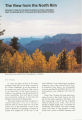
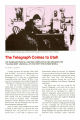
Show The View from rne lvorth Rim DRIVING TO ONE OF THE WEST'S GREAT NATURAL WONDERS USED TO REQUIRE BOTH COURAGE AND RESOURCEFULNESS! t Grand Canyon from the North Rim. Photograph by L. V. McNeely. In 1913 one great section of the Inter-mountain West had not yet been covered by the Tribune Pathfinder. It was the section of the country just south of Kanab, Utah, and on to the North Rim of the Grand Canyon in Arizona. I was anxious to see this section for its scenic possibilities. Zion and Bryce Canyon were practically unknown at that time and therefore were not put on the schedule. The Grand Canyon had been set aside as a National Monument; it was not to become a National Park for several years yet. A11 of the activity was on the South Rim. A spur of the Santa Fe Railroad was bringing in numbers of tourists who stopped off on h way to and from California. A rim railroad gave an almost continuous view of the canyon from El Tovar to Grandview Point. Quite a few automobiles were also reaching the South Rim. But few cars and spectators were seeing the view from the north. Uncle ' Dee'' Woolley of Kanab asked me to make the trip to the Grand Canyon He told me that the forest supervisor, Jim Pelton, was then constrvcting a road to the top of Kaibab Mountain plateau] that would make the trip possible to Bright Angel point. I contacted the Continental Oil Company and made arrange-ments with them to ship gasoline to both Kanab and a point on Kaibab Mountain and organized a party of e& t automobiles and 21 people to make the trip early in September. We made Richfield the first day out from Salt Lake. We held a meeting with the Rich-field Commercial Club that night to enlist their efforts in opening a twrist route to the North Rim. We were unable to interest them and, in fact, were told that such a kip was impossible. Even if it were possible, Richfield was not interested in any tourist travel that might come through the town. It is amusing to remember this incident in view of the efforts civic and business groups made in later years to detour all the tourist travel in southern Utah through Richfield. W. D. ( Bill) Rishel. Courtesy of Virglnla Rishel. We left Richfield early the next morning and reached Panguitch with no trouble. Here we were received with open arms in a meeting held that night and pledged all possible assistance. The next morning we bought shovels and other implements to help us on tt. le roads ahead and started out for Kanab. It is fortunate that we were well prepared, for we encountered by far th warst roads on the trip between these two points. We were un-able to do more than thirty miles on the first day. We dug miles and miles of high centers out of the road and frequently had to swing out into the sagebrush alongside of the road to get through. We camped that night at the head of Johnson Canyon without supper or water. The next day, just before noon, we reached the one lone ranch in the canyon and got a good meal. From there on it was slow traveling through the town of Johnson on account of heavy sand. That night we reached Kanab where the town had - prepared dinner for us. Their dinner had been carried wer from the night hfore because we were a day late on our schedule. We spent the entire next day overhauling our cars and preparing for the final dash down to the Grand Canyon. Our cars were the fist that had ever reached Kanab. Many of the citizens had never seen an automobile before. At that time Kanab had a woman mayor, women councilmen, and women in control of all city offices. I took the mayor for a ride around town in my car. She perched behind the steering wheel and steered the car while I manipulated the throttle, dutch, and brakes. However, to all of Kanab, there was their mayor driving an automobile around the stxeets of the town. We took Uncle " Dee" Woolley and forest supervisor Jim Pelton aboard and headed for the North Rim next mornmg. We found that Pelton had built a pretty fair road up Kaibab Mountain, and from there we followed the forest floor down to the North Rim. The present highway follows very closely the route we took. This trip through the forest, although slow, was one of the finest drives I had ever taken. The country was beautiful, with tall stands of pine, as well as dense groves of aspen and juniper and here and there shady glades or open green meadows. We saw deer every-where and an occasional mountain lion or . bear. When we arrived at Uncle " Dee's" cabin we camped for the night. The next morning we walked up to Bright Angel Point for what is m l y one of the most magnificent views in all of the world. We spent the day there. The view is a thousand feet higher than on the south and, to my mind, much more spectacular. We could see almost the entire South Rim stretched out before us. The next day we drove over to Point Lookout to see the canyon from another breathtaking view and also to look at the river winding through the bottom of the canyon. Reluctantly, we began the trip home. The good luck that had sustained us on our trip down took abrupt leave. About halfway through the forest the rear axle of one of the cars - a car from Michigan - broke. Pelton said there was a sawmill located in the north-ern part of the forest; so he and I took my car and started a night drive to the mill, taking The Tribune Pathfinder mr with Bill Aishel at the wheel pioneered auto routes to the West's scenic attractions. Courtesy of Virghia Rishel. the broken axle with us. We got lost in the forest and had to camp until daylight when we could again see to continue on our way. What followed was an example of what two unskilled men could do on a job of welding at a sawmill forge. It took some time, but we finally got our entire party back safely to Kanab. Our trip home was without further in-cident. We had practically built the road b e tween Pawitch and Kanab on our way down. So what had taken us two days to drive on the trip south, took only about six hours on our way back north. The trip to the Grand Canyon was exploited by the Salt Lake Tribune, and work was gradually started to improve the road from Panguitch to Kanab. About two years later, in order to direct further attention to the route to the Grand Canyon, I organized another party to make the drive down We planned to return home via Zion Canyon, thus demonstrating the possibility of making a loop trip and seeing both of the canyons at the same time. The ex-ploitation of Zion had begun shortly after my first trip to Grand Canyon, and I, therefore, decided there should be a route connecting these two great scenic attractions. The second party, in eight cars, traveled without trouble to Panguitch. From there to Kanab we ran into so many difficulties that our previous trip looked like a picnic. We were compelled to camp out two nights between Panguitch and Kanab instead of one night as on the first trip. Heavy rains had washed out roads and bridges, and at times we had to use low gear for mile after mile to get through. We found an especially bad wash in Johnson's Canyon and had to drag all of our cars through with block and tackle and manpower. And also, some woman power. After we finally got through, Ben Redman staged a " lynching party," showing the bunch hanging me from the rim of the wash. Ben declared that the next time it would be " for real" if I led the party into any more holes like the one in Johnson's Canyon. The pictures appeared in the Tribune and I got a lot of ribbing. From Kanab we found the road in fairly good shape down to the North Rim. The Forest Service had greatly improved it since my last trip there, and the entire party reached Grand Canyon without further incident. We then turned toward the town of Hurri-cane on the route to Zion Canyon. Here we were forced to send a team of horses ahead to pull us through the Kanab Wash east of Pipe Spring. As we left Pipe Spring we met a party traveling in a big white bus, including Gov. William Spry of Utah and a number of Union Pacific Railroad officials. They were headed for the North Rim of the canyon to inspect its potential as an attraction and to see if the Union Pacific could bring in visitors there and compete with the Santa Fe on the South Rim. I told the bus driver he had better arrange with the owner of Pipe Spring to get a team of horses to pull the bus through the Kanab Wash. But the driver was one of those wise guys from the factory, and he told me he did not " need horses to get through anywhere." I said it was okay by me, and let the matter drop. When I returned home I learned the party had been stalled all one night in the Kanab Wash and had to get a team of horses from Kanab to pull them out . But my own trials were just ahead. About halfway to Hurricane trouble began to develop in the rear end of my car. I sent the rest of the party on and started the search for my diffi-culties. After considerable delay I found that one of the gears in the differential was broken. Nothing could be done to remedy it. It was a case of camp out for the night and await help or walk into Hurricane - about thirty miles away. There were four people with me. We camped that night and the next morning decided to wait a while to see if anyone would come along before I started out with one of our two canteens of water for the long hike to Hurricane. About noon we saw a team of horses and a wagon approaching. It was a farmer taking a load of fruit to Kanab to sell. I asked him what he expected to get for his fruit, and he said fifty dollars. I saw myself going into the fruit business right then and there. I made a deal to buy the fruit for his price if he would pull the car into Hurricane. The farmer agreed but was worried about what I would do with the fruit. When I told him I would dump it out and let the coyotes enjoy it, he rebelled at the idea of a whole wagonload of fruit going to waste. Finally, we compromised by leaving the fruit in his wagon by the side of the road and using the horses to pull the car into Hurricane. He could then return to get my wagonload of fruit and take it on to Kanab. This was fine with me - so long as I got to Hurricane. On our way to Hurricane we came upon attorney Andrew Hoppaugh of Salt Lake and his party in a Hudson with a broken axle. We sent a team out from Hurricane to pull him in also. We were delayed for two weeks in Hur-ricane while we waited for parts for our cars from Salt Lake. We made the trip into Zion where we saw for the first time the Great White Throne and the other monumental red rocks that tower above the canyon floor. We finally got back to Salt Lake, several weeks later than we had planned. Since then, a new route has been built into Zion Canyon, and the Zion Tunnel route wount Carrnel Highway] has cut out the long drive through northern Arizona we had to make. This extract appears here by arrangmnent with Howe Brothers, publishers of Wheels to Adventure - Bill Rishel's Wesfern Routes by V i w a Rishel. From Rishel's Routes, 1924, a tour guide with detailed sectional maps. |