| OCR Text |
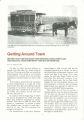
Show This 1883 mule ear included Main Street, part of the Avenues, and the D & RG depot on Its route. USHS collections. Getting Around Town BEFORE TODAY'S MOTOR BUSES THERE WERE MULE CARS, STREETCARS, AND TROLLEYS. A RIDE HOME MIGHT TURN INTO AN ADVENTURE. BY C. W. MCCULLOUGH On May 31, 1941, the last streetcar to operate over Salt Lake City tracks made its final run. Th tracks were then torn up and the shets repaved. Thus closed an era of urban transportation of great local and national significance, one that U t a h may look at with pride. To the oldsters of Salt Lake City, the history of mass transportation is a page out of the book of their lives. But to oncoming youth, the scrapping of outmoded rails and trolley wires gives only a small hlnt of the drama of the trolley car's heyday and its early pre-decessor, the mub car. In common with the beginnings of street-car service throughout the world, Salt Lake City's first streetcars depended on animal baction. From 1872 to 1889 the lowly mule served as " horsepower" to operate a system that included some 14 miles of track and a total of 21 cars. The first streetcar line charged a lment fare. The electrification of the city's streetcar system began in 1889, one year after the first successful operation of an elecbic car line in the United States at Richmond, Virginia. Local service was then in the hands of two com-panies, the Salt Lake Rapid Transit and the Salt Lake City Railroad Company. Corn-petitors for eleven years, the two Iines finally merged into the Consolidated Railway and Power Company. A third line, the Fort Douglas Rapid Transit, was organized in 1890 but was taken over by the SLRT before operating. The trolley cars of this era marked a definite advance over the slow- moving mule car. Yet, they, too, left much to be desired in service and comfort. Open cars were the rule rather than the exception, and no provision was made for heating them in winter. Because of the danger of frostbitten feet in very cold weather, straw was spread deeply over the car floors. Thus, in a few short blocks; a passenger's clothing might acquire the appearance to be gained from a day's visit to the Ogden Livestock Show. Roadbeds and trackage were not engi-neered to present- day standards of smoothness. The single- track cars then in use had a habit of centering themselves on the many humps in the tracks. Once stopped, the vehicles would refuse to move until passengers and crew unloaded and rocked the balky car over the hump. The bouncing of a homebound sb- eetcar over bumps appears to have been listed among the stock excuses to which wives had to listen when husbands arrived late for dinner. Despite h esho rtcomings, the trolley cars met a definite need and were widely used. New lines and extensions were built to keep pace with the city's growth. With the development of new mutes came a need for transfer privileges. In keeping with the nationwide practice of streetcar com-hove: S a~ r~ a kCel ty Railroad trolley of the type that sornetlmes had to be rocked over humps in the track. Below: Transfer featuring seven faces for conductor to match wlth customer. USHS collections. panies, these bansfer slips bore the notice " Not Transferable." Just how such a rule might be enforced has ever been a mystery to streetcar riders. It is doubtful that many riders ever gave their hansfers to other patrons or that the sbetcar companies lost much money from the practice. Nevertheless, local officials tried to put teeth into the " Not Transferable" rule. Salt Lake City fransfers sported a gallery of seven faces, five men and two women. When a rider asked for a transfer, the conductor punched out the usual time and place information. In addition, he also punched the face that looked most like the patron's. Foolproof! Only an identical twin could beat that game. Lst us see! The five men pictured displayed the typical male facial hair styles of that era. Passing on to the ladies, we find the emphasis turning to hats. The younger miss sported a sailor hat and the older woman a bonnet. Imagine allotting the men of today five faces while the women rate only two! And what modem bus driver would want to distinguish younger from older women! Transfers would need to assume the size of an around- theworld have1 ticket to classify the range of zany hair and hat styles seen on any bus today. Rumor has it that neither the company nor the riders liked these transfers. Some of the more mature ladies of that time had young ideas and resented being thought of as oldsters. And there were complications with the males, too. Mr. Muttonchops thought he was p aa fast one when he dashed into the barbershop and reappeared clean- shaven to match his to go by e t - over line pinched whm * t frrmtbd a Lbc wiat of intcrrrcedari with thtm llnr mahtrr, + n + ha Dl.#-. A# . LA H - 1 84 6 8 7 8 9 10- 11 ,---,,,, 16 17 18 10 90 533 8s 28' ! M 25 26 27 28 90 30 -- -& xlh Third tjnd # - k- t S o 2 ~ da A These streetcars ran between Caldefs ( now Nlbley) Park and Warm Springs, a public bathhouse In the northwest part of Salt Lake City. UStlS collections. bogus transfer. T h n again, there was the case of a rider who boarded a streetcar and presented a transfer punched to provide free transportation to a smooth- shaven individual. The conductor noted this and, in turn, the ample growth of stubble on the mads face. When confronted with this, the passenger insisted that he had waited so long for the car that his whiskers had grown! Whether this latter incident is true, it appears that after a reasonable trial Salt Lake City's " keep ' em honest" transfers were abandoned. A third era in urban transportation saw sbetcar and lighting companies in Salt Lake City and Ogden brought together under one management, the Utah Light and Railway Company. Thls occurred in 1904. Two years later, this company's entire holdings were purchased by E. H. Harriman and operated as a subsidiary of the Union Pacific Railroad until 1914 when the Utah Light and Traction Company took over. The UL& TC, in turn, gave way in 1944 to the Salt Lake City Lines. The early 1900s were the golden years of the streetcar. The automobile was still in its infancy. Sbetcars were the accepted means of urban travel. Young and old, the rich and poor, everyone rode the trolleys. Larger, heavier cars were introduced. New lines were extended into growing suburban areas. At their peak, trolleys ran over 150 miles of track within the metre politan area. With h coming of the automobile, the tables were turned. Trolley patronage fell off as the use of private cars increased. Mo$ cars on the road led to a demand for paved roads. This paving tended to follow the routes usd by the streetcars. Often one- third of the paving expense was charged to the streetcar company because of the outdated franchises under which they operated. The speed and comfort of the automobile led streetcar patrons to demand faster and more luxurious trolleys. In addition, the growth of the city created pressure for new streetcar lines and extensions that gave no promise of producing adequate revenue. During these years the public often cried out against large corporations and utilities. " D m with the h s t s ! " and " Soak the rich!" were popuIar sIogans of the day. City and state officials were generally unfriendly, too. The streetcar companies could hardly seek help from them. So, operating costs rapidly went into the red. The sbeetcar was doomed. The success of the automobile and the lugh-way motor bus led to the development of a rubber- tired trolley bus that would not need to The intersection at Main Street and Second South was torn up In 1928 to lay tracks. Note streetcar on right. USHS collections. run on tracks. The advantages of pneumatic-tired buses over track- type streetcars were many: 1. Cost of instollation and maintenance of tracks would be eliminated 2. Opemtion would be quieter. 3. Maneuverability would be increased. 4. Traffic capacity of streets would be increased. 5. Passengers could be picked up and unloaded at the curb. 6. Routing of buses could be changed at wi1I to meet any emergency. The first successful pneumatic- tired holley bus to operate over any city street was engineered and developed by officials of the Salt Lake Traction Company under the direction of E. A. West, general manager, and Jed F. Woolley, chief engineer. Their contribution to mass transportation included introducing many new ideas that are still in use. The basic feature of their revolutionary bus was a new type motor with a lower starm torque that permitted the use of pneumatic tires. Strangely enough, engineers and financial backers were sold on Woolley's idea by a photograph of a trackless trolley car that never existed. As much as West and Woolley believed in their dream trolley, they knew that hard- headed businessmen and financiers would be difficult to convince. Blueprints alone were unexciting. They needed a way to dramatize their idea. They found it! . - .. .. h v r a r r I ~ I J L : I ~ a~ kletsrosl ley buses representeda major improvement In public transportation worldwide. USHS collections. A gasoline highway bus was passing through the city at that time. The driver was induced to park his bus on South Temple where it could be photographed with the Mormon Temple in the background. Using photographic tricks, they superimposed a trolley with its overhead arm and wires onto the bus. The final photograph showed an eleckic trolley bus operating on Salt Lake City streets! This luxurious and practical vehicle could compete with the automobile in comfort, maneuverability, and rider appeal. With this fake photograph, plus the complete plans and specifications for a real trolley bus, West and Woolley were able to negotiate a contract for the manufacture of a fleet of buses by the Vesare Corporation of Albany, New York. Without knowing it, Vesare had agreed to build buses from an unproven, experimental design - an amazing result from a single photograph. When delivered and put into service in 1928, these buses focused the attention of the world on Salt Lake City. Representatives from 26 states and 13 foreign countries were sent here to study their design and operation. The success of the backless holley bus was sen-sational. A new era in urban kansportation was born. The streetcar was definitely on its way out. But, the economic operation of local lines was only half solved by the trackless trolley bus. There still remained the problems of service over very hilly routes and to out-lying areas where the number of riders would not justify the cost of trolley wire installation. The gasoline motor bus appeared to be the logical answer. But the frontengine gas bus had disadvantages that made it unsuitable for city use. Again, engineer Woolley worked out the details of a new model - a rear- engine gasoline bus - and found a manufacturer willing to build it. In 1933 Salt Lake City enjoyed another hanspsortation " first" when these rearengine buses were put into senice. The trackless holley and the gasoline bus replaced the streetcar. These improvements helped to meet the demand for better public transportation through the difficult years of the depression and World War II. Mr. McCullough was a safety engineer for the United Park City Mines Company in 1956 when he wrote " The Passing of the Streetcar" for Utah Historid Quarterly. vol. 28. The above article is an edited version of the eadier piece. Fritz Zaugg - Teenage Immigrant THIS SWISS BOY'S ADVENTURE WAS SHARED BY OTHER YOUNG IMMIGRANTS - INCLUDING GREEKS AND ITALIANS - WHO CAME TO AMERICA AND UTAH ALONE, NOT KNOWING THE LANGUAGE OR CUSTOMS OF THE COUNTRY. BY DOUGLAS D. ALDER Something elechifying happened to four-teen- yemld Fritz Zaugg that afternoon in the year 1884. He walked home from school through his Swiss village as he always did. But when he entered the house his parents were waiting for him. That was unusual. His father was seldom home before dark. They had a most subdued look in their eyes. Fritz could tell that there would be some long talking, just like the times when he was in trouble. But he sensed he wasn't in trouble. Nonetheless, his f o b had that low pitch in their voices, like when there was to be serious talking. The story came tumbling out as Fritz lis-tened, dazzled with the picture that opened before his eyes. As his f a b r said, the Mormon elders had been by that day. ( The Zaugg family were members of the Mormon faith.) They told of a farmer with the good Swiss name, Christian Hirschi, who lived in faraway Utah. Brother Hirschi had sent some money to the Mormon mission president in Switzerland to purchase boat and railroad tickets for a healthy boy who would come to " Zion" and be his farm-hand in Park Valley, Utah, for four years. He asked the president to choose a willing boy who would agrea to the terms - four years of farm labor with room and board in return for the price of the fare. The missionaries had come to the Zaugg cottage with the invitation, asking if their son wanted to be that boy. Fritz's parents had talked soberly before their son had come home. It was a great oppor-tunity. For Mormons, the chance to " gather with the Saints" in Utah was their ultimate dream. The cost of the long journey was an obstade for many families like the Zauggs who wanted to go. Thus, an invitation to go to Utah could be a breakthrough for the Zauggs. Fritz could be the first arrival and could help the others come. But it was such a long distance - 10,000 miles. And in a com- |