| OCR Text |
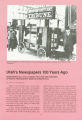
Show Messenger used a Salt Lake Tribune story about a disastrous fire in New York that had T A H PAPPD@$ La 7 burned two factories, five houses, and - - m m CLOSZNa ( DOT 1. DlhDUd. ilU*--. s- L-,". F: E =$. dm$ . *-+. pY* rdM + m- d&; aw. Y1 - m- rm. r nr- *" d. w.* -.. a. - I- h- YI * I , b. I'. .. XI Fiyt Srdrrt 7 ! kiqor$. = m% T#) OP. a*- PIC S o r t ~ o i l P ort 11 STOPREADAND-" 1 . FA11.4 TH. E.- C.- O- U. NTY- ~ N S ~ E RPHYSI~ CIAN ROEOX-MERCHANDISE. ' ~~~, h--. Th'dM msy2g w UL 1.3 n * , llLl. . -- N E W PRICES. BSP~~ SI~ IHJY, c @ a r w goal* p , o, a * pi, Ly+ ua 4 Qbttt- rtfay. UIntah Psppoose masthead and the paper's back page with advertisements, January 16,1801. had his left foot severely cut by the saw at Mr. Kenner's saw mill, Six Mile Canyon," and that " Prof. A. C. Smyth is training a special choir for singing at the dedicatory service of the new school building, which will take place on the 15th of next month." These columns also carried notices of parties, visits, meetings, and births. Some state, national, and international news appeared in the weeklies, Almost always it was copied from other newspapers. It was a common practice to exchange subscriptions, and editors borrowed anything they thought rmght interest their readers from the papers they received. Sometimes credit was given; sometimes it was not. For example, the a store. Another article in the same paper gave no source for a report of a shooting in Wyoming that occurred when a railroad watchman came into the cabin of a sleeping friend and was shot twice in the head before he cwld identify himself. " Drunkenness seems to have been the cause," the story concluded. In some cases the national and interna-tional news came not from exchanges but from ' organizations that put together whole pages and then sold them to the weeklies. These were called " patent pages" and could be printed along with the pages that the editor had pre pared locally. A paper might use patent pages for the front and back and fill the two inside pages with town news, editorials, and adver-tising for local businesses. An 1898 number of the Piute Pioneer had patent pages that included articles titled, " Temperature in Tunnels," " An Oriental Beauty," and " A Sub-marine Boat," along with jokes and small woodcut illusha tions. l3omte- Even the papers that used patent pages found plenty of space for praising their towns. In both news articles and editorials, this boosting was common, for the editors wanted to attract the settlers and businesses that would mean prosperity - including new subscribers and advertisers. A statement from the Uintah Pappoose of 1891 is typical: From a small store on a sagebrush flat, Vernal had grown " in less than four years to a bright busy town, with substantial business houses, pretty homes, shade and fruit trees. . . . Fertile fanning land, unlimited grazing, thousands of acres of coal and gypsum, and as rich gold, silver and copper prospects as there are in the territory." A " glorious future" was expected. Editorials might also call for community improvements, encourage participation in meetings or projects, express support for political parties and candidates, or greet nsw businesses, including the newspapers that popped up frequently in towns across the state. The Warn tch Wave complimented Candace Alice De Witt on the improvements she had made in the Piute Pioneer after she became editor in 1898 and stated, " It reminds one of the change a female is competent of malung in the appearance of some bachelor's hall after giving it a going over for about ten minutes." Fighting wolds However, editorial comments were not always so friendly. The Daily Enquirer of Provo commonly called the Utah Gazette the " Guzzle." The Southern Utonian of Beaver in 1887 referred to the Southern Utah Times as " that lying contemptible sheet, printed by devils, edited in Hell, and issued from the Western part of ths county." Sometimes this personal journalism led to fist fights. The Wasatch Wave reported that its news editor received a " thumping" in 1895 and added that it was looking for a " fighting editor . . . . One who stands six feet eleven inches in his stock-ing feet and tips the beam at 197 pounds fighting weight, who can handle his fists, feet, agunor aclub . . . ." Along with news articles and editorials, most of the papers used pmQ now and then. The Uintah Pappoose printed a poetic wel-come in its third issue: The Uintah Pappoose, so it is said, Is growing fast, and we hope it wiI1 spread Both far and near, to the great and small, And get to be, Big Chief after OH. Another common kind of content was the filler, consisting of a few lines of type used to fill a small empty space on a page. It might be a joke, a short local item, or a fascinating fact. Here's one from the American Fork Item of October 27,1894: ' What would you do if you were a mon, Ethel?" asked Mr. De Sappy. " I'd work as hard as I knew how for the good of my country. What would you do if you were a man, hh. De Sappy?" A d v m Most important of all, as far as the survival of the papers was concerned, were the adver-tisements, for without the money that businesses paid for the privilege of having information distributed to prospective cup tomers, newspapers could not exist. Sub-scriptions alone did not come close to paying the publishers' expenses. Most of the ads, like mcst of the news, were local. An 1894 number of the Millard Progress contained ads for such local businesses as the Fillmore Roller Mill Co., manufacturers of and dealers in Best Grade Flour; Greenway's General Merchandise Store; Mrs. Merrill's Dressmaking and Millinery Store; The Fillmore Dairy Co.; The Cosmo-politan Saloon; Ashrnan and Giles Stage Line; and the Hotel Millard. There were also a few ads for products that were distributed The newspsper staff In Corinne, Utah, 1869, worked out of a tent. W. H. Jackson photograph, USHS collections. nationally, like Royal Baking Powder and patent medicines that made extravagant claims about their healing powers and were later put out of business by the Pure Food and Drug laws. Dr. Pierce's Golden Medical Dis-covery, for instance, advertised that " Children who are weak, thin, pale, and puny are made strong, plump, rosy, and robust by the ' Dis-covery.' " Still another sort of ad was for the paper itself. These ads sought subscribers by listing appealing articles that were coming up or by offering special subscription prices when the paper was taken in combination with some other publication. There might be special prizes for readers who found 10 or more new subscribers. If the newspaper publisher also did other kinds of printing, and most did, the ads would mention that service as well. Some of the printing offices sold stationery and office supplies, too. Editing a weekly newspaper was not an easy task. Editors had to persuade advertisers to buy space and readers to subscribe at the same time they were gathering news and writing articles and editorials. Some of them had assistants. But others worked on their own even doing the typesetting themselves. Yet, their papers were usually good looking and readable, if much more personal than the newspapers of today, and they give an excel-lent picture of what Utah was like a century ago. Dr. Remion is associate professor of journalism at Humboldt State University, Arcata, California. |