| OCR Text |
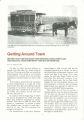
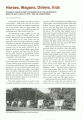
Show Horses, Wagons, Drivers, Kids FOR MANY YEARS AFTER THE INVENTION OF f HE AUTOMOBILE, MUCH OF SALT LAKE CITY STILL RAN ON HORSEPOWER. , BY C. RAY BALMFORTH Practically everything was hauled by teams and wagons - milk, sand, coal, ice, ice cream, furniture, bread, and even water for sprinkling the dusty streets. Each of these teams and wagons had a part in our childhood activities during the early 1920s in Salt Lake City. The sprinkling wagon, pulled by two big horses, was a huge wooden tank on four wheels. The driver sat on a spring seat and had two big pedals by his feet. There was an opening in the top of the tank and a length of firehose on the side. When the driver wanted to fill the tank, he'd attach the hose to the fire hydrant, turn on the water, and fill it up. A gang of us kids was always there to get a drink when he removed the hose from the hydrant and to wade barefoot in the g u s h , fanlike spray that spewed out behind the wagon when he pushed on the foot pedals. The iceman with his wagon and horses came about every other day. This iceman wore a heavy leather cover over his back to protect it when he carried blocks of ice weighing from twenty- five to one hundred pounds each into the homes and stores. His wagon was loaded with ice blocks weighing about five hundred pounds. The iceman chipped off the size he needed with an ice pick. The kids were always there to pick up little chips of ice to suck or to stick down someone's shirt. The milk wagons came very early in the morning, sometimes as early as 3: 00 a. m., and we were usually awakened by the clippity- clop of the horses' hooves and the rattle of the milk 1 bottles. On most routes the horses knew the 1 way so well that they could start and stop at the various homes without any guidance from I i the driver. The bottles were capped with a plain round waxed cardboard seal. On winter days if the bottle was left too long outside, the milk would freeze and push up the seal, some times as much as a couple of inches. In the hot summers the milk would swell and push the seal loose. In each case, the cats in the neigh-borhood could fare quite well. When the ice cream man came to the neigh-borhood, there was usually a lot of scurrying in the various homes - everyone wanted some ice cream. The ice cream man drove a small boxlike wagon pulled by one horse. The wagon was loaded with five gallon cans of vanilla ice cream packed in salt and ice. To let all know that he was in the area, the ice cream man blew a pea whistle [ that's a whistle with a small, round, hard object like a pea in the sound bowl to make it trill). This had a distinctive sound - three low notes, a high and a low, and another high and low. When we could talk Dad into it, we'd go out with a big bowl and tell the man, " Fifty cents worth!" Then we'd watch very closely to see that he gave us full scoops and the right number. Sand and gravel were hauled from the pits north of the city, above the city cemetery. The wagon box was about ten feet long, four feet Kids Iwed to follow the Ice wagons. USHS collections. Leo Anoeraon ana his sprin~~ lnwga gon In dldvale, Utah. USHS collections. wide, and eighteen inches deep. When loaded, it made a heavy haul for a good team of horses. The bottom of the wagon was made of two- by-fours the same length as the width of the wagon, laid side by side from front to rear. Before the wagon was loaded, gunny sacks were placed to cover the openings where the sand could leak out. When the job site was reached, the driver would undo the tailgate, and with a handpick loosen the two- by- fours - one by one, letting the sand fail out under the wagon. And who could forget the horsedrawn side walk plows in the wintertime? Always after a heavy snowstorm, and there seemed to be far more of them then than now, the snowplow man would come along and push the snow off of the sidewalks. This plow was made of twe by- twelve planks standing on edge and shaped k e a V. A seat was arranged in the center of the V, and a single- tree fastened at the vortex so that a horse could be hooked up to it. The back of it opened up to a space about four feet wide - the width of the sidewalk. This h o d r a w n , V- shaped plow pushed the snow aside and piled it high on either side of the sidewalk. Chasing after the snowplow man was'fun if we were outside early enough. Like the milkman, he began early. I can't leave horses in the city area without saying something about their leavings. The city employed quite a number of men who had the task of keeping the uptown streets clean. Each man pushed a little twwwheeled cart shaped like a wide scoop shovel. And each man wore a white cotton jacket, thus they were called " white wings." The men would push their little carts up and down the streets in the business district, and whenever they came upon the leavings of a horse, they'd take a longbristled broom with a scraper attached to the long handle and sweep the debris into their cart When it was full, they'd wheel it to one of the large metal cans that stood at each inter-section and dump it. Just as the automobile replaced the horse, it also replaced the picfiimsq~~" ew hifF! w ings." Watering troughs for horses were located at strategic places throughout the city. They were also good places for kids to get a cold drink of water, soak bare feet, and even to dip in on a hot day. Once in a while, a driver wwld be kicked by a horse. He could usually be assured of an audience of kids watching a doctor or some good Samaritan taking care of him. Other times a horse would fall from heat exhaustion or by slipping on the ice. This would be a real show for us kids as the driver bid to unharness the horse and get it back on its feet, a real problem when the streets were icy. " White wlngs" clean- up crew. USHS collections. Finally, 1 remember the banana man. He had only one eye and a crooked arm, both the m l t of an accident in times past. He pushed a twewheeled cart - no horse for him. It was a box four feet square and fourteen inches deep. The two wheels were about five feet in diameter. The box held a bed of straw on which were bunches of ripe bananas. We always knew when he was coming as he would call in a very strong voice as he pushed his cart down the sheet, " Bananas! Bananas!" We'd ask the banana man if he had any bruised bananas he could give us. And usually h had two or three tucked away, almost as if he were saving them just for us. Wagons - four- wheeled, two- wheeled, onehorse, two- horse or no horse, drivers, kids tagging along - a familiar part of the sbeet scene in the city. Mr. Balmforthis now a resident of hovo. |