| OCR Text |
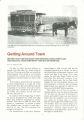
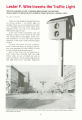
Show Lester F. Wire Invents the Traffic Light PEOPLE LAUGHED AT HIS " FLASHING BIRD HOUSE," BUT NO ONE WOULD WANT TO DRIVE ON CITY STREETS TODAY WITHOUT A SIGNAL LIGHT. BY LINDA THATCHER 1 Today we take things for granted that have not always existed - the traffic light, for example. Have you ever wondered how traffic was conbolld before the traffic light? What happened when cars met at an intersection? Who had the right of way? In the early 1900s automobiles were just starting to appear on the streets of Salt Lake City, joining horses and buggies, trolley cars, and pedestrians. As more and more vehicles appeared on the roads, traffic problems began to occur. To help solve some of these problems, Lester Farnsworth Wire, at the age of twenty-four, was appointed by Police Chief B. F. Grant in 191 2 to head the first traffic squad, Born in Salt Lake City on September 3, 1887, Lester Wire attended Salt Lake High School where he was a football star and an expert marksman. He also helped organize the first high school boys' and girls' basketball , ashlng C.," , , uu, w , , ,,,, , wut, I , I,, , I& Street, 1918. USHS CO~ I~ LIUIIJ~. I U of Wire Memorial Library. teams. After graduating from high school in 1909, he enrolled at the University of Utah as a law student He found that too expensive and quit to take a job with the Salt Lake City Police in 1910. Until Lester was appointed to the traffic squad there had never hen a police traffic patrol in Salt Lake. Streetcars stopped wherever they liked to Iet passengers off, cars made U- turns anywhere, and vehicles traveled on either side of the sbet. PedesMans were fair game and had to cross the street quickly or be run down. As head of the traffic squad, Lester was supposed to bring order out of chaos. He started by writing the city's first baffic regulations, but citizens were divided over accepting them and his job was not an easy one. Whenever there was a traffic accident, a patrolman walking the beat would settle it. Lester could see that traffic problems were getling bigger and n d d more manpower, so he appoint4 a patrolman to stand at the busy intersection of Second South and Main Street to direct traffic. The patrolman stood on a small platform in the middle of the inter-section to direct the flow of traffic. In order to be fair he timed the traffic going each way, giving each direction an equal amount of time. traffic lights. Lester spent many hours sitting in the city commission chambers waiting to ask them for more traffic lights, but whenever he stood up to speak they ignored Mm. Finally, thgr did ask bim if he had something to say. " No, I just got up to spit," he said in disgust and walked out of the meeting. Next time they listened to his request. People from larger cities were impressed by the light, but local residents thought it a curiosity and a nuisance. Pedestrians would yell at drivers waiting in cars for the light to change, " Are you waiting to see if the birdies will come out?" or " I saw a birdie that time; now you can go!" The traffic light became known as " Wire's bird cage" and " Wire's pigeon house." Sometimes officers arrived to find that the light had been knocked over and destroyed during the rught. But as time went on the signal became better accepted and Lester kept hying to improve it. In 1914 a plat€ orm was attached to the side of a hght pole on the corner of the intersection where the traffic light was located. An officer sat in the cupola, or " the coop" as it was called, and controlled the light from h r e . An umbrella was placed over the top to protect the patrolman from the weather. The coops were removed from the poles in 1926 with the Traffic patrolmen had to stand in all kinds of weather for many hours. Concerned about the long hours and poor working conditions for his men, Lester wanted to find a better way to control traffic. After experimenting, he came up with the design for what is believed to be the world's first electric traffic signal. The signal consisted of a square wo& n box with a slanted roof, painted a bright yellow and : containing red and green lights inset on each of its four sides. It was mounted on a tall pole, placed in the middle of the intersection,- and connected to the electric lines used by the troiley cars. The signal was operated with a tweway switch by a patrolman standing at its base. At first the signal was a novelty and even a joke to the local community. No one wanted to stop for a " flashmg bird house." People stood on the corner just to watch it. Needless to say, Lester became very discouraged. How-ever, a few citizens thought it was an improve-ment and wanted more placed around the city. Lester Wlre, right, points out differences between his Chief Grant Lester to go before the metal stoplight In foreground and modern th- light commission and ask for funds to build more signal. Courtesy of Wire Memorial Library. invention of " iron mike," an automatic system that relieved the officers from having to control the stoplights manually. In 1917 Lester enlisted in an ambdance corps sent to France during World War I. When he returned in 191 9 the man who had replaced him as traffic sergeant did not want to give him his job back. So Lester walked the beat for a short time before being promoted to the Detective Bureau where he remained until his retirement in 1946. Even though he worked in the Detective Bureau, Lester did not lose interest in the traffic light and continued to make improve-ments on it. Finally, he devised a durable metal stoplight, using the smokestack from an old locomotive engine for the frame. This metal stoplight looked much like the stoplight of today. except that it did not have the yellow caution light. Lester thought of having his traffic light patented, but he found that he had waited too long. Too much time had elapsed since his original invention. So, he never received any money for inventing the traffic hght. He died on April 14, 1958, at the age of seventy. In March 1963 the Wire Memorial Museum and Historical Association was started in his family home. His sister, Edith, Med to secure the original stoplight from the Tracy Aviary where it had been used as a bird house, but it had disappeared shortly after Wire's death. The original metal stoplight had been dis-played in Syracuse, New York, for many years. In 1964 Edith asked if it could be returned to Utah for display in the museum, but the people in New York replied that it had been thrown out two days before her letter arrived. Edith died in 1973. She left her money to keep the museum operating, but there were not enough funds to do that. Trustees for the estate referred the problem to the courts. As a solution, the Utah State Depariment of Trans-portation agreed to use the assets of the estate to create and maintain a suitable memorial to the inventor of the traffic light. To that end the Lester Farnsworth Wire Memorial Library was included in the new Department of Trans-portation building at 5401 South 2700 West in Salt Lake City. Ms. Thatcher is a librarian at the Utah State Historical Society. This article uses information from the Wire Memorial Library. The safety of children sledding on city streets also concerned Lester Wlre. He devised the stop sign at right to alert motorists. Courtesy of Wlre Memorial Library. 24 |