| OCR Text |
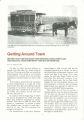
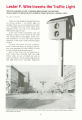
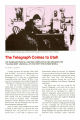
Show A gasoline highway bus was passing through the city at that time. The driver was induced to park his bus on South Temple where it could be photographed with the Mormon Temple in the background. Using photographic tricks, they superimposed a trolley with its overhead arm and wires onto the bus. The final photograph showed an eleckic trolley bus operating on Salt Lake City streets! This luxurious and practical vehicle could compete with the automobile in comfort, maneuverability, and rider appeal. With this fake photograph, plus the complete plans and specifications for a real trolley bus, West and Woolley were able to negotiate a contract for the manufacture of a fleet of buses by the Vesare Corporation of Albany, New York. Without knowing it, Vesare had agreed to build buses from an unproven, experimental design - an amazing result from a single photograph. When delivered and put into service in 1928, these buses focused the attention of the world on Salt Lake City. Representatives from 26 states and 13 foreign countries were sent here to study their design and operation. The success of the backless holley bus was sen-sational. A new era in urban kansportation was born. The streetcar was definitely on its way out. But, the economic operation of local lines was only half solved by the trackless trolley bus. There still remained the problems of service over very hilly routes and to out-lying areas where the number of riders would not justify the cost of trolley wire installation. The gasoline motor bus appeared to be the logical answer. But the frontengine gas bus had disadvantages that made it unsuitable for city use. Again, engineer Woolley worked out the details of a new model - a rear- engine gasoline bus - and found a manufacturer willing to build it. In 1933 Salt Lake City enjoyed another hanspsortation " first" when these rearengine buses were put into senice. The trackless holley and the gasoline bus replaced the streetcar. These improvements helped to meet the demand for better public transportation through the difficult years of the depression and World War II. Mr. McCullough was a safety engineer for the United Park City Mines Company in 1956 when he wrote " The Passing of the Streetcar" for Utah Historid Quarterly. vol. 28. The above article is an edited version of the eadier piece. Fritz Zaugg - Teenage Immigrant THIS SWISS BOY'S ADVENTURE WAS SHARED BY OTHER YOUNG IMMIGRANTS - INCLUDING GREEKS AND ITALIANS - WHO CAME TO AMERICA AND UTAH ALONE, NOT KNOWING THE LANGUAGE OR CUSTOMS OF THE COUNTRY. BY DOUGLAS D. ALDER Something elechifying happened to four-teen- yemld Fritz Zaugg that afternoon in the year 1884. He walked home from school through his Swiss village as he always did. But when he entered the house his parents were waiting for him. That was unusual. His father was seldom home before dark. They had a most subdued look in their eyes. Fritz could tell that there would be some long talking, just like the times when he was in trouble. But he sensed he wasn't in trouble. Nonetheless, his f o b had that low pitch in their voices, like when there was to be serious talking. The story came tumbling out as Fritz lis-tened, dazzled with the picture that opened before his eyes. As his f a b r said, the Mormon elders had been by that day. ( The Zaugg family were members of the Mormon faith.) They told of a farmer with the good Swiss name, Christian Hirschi, who lived in faraway Utah. Brother Hirschi had sent some money to the Mormon mission president in Switzerland to purchase boat and railroad tickets for a healthy boy who would come to " Zion" and be his farm-hand in Park Valley, Utah, for four years. He asked the president to choose a willing boy who would agrea to the terms - four years of farm labor with room and board in return for the price of the fare. The missionaries had come to the Zaugg cottage with the invitation, asking if their son wanted to be that boy. Fritz's parents had talked soberly before their son had come home. It was a great oppor-tunity. For Mormons, the chance to " gather with the Saints" in Utah was their ultimate dream. The cost of the long journey was an obstade for many families like the Zauggs who wanted to go. Thus, an invitation to go to Utah could be a breakthrough for the Zauggs. Fritz could be the first arrival and could help the others come. But it was such a long distance - 10,000 miles. And in a com- plete wilderness! ~ g hFtrik face unkindness or danger? There would likely be no school for him. And they didn't really know much about Brother Hirschi. Would Fritz be able to earn enough money after his indenture period so that he could pay the way for other mem-bers of the family to come? Would the railroad get Fritz through without an Indian attack? Would Brother Hirschi dependably meet Fritz at the station? How would Fritz know Brother Hirschi? Could they take risks with the life of their own son? So went the questions between father and mother that afternoon before Fritz came home from school. The missionaries assured the Zauggs that John G. Hafen, traveling with the emigrating Mormons as president of the voy-aging group, would take special care of Fritz. In the end, the fact that tipped the balance was that the Zaugg family had no way of sav-ing money for their family's fare to Zion. Fritz could be the first foot in the land of oppor-tunity, in the new Zion on the American desert. So the Zauggs had sober faces when they asked Fritz if he would like to go to Utah to work for a homesteader in Park Valley. Fritz didn't weigh any of the questions that bothered his parents. He shouted a Swiss holler, whooping and yelling, So what if he had to bavel alone! There would be ships and trains and eventually Indians and horses. He trusted the missionaries, even idolized them. There was no question in his mind that he was ready for a man's adventure. He c d d hardly wait for the next day when he could tell his schoolmates that he was heading for the American West. Their staring eyes made him puff up his chest. But he was taken aback when he found his teachers were horrified at his announcement. They tried to dissuade him, talking of wild tales about the Mormons - of polygamy, of schemes to abuse immigrants, of physical dangers, of ignorance, of dry deserts, of savages. Fritz was used to criticism of the Mormons; he ignored their warnings. After all, none of them had ever seen Utah, but the ~ o n a r i e hsa d lived there. So it was decided. On the 10th day of May Fritz left Switzerland in company with several families and returning missionaries. They traveled by train to the English Channel, by boat to England, and by train again to Liver-pool where they met many other Mormons. After a wait of several days they boarded a steamship, descending deep into the hull where the steerage compartment was. That large dormitory- type room in the heart of the ship accommodated scores of Mormons in bunks and hammocks through the many days of seasickness. To Fritz, traveling was exciting. It all went so well that he did not even record his train trip from the East Coast to Utah. He simply said, " All arrived happily in the dreamed- of Utah." Then crisis struck. Their voyage had been so successful that they were at their destina-tion, Ogden, Utah, four days ahead of sched-ule. Fritz stood on the train platform and watched as families came to meet members of the immigrating company. One after another the newcomers left with their friends. But no one called his name. No one came to claim him. No Christian Hirschi came. Suddenly the fourteen- year- old lad who had been so strong in hls determination dis-covered that people could not understand his Swiss language. He asked people for Christian Hirschi. No one knew him and no one knew what Fritz was saying. Fritz felt the h o r s of panic rising in his veins. He must think. He must do something. As he recalled: According to instructions, 1 waited at the depot on info the nighf but no one came lo claim me. I couldn'l ask for information because it was all in English. It seemed to me that I remembered the conductor naming the town where I was to finally go park Valley) on the stretch before Ogden. I decided to enter a returning train and go to that place. Soon the conductor cume for my ticket - but I didn't have one, then he wonted money, which I also did not have. Then he tried to talk fo me, but that didn't work either as he spoke English and I. German. Soon we came to a town called Box EIder where I got out, accompanied by the conductor, and Frledrlch (" Fritz") Zaugg. went into the waiting room. There the conductor talked to one of the employees who later - around I I p. m. - took me to a nearby town. Because Fritz spoke the Swiss dialect of German, the stationmaster didn't recognize the language the boy was speaking. He took Fritz to a home where he thought the people might be able to understand his speech. Both were disappointed when they discovered that the Danish family there also could not com-prehend Fritz's message. But the family did understand enough to realize that the boy was alone and very scared. They invited him to stay the night with them. The stationmaster went on his way. The Danish wife prepared Fritz some bread and milk but Fritz was too apprehensive to eat the food. So the family gave him a bed and he tried to sleep. After a fitful night Frih arose with an idea. He described his predicament on a piece of paper in both German and French languages. He wrote of his desire to find Christian Hirschi and Park Valley. Fritz felt better. He ate a healthy breakfast. Then the good Danish farmer took the note and went from house to house in the village until he found a young man who spoke to Fritz in French. Fritz was astounded to hear that Park Valley was a 25- hour wagon ride away. The Frenchman told Fritz that he could come and live with him until they found a way to get to Park Valley. As Fritz told the story: Soon thereafter, as I was working in the garden, a wagon passed in which were two men, one older and one younger. The young man was one of those in the same traveling company in which I came lfrorn Europe). They stopped at the French family's neighbor, who also happened to be a friend of Brother Hirschi. When Brother Himchi discovered that he had arrived four doys foo late at he station to meet me, he decided to drive to his friend's house to inquire after me. There he was told that I re mained in Ogden. But no one knew of me in Ogden. So Brother Hirschi decided to take the other young man in my place. As they were possing I recognized the young fellow. Quickly an exchange was made so Frib could go with Christian Hirschi to his original destination, Park Valley, Utah. The wagon ride in that direction took them through an in-creasingly dry desert. After two days of hot and dusty riding, they approached a tiny village, hardly a dozen cabins. Fritz was quite surprised. He turned to farmer Hirschi and inquired, " Is this Zion?" The reply was, " It will be when we build it into a Zion." Fritz said to himself: Then I first realized that Zion wos not yet a heav-en, rather a place where the Saints gother ond where they wouId make a Zion. But soon I Iiked it right well, although it was nof as beautiful as my homeland. At first Fritz hardly realized how people could grow crops in such a parched, dry cli-mate. His village at home was surrounded with lush green fields that were kept ever fertile by frequent rainstorms. In Park Valley it hardly ever rained. Everything seemed dry. But he soon learned how irrigation could bring water to the crops. Fritz worked hard, even earning enough to repay his fare in one year. Soon he sent money for one sister to come to America. The next year they earned enough together to send for two brothers. In the meantime, their mother died, so the next year they sent for their father and remaining two sisters. On the very day that the sisters received money for the three of them to buy a ticket their father died in the village of Erlach, Switzerland. So Park Valley, Utah, a snug village on the edge of a desolate desert in the Rocky Mountains of America, became the refuge for the Zaugg children. They found Park Valley to be a good place to work and a homeland from which has sprung several generations of Zauggs who now live throughout western America. Dr. Alder is professor of history and geography at Utah State University. The article by Friedrich Zaugg entitled " How I Got to Zion" appeared in Der Stern, vol. 64. The English banslation may be found in appendix D of Dr. Alder's master's thesis, " German- speaking Immigration to Utah, 185& 1Q50," University of Utah, 1959. |