| OCR Text |
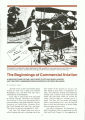
Show Photographs in the Salt Lake Tribune, September 9,1920, h eralded the first airmail plane to land in Salt Lake City with pilot Buck Hefron. Another pilot, S. S. Boggs, lower left, wasscheduled to fly to San Francisco. The Beginnings of Commercial Aviation A WIND SOCK WAS THE ONLY HELP MOST PILOTS HAD WHEN LANDING, AND THE FIRST PASSENGERS WERE SQUEEZED IN BETWEEN MAILBAGS. BY CHARLES S. DAVEY Airmail service in the United States began on May 15, 1918, over a single route between Washington, D. C., and New York City with a refueling stop in Philadelphia. From 1918 to 1920 mutes were expanded to include Chicago, Cleveland, and Omaha. The last leg of what was developing into a transcontinental route linked Omaha with San Francisco via North Platte, Cheyenne, Raw-lins, Rock Springs, Salt Lake City, and Reno. This route was opened on September 8,1920. Salt Lake City offered little more than a safety landing strip and a refueling stop in the first months of the airmail run. In fact, one pilot flying in from Reno on September lo, 1920, had difficulty finding the temporary landing strip at Buena Vista Field near 8th South and 14th West. While he circled the valley, officials lighted a smudge pot as a signal. The flyer saw the smoke and finally made a safe landing at 4: 15 p. m. He had left Reno at 9: 25 that morning on an allday flight that now takes an hour or less. Just before Christmas, on December 21, 1920, Woodward Field was dedicated at 22nd West and North Temple. At the suggestion of Salt Lake City Mayor Ciarence Neslen, the new facility was named after John P. Woodward, an airmail pilot who was kiHed November 6, 1920, when his plane crashed in a snowstorm in Wyoming. With its 106 acres, Woodward Field was one of the largest of the 15 U. S. airfields used by the Post Office Deparbent. In addition to runways, it had an office building, a hangar for eight planes, and a service area to rebuild planes. Later, Woodwd Field was renamed Salt Lake City Airport. According to Vern Halliday, airport manager from 1927 to 1936, a large wind sock indicated the wind direction during the day, while a large illuminated arrow, free to turn, provided pilots with landing information during the early evening hours. The Post Office Deparlment began trans-porting mail by airplane in cooperation with the U. S. Army, but they hoped to encourage private enterprise to take over the mail contracts. With the passage of the Air Mail Act of 1925, individuals began to compete for airmail contrack. Walter T. Varnsy was awarded the contract from Pasco, Washington, to Elko, Nevada. This route was described by one Post Office official as " starting nowhere and ending nowhere, and over impossible country getting there." Salt Lake City was quickly pinpointed by Varney Sped Lines and Western Air Express as a connection for points east. So, on October 1, 1926, seven months after Varney began the Pasco- F, lko route, Salt Lake City replaced Elko as the southern terminus. Meanwhile, Western Air Express delivered the first airmail from Los Angeles to Salt Lake City on April 17, 1926. WEA had been incor-porated a year earlier by a group of young Los Angeles businessmen who felt that their city was being deprived of airrnail service. Not to be outdone by San Francisco, these LA men pushed for a Los Angeles to Salt Lake City route. Five weeks after its first airmail flight, WEA ( later Western Airlines) carried its first passengers. The early airmail carriers were permitted by their conlxacts to carry passengers only if LroWI much n Main street greetea nero r; narles LlnaDergn on nls VISIT ro salt LaKe Lrry In wzr. LUCKY unay ala rotnote air travel. USHS collections. priority was given to the mail cargo. The average mail load per plane was 400 pounds. About a quarter of a million letters were flown across the country daily. Western's first passenger flight on May 23, 1926, carried Ben Redman and John Tom-h o n from Salt Lake City to Los Angeles with a stop at Las Vegas. Pilot Charles N. James flew the route in eight hours. During its early years, air travel was expensive. A one- way ticket from Salt Lake to Los Angeles cost $ 90 and a round- trip $ 1 50, large sums in those days. From 1926 to 1929 commercial aviation expanded rapidly in Salt Lake City. Walter Varney extended his PascwSdt Lake mute to include Portland and Seattle. Two other contractors, Pacific Air Transport and Boeing Air Transport, began operating in the western United States about this same time. Varney was enthusiastic about carrying passengers to and from the Pacific Northwest, connecting in Salt Lake City with Boeing Air Transport which had the San Francisco to Chicago airmail contract. Passenger facilities were simple: a crude mimeograph machine cranked out tickets and safety instructions and a small percolator provided coffee for those waiting to board flights. In 1931 Varney joined with three other airlines to form United Airlines. The Salt Lake City Airport kept pace with airline growth. A hard- surfaced runway, runway landing lights, a primitive aircraft approach control ( a siren blew once for landing, twice for takeoff), and improved buildings demonstrated that the transportation of mail, commodities, and passengers by air was here to stay. From the beginning of transcontinental airmail service by the Post Office Departnwnt, through the development of large cornmerical airlines, Selt Lake City has filled an important role in aviation. And commercial aviation has provided Utah with economic growth, good access to other American cities, and a basis for attracting additional business and industry to the area. Mr. Davey is a travel agent. Information for this article was compiled from airline histories, newspaper accounts, and interviews. |