| OCR Text |
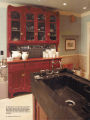
Show The original kitchen in this Victorian home war gfzered long ago. To restore a period feel, the owners added Eustom-made soapstone sink from Vermont. The free- standing base - cabinet reflects their interest in early Mormon furniture -- and matches the other kitchen cabinet~ th ey desinna* --. I hand- grained. 30 UTAH PREIERVWf ION < -- I n1s reTurDIsnea Dungalow Klrcnen rearures rlusn- lnser caolner doors with visible hinges, Marmoleum flooring, and a William Morris pattern wallpaper. Cheery colors, like carnation pink, were common in baths and kitchens of the 1930s and 1940s. m T . + II - . U5t KITCHtN3 AND BATHS . r--. * Giving Modern- Functioning Rooms an Historic Look By Alysa Revel1 ~ u u nyto urself lucky if your old house ill retains some of its original plumbing fixtures or kitchen cabinetry. More com-monly, as homeowners remodeled kitch-ens and bathrooms over the years, they threw -- - ou- t most, or all, historic materials, - leaving old- house restorers without any original elements left to restore. But it's entirely possible to recreate the ambiance of an old room by selecting historically-appropriate materials, thus avoiding the painful " architectural whiplash" caused by going from a perfectly restored dining room into a glaringly modern kitchen. In houses new or old, there is no harder-working room than a bathroom and none more multi- tasking than a kitchen. When yuu corlh~ detrh e ~ urntancth anges in cook- . , ing trends and the ever- increasing techno: _ logical advances in appliances, it's easy to see why homeowners typically update their kitchens about every fifteen years or so. Bathrooms undergo remodels less fre-quently, but have dramatically increased in quantity, size, and importance over the years to the point where bedroom- sized, " spa- styled" master baths are the norm in most new houses today. So how does a period- sensitive renova-tor refurbish a kitchen or bathroom to support a modern lifestyle while retaining ( or recreating) the charm of an old house? First, get to know the past. Research your home's history and educate yourself about U T A H PRESERVATION 31 A local woodworker built this bathroom vanity from drawings of This recreated 1918 kitchen features a subway tile backsplash, antique lighting fixtures, linoleum tile flooring, glass cabinet an antique washstand. doors, and a mix of counter surfaces. its era and style. The more you know, the more you'll start to notice the many era- appropriate materials currently available. To get you started, here is a quick history of local kitchen and bath evolution. Pr.- li'jQ0* Ncj ~ ~ r a ~ iflf/ aafgerd nii o~! hcjcjr; ps - * - 7- ( a. tc. a. i lie ( lo:! ci Oici i3, ij. s) A pioneer- era home ( c. 1847- 1869) could be anything from a tiny log cabin or two- room adobe house to a larger home made of stone or, more rarely, brick. These small houses often served big families in multipurpose kitchen areas that doubled as living room space and probably a bedroom as well. If your home is from this era, its indoor plumbing and bathrooms were added decades later. The Victorian- era kitchen ( c. 1870- 1910) became slightly more civilized. It typically contained a work table, wet sink ( with a pump) or dry sink, kitchen tools, freestanding storage pieces, and a coal- or wood- burning stove. If your Victorian house con-tained the luxury of a bathroom ( kitchens and bedrooms were more commonly used for bathing), it was never meant to be seen by visitors and no attempt would have been made to decorate it. These kitchens and baths were radically remodeled around the turn of the century as indoor plumbing became widely available and the revolutionary " sanitary movement" took hold nationwide. Pr- 1 t j y n crl ph! l<~~- j~ hjry: ' f'& i[\ irl' - & ~ ~ Lij lf {<~~,,-<;];:~;<);~ The revolution happened like this: most homes acquired electricity and indoor plumbing at roughly the same time the theory that contagious disease is caused by germs became widely accepted. Thus the pursuit of spotless, germ- free homes began. Form followed function as the owners of both old and new houses installed linoleum floors, porcelain sinks, smooth zinc countertops, and ceramic tile backsplashes. The point of it all was clenr~ nbility. This revolution transformed homes dramatically and has been the basis for modern kitchen and bath design ever since. While colors, materials, and styles have changed to suit the fashions of the day, the philosophy behind the sanitary movement has remained constant. There has been no real shift in hard- surface, easy- to- clean bathroom and kitchen finishes despite the evolv-ing functions of these rooms. * . i' 3rjir- lo ~ i? jcj--~ jL,: t~~ Jh2 ; ii p n? u ry: b,, ' L, ,% L , C ~ F ~ j , j 6 x~~; _ C > ~ J ~ lwT& Z a{ C.:~" ltj This obsession with sanitation made all- white kitchens and baths the rage until cheery greens and yellows appeared in the 1930s. Succeeding decades witnessed the popularity of carnation (" band- aid") pink, turquoise, black, and cherry red. Early to mid-century tastemakers and homemakers personalized American 32 UTAH PRESERVATION When adding a new bathroom in their bungalow, the owners of this home used beadboard For the truly dedicated, there are appliances with an historical appearance, llke th~ sF rench- made wainscoting, a salvaged medicine cabinet, and a pedestal sink give the room a period feel. black enamel stove with brass knobs. kitchens and baths with upbeat color and cheerfully printed fabrics and wallpapers. Keep in mind that these homeowners had options and you do, too. You can customize your rooms to reflect your own personality and still stay true to your home's style. For instance, Craftsman- style homes relied on natural materials in their finishes and furnishings, like copper, iron, and stained wood. The look was heavy, linear, and awash with warm earthtones. The sanitation movement's prescribed slick and shiny all- white kitchens and baths contrasted mightily with other rooms in these homes. A rich wall color or stained cabinetry can create a more consistent Arts and Crafts feel than the original kitchen did. 114dih'id~ ilEl lements: \ Ted 11 5 If you're attempting a period- appropriate restoration, keep in mind that wallpaper was the dominant trend in old homes. ( Big surprise to all those who've spent countless weekends stripping away layer after layer of crumbling, brittle, melded- to- the- wall paper, huh?) Even so, many period paint colors are smashing in an old kitchen and provide interest to a tiny bath. Many paint companies, like Benjamin Moore and Sherwin- Williams, now have entire collections of period colors, helpfully classified into eras/ styles to make selection even easier. If you opt for wallpaper, you'll find an amazing selection of great reproductions. Visit a designer showroom for help wad-ing through the myriad options to find the right design. And it doesn't need to be a pricey Burrow or Bradbury & Bradbury design ( although these are lovely). Many " regular" wallcovering companies, like Seabrook, now produce some excellent repro-ductions. 1 kVlndt~ ict- t r r i i t ~ n c ~ n t ~ Pioneer homesteaders used what they had: simple fabric panels over the windows, usually in a plain muslin or cotton. These are easy to replicate. Victorians loved heavy, layered draperies in for-mal rooms. But for kitchens and other informal areas, they hung more simple curtains. Roller blinds were also used extensively from Victorian times through the 1960s and are still available from companies like Smith & Noble and the Handwerk Shade Shop. ( Choose fabric ones, not vinyl, with traditional spring roller systems rather than the newfangled continuous loop. It's not a real, old- timey blind if it doesn't flip- flip- flip once in awhile!) Arts and Crafts- style homes had their own prescribed styles of window treatments, as they did for everything else. These included wooden shutters, stenciled muslin and linen panels, and roller shades. Kitchens and baths of early to mid- twentieth century homes look right with a cheerfully- patterned, shirred valance over sheers, shutters, or roller shades. Caf6 curtains work beautifully here, too. UTAH P R E S E R V A T I O N 33 ** a e . a a&* Trade Secret Magicians never share their secrets, but I do. Here's a handy technique I use for old- hour? kitchen and bath renovations. Use elements from the earliest " modern" kitchen and bath design to create rooms that function well, yet have the look of a previous era. The current E-, market offers mainly modern products like Corian and wall- to- wall carpeting, but old- fash-ioned goods- those on my " Materials Checklistv- are also available. Incorporating them into your modern- functioning kitchen and bathrooms will lend them an appropriately vintage flavor. Because demand for these products has skyrocketed in the last decade, many kitchen and bath showrooms now display them and many items can even be special ordered from " big % wT=. & b. o- x " home improvement stores. g;= z -,;- +!=#& f . **' 1= .-.* a. Fic> r:. yi[:, g Most pre- 1900 kitchens started out with a wood floor, prob-ably a painted non- hardwood like fir. Wood floors are still warm and wonderful, especially if the boards show wear, inherent flaws, and texture, rather than being honed to a perfectly slick, shiny finish. The stain should be a medium to dark brown. Linoleum, available since the mid- 1800s, was installed both in tiles and sheets. Get the real stuff ( made from natural linseed oil), like Marmoleum, if possible. An inexpensive alternative is Armstrong's vinyl composition tile, avaiIable at home improve-ment centers. Ceramic and porcelain tile can also work, as long as it is smaller- scaled ( nothing over 12 inches square) and does not attempt to resemble stone or anything other than tile. When it's done, throw down some braided- rag or wool- hooked rugs for a warm look and warm toes. 1- 1 ;; kit! j7 2; Good light and good lighting fixtures are both important ele-ments of a period room. If you have the original lights, leave them ( just make sure the wiring is in good shape). If the originals are missing and you have to replace them, it's important to stay as close as possible to your era, since they are almost an architec-tural element of a room. Try to find true antiques first. I've found great antique light-ing at local antique stores, on eBay, and also at Retrospect Water & Light in downtown Salt Lake City. If you can't find a good antique, Rejuvenation Hardware out of Portland does the most gorgeous reproductions. All of their fixtures are put into period collections, so it's easy to find lights in the right style. ~ l~: plrtzr~ ci.~, , Great- grandma didn't enjoy the comforts of dishwashers or microwaves, so how best to incorporate them into our new, old kitchens? You can easily hide the microwave behind a cabinet door and install a two- drawer dishwasher with custom panel kits if you really don't want it visible. The practice of " hiding" refrigerators behind huge doors is cur-rently all the rage in new homes, but I recommend against it for old ones. Gigantic cabinet doors are historically inappropriate, and major appliances ( stoves, iceboxes, etc.) were traditionally meant to be seen and easily accessible. Stainless steel or black enameled appliances from " professional" lines, like those made by Wolf and Viking, look surprisingly good. Some specialty com-panies, like Heartland, manufacture reproductions of vintage models. A few companies even refurbish actual antiques. ACC~? SSI~ T'? CS Simple, humble, handcrafted items ( preferably old) make appropriate accessories in pioneer- era homes. Victorian homes benefit from floral motifs and proudly- displayed china collec-tions. Play up the hominess of early- twentieth century cottages with vintage elements. The popular " shabby chic" look is suc-cessful in many of these homes. Get it by incorporating white wicker, ticking striped fabric paired with colorful vintage florals, depression glass, painted ( but chipped) case pieces, and yellow-ware. Collections of Jadeite and other refrigerator- ware make fun accessory collections for homes built in the 1930s and 40s, as do flea- market finds of printed tablecloths and linens. An old home will feel like it evolved if you've got mostly pieces that are styled to the era of the home and then add in other elements to personalize the space. Family heirlooms make the best furnish-ings of all. P~ latt; ri;~. Cl~ h~ il; c k; t, i$ t Whether your old house was built in 1870 or 1920, at some point the kitchen and bath probably incorporated these materials: Subway tile: White 3- inch by 6- inch is the classic. Great for a backsplash or even entire walls in kitchens, bathrooms, and shower stalls. Hex and square tile: One- inch is most common, but some are larger. Great for bathrooms on walls, floors, and showers. Linoleum: Sheet lino and 9- inch square tiles were the most common. Beadboard: Used on walls as wainscoting ( sometimes on full walls) and ceilings. Also used on cabinet interiors where it was often painted in surprising colors like red and orange. V- board was also very common and used the same way as beadboard. Cabinetry: Specify face- framed doors, flush- mounted into 34 UTAH P R E S E R V A T I O N Sources + a *** Wallcovering, fabric, window treatments, design assistance: Rice & Strand Interiors, 300 South Hwy. 89, North Salt La:%_ ( 801) 936- 5087, www. riceandstrand. com ?'. **-+. rn Plumbing fixtures and lighting: Retrospect Water & Light, 68 EasLM) B Sauth, SLC, ( 801) 517- 3876 --!- G q old- h% sc?< ontractors directory, state rehabilitation tax - J** s credits: State Historic Preservation Office, '@ The kitchen in this 1911 bugatow was remodefed in the 1930s. The cabinetry, tile a, www. history. utah. gov/ historic preservation/ index. html courtertops, and tite backsplash were typical of, if not as colorful as, many kitchens of the ,,-! 35 era. The large, pull- out cutting board creates a handy additional workspace. b @ J Rehab it Right! Workshops, low- interest rehabilitation loans: !- - Utah Heritage Foundation, www. utahheri~ gefoundation. org the cabinet face instead of " euro" doors which migrated to I * Roller shades: The Handwerk Shop, www. thehandwerkshop. com America after WWII. You really can't go wrong with a simple a Window over ings: Smith + Noble, www* smithandnoble. com Shaker door style. Painted was more common than stained, but stain in a medium to darkish wood tone works well, too. Real linoleum: Forbo, w~. themarmolemstare:. com Lose the toekick ( small recessed space beneath the cabinets). Lighting: Rejuvenation Hardware, www. lreju~ enafAon. corn It's a modern detail and most kitchen and interior designers admit you don't need it. Plate racks and open shelving con-tribute to an old- house look, as do glass doors on some or all upper cabinets. Countevtops: Don't be afraid to use wood. It was the stan-dard for decades. Wooden countertops are gorgeous, warm, and durable. Plus, new synthetic finishes make it more water repellant than ever. Hardwood, butcher block, stainless steel 1 ( or better yet, zinc, if you can find it), and stone ( honed fin-ish, not slick) provide different surfaces for different tasks and all are appropriate for an old house. You can even use a mix of I these materials. The development of synthetic plastics in the thirties led to full- length countertops covered in laminates by the 1950s. Laminate counters with metal edging look terrific in a mid- century kitchen. Sinks: A big old salvaged " farmhouse" sink is sheer perfec-tion in a pre- WWII kitchen. Reproductions of these are also fabulous. I highly recommend integral drainboards and have I no idea why these attractive and highly- functional sink parts 1 went out of vogue. You can't go wrong with vintage- style, nickel- tone plumbing fixtures. White pedestal sinks, whether vintage or reproduction, are always proper in an old bath- I room and take up less room than a vanity. ( I know, I know - no storage with the pedestals. But you're living in an old house so you're used to that, right?) You Are Not Alone Help is out there. The Utah State Historic Preservation Office maintains a list of old- house contractors. The Utah Heritage Foundation offers do- it- yourself workshops. Talk to other old- house owners/ restorers. Engage the services of local architects and designers who specialize in historic restoration 1 projects. They can assist you with finding creative solutions and specific sources that will make your old- house kitchen and bathrooms sparkle like it's 1925. * Appliances: Heartland Appliances, m. hedandstppliances. com Alysa Revel1 is a local interlor des~ gners pecializing in old- house restorations. She lives in Farmington with her husband, their two- year- old twin sons and lovable mutt, Tagalong, in an old house that has owned them since 1999. American HeritageN Window R l e b u i l d e r s tamr* a; J%**- d-- Exact replicas of historic windows and woodwork. I Historic wooden window restontion. New custom window ,# I! manufacturing. Storm windows and smms. Thermal storm sash unlh L Window and door hardware I I ( new, used, antique, stwage). Weatherstripping. I Fast turnaround. Guaranteed satisfadion. 46 East Herbert Avtnue Salt Lake City, Ut 841 11 gh 801.359.6639 fx 801.323.9055 www. vi~ tagewi^ ndow. tom UTAH P R E S E R V A T I O N 35 |