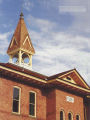
| OCR Text |
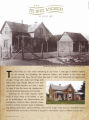
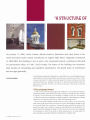
Show C m- - - - -- \ - 2q * w - dmmA Sueeess mating American Fork City . Hal I - Y THE DISTINCTIVE BELL TOWER OF THE AMERICAN FORK ClTY HALL DOMINATED THE CITY'S SKYLINE FOR DECADES. THE BELL TOWER MARKED THE LITERAL AND COMMUNAL CENTER OF AMERICAN FORK. AFTER THE BELL TOWER WAS REMOVED IN 1959 TO MAKE WAY FOR Stew Come[[, RacLeL Qauid, and MicLae[ L t s L m a n AIR CONDITIONING. TALL MODERN BUILDINGS ECLIPSED THE ClTY HALL. TUCKED QUIETLY BEHIND MAIN STREET'S COMMERCIAL BUILDINGS, ClTY HALL QUIETLY LANGUISHED FOR MORE THAN HALF A CENTURY. Juel Belmont recognized the unimposing building's importance. " It has been the seat of city government continuously since it was built at the turn of the twentieth century. It is the centerpiece of a town that is suffering from " Big Box" syndrome," she explains. Belmont grew up on West Main Street in American Fork and saw the city's historic buildings begin to disappear in the 1960s. In 1986, she helped establish American Fork's Preservation Committee. These stal-wart preservationists fought, but lost, battles to save the American Fork Carnegie Library, the Tithing Office, Chipman's Mercantile, and the old high school. " The losses are so great. It is such a tragedy when you begin to tear at the fabric of community, especially the landmarks," Belmont notes. The demolition of so many American Fork landmarks only strengthened Belmont's resolve to preserve the city hall. A window of opportunity opened in 2003 when the Utah State Legislature passed legislation allowing smaller cities to use RDA funding for renovation projects. Belmont was serving on the city council at the time and she had any ally in City Administrator Melanie Marsh. Although there was a long list of potential projects and a lengthy debate, Belmont and Marsh persuaded the city council to invest RDA money in city hall. They convinced their colleagues that renovating city hall could be a key component to the revi-talization of downtown American Fork. Pride of the Town Set in the center of a grassy lot shaded by large conifer trees, the American Fork City Hall is a significant example of an early twen-tieth- century civic building. As noted in its 1993 nomination to the National Register of Historic Places, the building " presents an enduring, and somewhat romantic, picture of the nineteenth and early twentieth- century Utah and American small town govern-ment, civic pride, and community identity." The city hall was built in 1903 on the site where the town's civic offices had been concentrated since 1861. American Fork leaders paid architect James H. Pulley $ 50.00 to " get out the blueprints" for the building. Pulley designed both the city hall UTAH P R E S E R V A T I O N 17 A new roof to support the heavy bell tower and extensive masonry repair were important parts of the exterior renovation of American Fork City Hall. and its neighbor, the Harrington School, in the late- Victorian Komanesque style. The two- and- one- half story building is essentially square with two projecting central pavilions on the east and west. These two elevations are identical and anchored by large Romanesque arch-ways. A stone plaque inscribed " City Hall 1903" is located on the upper wall beneath deeply indented pediments. The hip roof features a small central deck topped with a wooden belfry. The belfry originally had a steeply pitched roof, Gothic roof pediments, and Queen Anne trim. Its bell came from American Fork's first city hall. Remuddling One hundred years of use and insensitive renovation dimin-ished the city hall's character. Many of the building's significant historic elements were obscured, lost, or replaced. In 1916, the building's exterior was painted white. Frequent reapplications of paint continued until 1977 when the building was sandblasted. Sandblasting removed the top, protective layer of the brick, leav-ing the exposed masonry susceptible to moisture and weather-ing. ' The mortar joints were also improperly repaired with caulk and Portland cement- based mortar, both of which accelerated the deterioration of the masonry. The belfry was torn down in 1959 and the bell was installed atop a Daughters of Utah Pioneer's monument in American Fork City's Robinson Park. The interior of the city hall was remodeled in the same year and then radically altered in 1977 with a new staircase, elevator, and partitions. Windows were painted shut or covered. Ceilings were lowered. Doors were replaced with alumi-num or glass substitutes. Through all the " remuddling," the building continued to serve as the seat of city government. Fortunately, enough of the building's historic fabric remained intact to make a renovation feasible. Other than the lost belfry and the sandblasting, the building's exterior had not changed significantly. While much less survived on the interior, the original floors and window fin-ish work were still in place. Rediscovering the Past The goals of American Fork City Hall renovation project included re- establishing the grandeur of the building by recreating its historic and character- defining elements, halting the building's deteriora-tion, and providing an effective, sustainable building to meet the needs of the community through the next century. An enormous amount of work needed to be completed with the $ 1.6 million available for the project. To guide this preser-vation effort, the city council hired Cooper Roberts Simonsen Architects, a firm specializing in the preservation, renovation and adaptive use of historic Utah structures. As they began to evaluate the building and demolish its non- 18 UTAH P R E S E R V A T I O N I n L976, \;\~ aZyC ooper and Allen Uefis es tal? hshed the first ardGtectwal j5~ 1- irn~ Utah io specialize iz1 lGs% onc ' b~ ddkgs. T-~ iriyye ars laterF C: onpe: r Roberts SUname~ xA r- ~ hieccr- hs as hundreds of projects a do vex eigL19- att~ ardsLC Di ts csrecEL-- renovatmg and restoring bdcs, scl- eools, &'~ x& es, museums, ~ OVBE~~ IIIIP~ IEI buildil- igs, theaters, warehusrs, stores, depots, apartments, houses a d nmxe. With advent of its & sf@& Preserva tion & Cc3nxmmtior7. Stu&~ C, RSA con hue^ tackle n- tel~ yof Zjt&~ mst exciting and prestigious histuric projerk: the res: nl. atinn/ Maeser School, American Fork City mi 11Vd tth House, Major Downe- y Mansion, Fort ' 130ug1iis hEfitary Mme~ rn' Fitzgerald Hause, So~ xthrrn Utah Univelrsityf. s Old ? v[& and Ogden IBgh Scl~ ool, an hf- Decs ; masterpiece. Renovating md res" iritn2 Utah's btorical. build- ' GO6 , H~ sToRI?' PRESERVATION .. & CONSERVATION STUDIO CLASS DETAI Terra Cotta Window Hood Panel UT State Capitol Restoration I KEPCO 1 Systems L - 20 U T A H P R E S E R V A T I O N ?[ Home- Tech r -. " I' h 19g3 wc' P. 0. BOX 526396 SALT LAKE CITY, UT 8415Z- b;; lYb ( 801) 484- 9360 FAX ( 801) 461- 0110 historic elements, renovation team members made several exciting discoveries. The removal of the modern suspended ceiling revealed original tin ceiling tiles with an intricate floral pattern. The elaborate historic ceiling also included tin banding and a decorative corner cove molding. To everyone's surprise, the bell tower's original tin finial resurfaced in the attic. Scraping through layers of paint revealed the city hall's original interior and exterior color schemes. The renovation team used this information, along with samples of historic interior wall fabrics, to create a color scheme that reflects the building's historic appearance. Starting at the Top Guided by early photographs of the building, the renovation team carefully reconstructed the bell tower. The finial found in the attic served as the model to fabricate a new finial. To complete the process, the Daughters of the Utah Pioneers returned the original bell to the reconstructed tower. A new roof was required to support the heavy bell tower and upgrade the build-ing's thermal performance. To preserve the historic soffits and fascia, contractors stabilized the soffits prior to demolition and tied them to the newly installed roof trusses. The gables on the east and west portions of the roof were rebuilt. Masonry restoration was another critical component of the exterior renovation. Sadly, nothing can be done to reclaim stone lost to sandblasting. The renovation team, however, used bricks salvaged from the building to remedy earlier repairs made with a lower- grade masonry. The offending caulk and Portland cement- based mortar that hastened the masonry deterioration were also removed and replaced with an historically- accurate lime- based mortar. Dramatic Changes While the portion of the pressed tin ceiling revealed during the evaluation was damaged beyond repair, the major-ity of the original ceiling was intact. The contractor carefully removed the tiles and reinstalled as many as could be salvaged. The original tiles were supplemented with custom tiles pressed to match the origi-nals, restoring the grandeur of the first floor corridor and second floor ceiling. Another dramatic result of the renova-tion is the restoration of the second lev-el's original open floor plan. During the radical remodel of 1977- 78, the second floor was divided into numerous sepa-rate rooms. Moreover, existing walls were furred out for new wall surfaces resulting in the removal or modification of much of the historic interior trim. Even the city council chamber windows along the west wall were covered with panel board. The renovation removed the non- his-toric interior walls and the paneling over the chamber windows. The team also recreated missing historic elements like the wood trim. The second floor is now a monumental, light- filled space appropri-ate for the significant city work that takes place there. Green Preservation While restoring the American Fork City Hall's historic character was the primary goal of the renovation, the project also consciously integrated " green" design features. The building's new mechanical system and light fixtures are significantly more energy efficient than those installed during the 1977 remodel. New insulation and proper sealing of the roof, walls, and windows have raised the insulative value of the building by 467 percent. In addi-tion, the restored windows can be opened to provide natural ventilation throughout the building. These measures reduce the energy consumption required to light, heat, and cool the building. Every effort was made to salvage and reuse as much building material as pos-sible, including the ceiling tiles, win-dow sashes and frames, and stairway treads. The new construction materials used in the building, including gypsum board, insulation, and carpeting, contain The building's historic interior was radically altered by a 1977 remodel. Original tin ceilings remained intact underneath the drop ceilings installed in 1977. The renovation restored the second floor's original open floor plan. UTAH P R E S E R V A T I O N 21 |