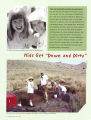
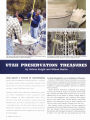
| OCR Text |
Show FROM THE MUSHROOM SPRINGS ARCHAEOLOGICAL SITE ON THE EASTERN SIDE OF ANTELOPE ISLAND, I YOU CAN SEE THE TALL BUILDINGS OF DOWNTOWN I SALT LAKE CITY, THE BUSY STREETS OF BOUNTIFUL, AND THE MALL AT KAYSVILLE. BUT IT IS THE REM-NANTS OF AN ANCIENT LIFE, NOT THE PROXIMITY OF THE MODERN WORLD, THAT GRABS KIDS' ATTENTION AT MUSHROOM SPRINGS. HERE THEY HELP UNLOCK SECRETS OF THE PAST AS THEY WORK ALONGSIDE ' ROFESSIONALS ON A REAL ARCHAEOLOGICAL " DIG." AS STUDENTS LEARN AND APPLY THE SCIENTIFIC PROCESS, THEY CONTRIBUTE TO OUR UNDERSTAND-ING OF THE ANCIENT FREMONT PEOPLE. AS THEY MAKE PERSONAL CONNECTIONS TO THE PAST, THEY BECOME THE FUTURE STEWARDS OF UTAH'S RICH ARCHAEOLOGICAL RESOURCES. kids Ge+ " Down and birqy" Kids get the chance to work with professional archaeologists, like Jim Dykman ( center), on the Mushroom Springs project. 10 UTAH P R E S E R V A T I O N Kids take part in all aspects of the excavation pmcess at Mushroom Springs, including making careful records of their observations and discoveries. a MUs h l' 0 0 Ib Sb By Ronald J. Rood Utah Assistant State i\ rchaeoogist Discovery at Mushroom Springs Freshwater springs dot Antelope Island and, in the Great Basin, anywhere there is fresh water there are traces of the prehistoric past. Utah State Parks officials planned to tap into the water at Mushroom Springs for the new facilities at the historic Fielding Garr Ranch, located about one mile to the east. During the con-struction project, an archaeologist from Utah State Parks noticed clues- bits of charcoal, fragments of broken rock, fragments of animal bone, chipped stone, gray pottery shards, and grinding stones- suggesting humans had used this area in the past. Utah State Parks and the Utah Division of State History Antiquities Section excavated a few " test pits" at Mushroom Springs to better understand the nature of the site and the soil. Analysis of the artifacts recovered in these tests suggested Mushroom Springs had the potential to produce important information about Utah's prehistoric past. Since the site was inadvertently damaged during the construction, Utah State Parks and the Antiquities Section developed a plan to retrieve information from the site in a cost- effective partnership focusing , on public education and opportunities for kids to work on a real archaeological site. Public education is an important strategy for preserving Utah's extraordinary archaeological resources. Unfortunately, many of these resources are at risk from vandalism, looting, and simply being " loved to death" by visitors. One of the best protections we can provide these sites is a public that is aware of the value of archaeological resources and understands proper archeological site " etiquette." & king aestJans Questions are the root of archaeological investigations. The artifacts recovered from a site and their context allow archaeolo-gists to attempt to answer questions. Thus, before inviting the public to participate in excavating the Mushroom Springs site, we prepared a research design to guide the fieldwork. The research design identifies the types of information archaeologists hope to recover and how that information will be gathered. Not every site can address every type of question and Mushroom Springs is no exception. Based on information from test digs, it was clear that Mushroom Springs likely contained information on diet, hunting patterns, and butchering patterns. In addition, the large amount of burned rock and burned animal bone had potential to yield samples for radiocarbon dating that shed light on the age of the site. IJk~ LrxWikk!!% s& s af ( lbP a& The Antiquities Section has been working with students for over ten years. Through our public outreach program, profes-sional archaeologists have brought presentations on Utah's archaeological resources to over 300 fourth and seventh grade classrooms. With the discovery at Mushroom Springs, we had an opportunity to take this outreach one step further by involving kids in a real " dig" and laboratory work. Since 2001, over 80 students from Newman Elementary School and Escalante Elementary School in Rose Park, Our Lady of Lourdes School in Salt Lake City, and the Colby School in Park City have participated in the archaeological work at Mushroom UTAH P R E S E R V A T I O N 11 Springs. In addition, other students from around the Wasatch Island State Park manager, who has substantial skills in scientific Front interested in archaeology have become involved as indi- illustration. viduals. With the input of Danielle Patterson, a Salt Lake City educa-tor and one of the original authors of the nationally- recognized " Intrigue of the Past" archaeology curriculum, we designed an inter- disciplinary, hands- on program at Mushroom Springs. The students develop research questions, create photographs and art, and write each day about their experiences. Several of the students' contributions will be used in the final report. Through fieldwork and lab work, the students quickly learn that archaeology is more than the random collection of arti-facts. During the first season at 12 UTAH P R E S E R V A T I O N Students work hard at Mushroom Springs though the heat on the island is often brutal. In spite of canvas shades and plenty of water, the work day typically ends at 2: 00 prn with students running through the sprinklers under the cottonwood trees at the Fielding Garr Kanch. '*+%?& With the assistance of student archaeologists, we have learned a great deal about ancient life at Mushroom Springs. Although there are hints of earlier occupations, most of the material I excavated at Mushroom Springs J I with the Fremont occupation at &~ ftY% rsCm! real\\ bails up. Mk b r o t h e r is \ earning Mushroom Springs. We found Workingat Mushroomsprings h o l r ~ t o m a k e a r r o w h e a d s b u t h e ' s n o t bones from a variety of animals, helps students make personal con-verk good. He keeps breaking t h e m . He including antelope, deer, bighorn nections with the people of the sheep, bison, and rabbits at the past. One student, for example, g e t s mad and it's funok. 1 like corning t o site. All of this bone is fragmented wrote a narrative on what being a thei sLnd even thoughi t is hard work and splintered suggesting the Pro- 12 year- old kid living at Mushroom duction of bone grease and the Springs must have been like. The rock" for the fire making the extraction of bone marrow for student imagines the inhabitants bone grease, Son cross the lake in food. Bone grease was an impor-of Mushroom Springs 1,000 years tant source of fat and calories ago as people with feelings, needs, aur ( d- tle b o a t s and go back 1- c t h e b i g in prehistoric diets, Native people and a sense of humor. The pas- vi\\ age b \ r t h e rlver for t h e winter. mixed it with dried meat and sage also clearly shows the student's berries. understanding of the relationship Large numbers of hammer between artifacts ( fire- cracked rock) ( h. Rogers, age 12) stones and anvil stones, along - . . and human behavior. It paints a - - 4 -- . -- with thousands of kilograms of Mushroom Springs one 12- year- old dates to about 1,000 years ago. Participant said, " Archaeology is , j i t morning k n o t h e r day of Archaeologists call materials from sort of like dissecting a frog," and it this time period " Frernont," a term truly is. AS students create maps and hauling rack for t h e fires. 9 we\\, we'll h used to describe an ancient group grids and take copious notes, they \ s t s of b one grease For winter faod. / h of Native Americans who lived begin to understand the scientific t h e h u n t e r s g e t more antebpe t o d a k . over much of Utah. The Fremont process of forming questions and grew corn, lived in pithouse vil-using the data to test their ideas. Making b me grease is h a r d work b u t lages, made pottery, and used the They start to think of potsherds, I P e helping mk mom crack t h e bones bow- and- arrow. They also made arrowheads, and bone fragments their living by hunting and gath-not as curios from long ago, but as t h e n put t h e n info the pi;+ M ering a wide variety of plants and threads of scientific data- informa- b likes taking the hot f tion telling a story about the people Hunting, butchering, bone pro-that lived at Mushroom Springs the fire and ~~~~~~ g then in the pa and plant processing are 1,000 years ago. The hissins noise is funnL and the wa jor activities associated picture of ancient life based not on a lecture or reading a book, but on a first- hand experience. In addition to participating in the archaeological dig, the Mushroom Springs project offers learning opportunities for students with a range of interests. A young man named Austin Watkins was intrigued by the 35mm cameras and photography, After a quick lesson, he became our site photographer for sev-era1 days. He learned to set up the photo- board and document on paper every photo he took. Students interested in art took a workshop on illustrating artifacts from Kon Taylol; Antelope fire- cracked rock, are further evi-dence of bone grease production. The grinding stones found at Mushroom Springs indicate plant processing, but we are not sure what plants were being used. While we have learned much at Mushroom Springs, many questions remain. For example, we know bone grease produc-tion was important, but exactly how was it accomplished? What season of the year were they making bone grease? Fall? Spring? Both? Continued research and fieldwork will help us piece this story together. Top left: Large quantt~ eso f f~ recr acked rock bone grease production at Mushroom Sprlngs Top rlght: A student displays the arrow polnts Middle left: Archaeologists covered the slte w are ev~ dence af she d~ scovered. t h a shade dome ~ n 2006. Mlddle rlght: Assistant State Archaeologist Ron Rood and veteran Mushroom Sprlngs parttclpant Nkel Taylor. Bottom left: A Mushroom Spr~ ngs crew sweats lt out on a hat afternoon. Bottom right: After worklng at the excava-t ~ v nsi te, klds spend a week in the lab analyzing the artfacts they found. UTAH PRESERVATION 13 When we were a+ Mushroon Springs on - - Anqelope Island, everyone go+ + o unlock SOMe secrets of + he pas+. / personally love + o ge+ down and dirtv, bu+ sewing dirW warny+ all I loved abou+ ny experience a+ Mushroom I loved + he nys+ eries of frnding new objec+ s and discovering what + hev were. Mv no+ her would + ake ~ v pic+ ure before + he dig began and + hen af+ er. Oh nan, + here would be a + hick laver of black dir+ all over ~ y face and arw. One dav / was walking back froM + he sifier + O + he grid I war working and saw a piece of po++ ery jus+ lvlnp in + he oben. r picked I+ up and showed R + o Ron Rood, Sa+ e Ar~ heologir+~ He was surprised + ha+ I found I+ in + he Middle of + he oben ground. Ano+ her + ine I was digging in w grid and warn'+ finding anv+ hing. Afier a while I heard a ? bud. I s+ ar+ ed i o dig around anc uncovered a huge bile of FCR or fire cracked rock. Underneajh + he rock we found a rib bone of an aninal. I+ was really coo(. I would reco~ hendg oing + o a dig sRe + o anvone who loves discovery and ge++ ing down and dim. - Hikel Tavlor Talcing Omership As a professional archaeologist, the significance of a project like Mushroom Springs to me is twofold. First, the site is like an undiscovered library of books and manuscripts about life in Utah. The artifacts, the butchered animal bone, and the ubiquitous fire-cracked rock all combine to tell a story about how people made their way in what we now call Utah thousands of years ago. Our excavations at Mushroom Springs will teach us volumes about ancient Utah. Secondly, as I watch fourth grade students carefully excavate around a piece of bone or a pottery shard, get the map, plot the artifact's location, and carefully write notes about their find, it is clear that these students will never harm an archaeological site. Working with real archaeologists on a significant site gives these kids a sense of respect for the site and the people who lived here over 1,000 years ago. They become active owners and protectors of Utah's cultural heritage. * Ronald Rood, Utah Assistant State Archaeologist, has worked at the Ilivision of Statc History, Antiquities Section for ten years. He works extensively with the public on archaeological education, prcscrvation, and stewardship. He can be reached at rrood(@~ utah. gov. The Mushroom Springs project engages kids with many different interests. This student was responsible for documenting the excavation with photos. ' P . s fl U E T E 0 fl T [ / g.< , ' lt" lltll~ lZ 4 AfJflll 26- 2?, 2007 p- 201 UTRH P R E S E R U R T l O n i Historic Fort Douglas University of Utah A membership- based statewide historic preservation organization since 1966. U T A H Visit our web site to see buildings we are saving, find old- HERITAGE house resources, get a low- interest loan, and discover a FOUNDATION world for old building junkies, volunteers, and teachers. W U l U l . U T R H H E R I T R G E F O U n O c l T I O n . O R G " Ills The Best Weatherstriwing Solution Solid wood weatbentripping for doors, mement - windows, attic doors, d ouble bung windows. .. . Do- it- Yourself Installation Kits I . Creates Weather- tight seal even in older doors Reduces Heating Bills . Long Lasting . Much more efective than other weather strip- type materials American Heritage Window Kebuilders 46 East Herbert Avenue Salt Lake City, Ut 841 11 ph 801 .. 359.(; 63' 1 fk 801.323.9055 www. vinragewindows. com - HISTORIC PRESERVATION Committed to protecting Utah's historic resources-for a very long time. history. utlh. gov/ historic- preservation |