| OCR Text |
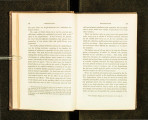
Show 118 APPENDIX. bear upon the question of jurisdiction, we are bound before the return to a . umc that the facts arc true as stated, and so taking them, the case is this: John II. \Vhcclcr voluntarily brought into the State of P ennsylvania three persons of color, held by him in the tate of Virginia as slaves, with the intention of passing through this State. \Vhile on board of a steamboat ncar \Valnut Street wharf, in the city of Philadelphia, the petitioner, rassmore Williamson, informed the mother that she was free by the laws of rcnnsylvania, who, in the language of the petition, "expressed her desire to have her freedom; and finally, with her children, left the boat of her own free will and accord, and without coercion or compulsion of any kind; and having seen her in possession of her liberty with her children, your petitioner (says the petition) returned to his place of business, and has never since seen the said Jane, D:micl, and I aiah, or either of them, nor does he know where they arc, nor has he had any connection of any kind with the subject." One owning slaves in a slave State voluntarily brings them into a free State, with the intention of passing through the free State. \Vhilc there, upon being told that they arc free, the slaves lcaxc their master. Can a judge of the di:ltrict court of the United States compel their restoration through the medium of a writ of habeas cor-pus directed to the person by whom they were informed of their freedom? Or, in other words, is it a ca e arising under the constitution and laws of the United States? \Vhnt article or section of the constitution has any bearing upon the right of a master to pass through a free State with his slave or slaves ? Or, when has Congress ever attempted to legislate upon this question? I most unhesitatingly aver that neither in the constitution of the United tates nor in the acts of Congress can there be found a sentence which has any effect upon thi. question whatever. It is a question to be decided by the law of the State where the person is for the time being, and that law must be determined by the judges of the State, who have sworn to support the constitution of the State as well as that of the United States- an oath which is never taken by a Federal judge. Upon this question of jurisdiction it is wholly immaterial whether by the law of Pennsylvania a slaveholder has or has not the right of passing through our State with his slaves. If he has the right, it is not in Yirtue of the constitution or laws of the United States, but by the law of the State, and if no such right exi. ts, it is because the State law has forbidden it, or has failed to recognize it. 1t is for the State alone to legislate upon this • APPENDIX. 41fl subj ect, and there is no power on earth to call her to an a.cconnt for lH'r acts of omission and commission in this be hal f. If this case, by any reasonable construction, be brought within the t erms of the third clause of the second section of article four of the constitution of the United States, jurisdiction might be cL.timed for the federal court:l, as then it would be a case arising under the constitution of the Ullitcd States, although I believe the writ of habeas corpus is no part of the Tnitchinery designed by Congress for the rendition of fugitives from labor. "No person (says the clause above mentioned) held to service or lahor in one State under the law thereof escaping into another shall, in consequence of any law or regulation therein, be discharged from such service or labor, bnt shall be clcJivercd up on claim of the party to whom. such ~ervi cc or labor may be due." By reference to the del>ates in the convention, it will be . ecn that this clause was inserted at the request of delcgaJcs from southern st:-ttes, ancl on the declaration that in the absence of a constitutional provision the right of reclamation would not exiHt unless given by state authority. If it had been intended to cover the right of transit, ~vords would have been used evidencing such intention. Happily there is no contrariety in the construction which has been placer1 upon this c:lauso in the constitution. No judge has ever so manifestly disregnrdcd its plain and unequivocal language as to hold that it applies to a shtvc voltm tarily brought into a free State by his rnastcr. On the contrary, there is al>undnnt authority that such a case is not within either the letter or the spirit of the constitutionnl provision for the rendition of fugitives from labor. Said 1\Ir. Justice \Vashingtou, Ex parte, 'immon ·, G \V. C. C. l{,eports, 30G: -"The slave in this case having l>cen voluntarily brought by his master into this State, I have no cognizance of the case, so far as respects thiH application, and the master must abide by the htws of this tate, so far ns they mny aficct his right. lf the man claimed as a slaYe he not entitled to his freedom under the laws of this State, the master mu~;t pur:uc such remedy for hi· recovery as the laws of the State have provided for him." In Jones v. Vanzandt, 6 Howard, 229, J\lr. Justice \Voodbnry uses language equally expressive: "Dut the po"·er of national law," saiu that cminen t jurist, " to pursue and regain mo::; t kinds of property in the limits of a foreicrn crovcrnment is rather an act of comity than strict right and 0 0 hence as property m. persons m1· g ht no t tl1 u 5 be 1·ccorrnizcd in some of the t'> ' • states in the Union, and its reclamation not be allowed through Clthcr courtesy or rio·ht this clause was undoubtedly introduced into the constitu-o ' h 1 . ti· on nq one of 1• b rompronu· ses trO r tl1 e sn f r 1Y of th'a t portion of t e r11nn |