| OCR Text |
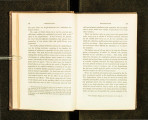
Show 334 ATROCIOUS JUDGES. [A. D.l687. complete control, lest any of then1 should oppo e the intended innovations in religion.* Jeffreys selected as his first victims, Sharp, rector of St. Giles's, called the "railing parson," who had made himself very obnoxious to the government by inveig hing against the errors of Popery- and Compton, Bishop of London, hi8 diocesan, who hau rabed the storn1 against the dis pen ing power in the IIouse of Lords. A mandate was i sued to the bishop to su pend the r ector, and this being declined on the ground that no man can be lawfully condemned till he has been ·heard . in. his defence, both were summoned before the high COffiilllSSIOll. The bishop appearing, and being asked by the chancellor why he had not obeyed the king's orders by suspending Dr. Sharp, prayed time to prepare his defence, as hi counsel were on the circuit, and he begged to have a copy of tho commis 'ion. A week's time was given ; but as to the commission, he was told " all the coffee-houses bad it ior a penny." On the eighth day the business was resumed ; but the uishop still said he was unprepared, having great difficulty to procure a copy of the commission ; when the chancellor made him a bantering apology. "l\1y lord, in telling you our commi ~ion was to be seen in every coffee-house, I did not peak with any design to r eflect on your lordship, as if you were a haunter of coflee-hou e . I abhor the thoughts of it ! " .A.. further indulgence of a fortnight was granted. At the day appointed, the bishop again appeared with four * The strong analogy between these ecclesiastical commissioners and our recent American slave catching commissioners, both in powers, method of procedure, and object arrived at, has been already referred to, and can hardly fail to strike the reader.- Ed. A. D.l682.1 GEORGE JEFFREYS. 335 doctors of the civil law, who were ·o frightened, that they hardly dared to say a word for him ; but he h.im~elf ~rmly, though mildly, argued, ''that he had acted Jl~nspentonun cons,ilio and coulu not have had any bad Inolive; t.hat he ' . should not have been justified in obeying an Illegal order; that he had privately recornmended to Dr. Sharp no.t t'o preach ; that this ad vice haLl been followed, so that t.he kings wi~ h was complied with; and that if he had committed any fault he ourrht to be tried for it before l1i archbi bop and ' 0 brother bishops." . Several of the cOinmis~ioncrs were inclined to let lnm off with an aumonition; but Jeffreys obtaineu aud pronounced sentence of suspens~• on dun•n g ti1l e t1-.v •t ng ' s P l ea sure ' both on the bishop aud the rector.* There was another polt. tt. caI trw. 1 '\r l1 e1· e J·u :·:>· ticc wa ~ done to the accu"ed, although J· eJuY 'r cys pr . H'1. c d ca. t it • A c• harror e w.a s brought agam. st Lord De1 a n1erc, ti 1e 11 e ·''~c l of <·m nnc1ent f• an1I•l y m. Ch es Iu. re, tha t b e ]1 ,a u-, tried to excite an in ·urrectwn In that county 1.1 1 a1. d of 1\ionn1out1 1 , ., r e b ,1 1l' 011 • .An indicLmen t for high trea ~on being foun<.l agm·n t 11 ·1 m, he was bronror ht. to tn.a l upon 1. t before J eff r eys, as ] 01· c1 1u .o rr h teward ' and 1.. lnrty peers-tr1. er ". rfhe ki. ng was pres, en t , c•U 1 d w'a s very de. I, rous of a conviction, as Lord DeI a mere, w 11 c,n 'a member of .t he llousc of Comrnons, had ta{l en an act I. V e I·) (a rt in supr)orlmg the exclusion Lill. Jeffreys did his best to gratify this wish. According to * Judo-e Kane in Passmore vV.1 lh. amson, s case, went further dt han . thha't . Because t>h e refus' ed to obey the mandato of J u do~-e Kane. to pro. ucte mt heIiSr court certain persons over whom he h a d no con t 1· ol ' w1 tht a v1te w enot enced surrender to slavery, Judgo Kane, und e1. th ena me of a con emp , s him to an indefinite imprisonment.- Ed. |