| OCR Text |
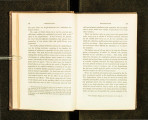
Show 23G ATTIOCIOC~ JUDG ES. LA. D.l685 A Parliament was found indispen alJle ; and, counting on the very loyal dispo ition 1nanifestecl by the n[l.Lion, wr.its for calling one were is ued, returnable the 19th of 1\lay. A.s that day approached, the lord k eeper began to write the . peech which he expected to deliver in the presence of the king to the t"~o hou es on their assen1bling. lie was n1uch plea.~cd with this perfonnancc, on which he hau taken uncomn1on pain~, and when fini.,hed, he rea<l it to hi brother anu hi ofncer"', who highly applauded it. But ·what wa hi CQn t ernation when he was tolLl that h e was not to be allowed to open his 1nouth upon the occasion ! * !larlian1ent meeting, the course was adopted which has been followed ever since. Instead of having on the first day of the ses ion, before the choice of a peaker by the Commons, one . ·peech fron1 the king, and another fr01n the lord chancellor or lor<l keeper, to explain the cau es of the , ummons, the Comn1ons being sent for by the black rod, the lord keeper merely desired them to r etire to their own chamber aml choo e a peaker, and to pre. ent him at an hour which was named, for hi· 1najesty's npprobation. The speaker being chosen and approved of, and having clernanc1ecl and obtained a recognition of the privileges of the Comtnon. , on the following day the king himself rnade a speech {i·om the throne, and imtncdiately withdr.ew. But thi. speech was not in 1nodern fa hion scLtled at the cabinet; nor was it read the evenino- before at the Cockpit, b or to the chief supporters of the government in both houses at the dinner-table of the two leaclcrti re pectively; nor was * See the speech at full length. Life, ii. 192. There is nothing in it vr~ry good or very bad. A. D. 1685.] :b'HAXCIS N OHTII. 207 it to be treated as the speech of the n1ini ·tcr. c; At le:•st the lord keeper had no hand in it; for he was not so n1uch as ~onsulted about either the matt r or expre ion the king mtended to use, as one might well j udgc by the unguarded tenor of it." Yet he still was mean enough to cling to office, an<l to do what he could for a govermnent impatient to get rid of him. He had been very active in the election ; and by hi · influence had procured the r eturn of a good many z alous churchand- king 1nembers. '' And to tnake the attendance ea ·y to these gentle1nen, whose concerns were in the country, he took divers of them to rack and 1nangcr in his fmnily, where they we~·e entertained while the Parli~.uuent at." But nothing whtch he could do would 1nitigate the hostility of those who had vowed his de ·truction. At the meeting of Parlian1ent, Jeffreys wa. made a peer, that he might have the better opportunity to thwart and insult the lord keeper; although there had lJeen no previou ill ~tauce of raisin o0' ca corn mon-1a w J·U (1 g e to the peerage. There were several appeals fr01n decrees of the lord k "cper speedily brought to a hearing. " (Jeffreys affected to let ft y at them, to have it thought that he wa ~ fitter to lJe chancellor." He attended, neglectin0o- all other busine'"'"" · and durino- the ' b argu.m ent ' and in g1· v1· ng 11 1·. ' opu· 11· on, too 1( every opportum· ty of dtspara'bo- ing th e 1o r·e1 1( eeper' ., ]a w, preparatory to mov.m g reversals · I-I e was parti.c ularly outrageous 1. n the case of Howard v · Th e D w1e e o)J- t .-L;\Tv orj•o lk, being emboldened to talk confidently 0 n rnat ters w1. th wh1. ch he was not much aequam. ted, by havinO' to t h . r b res ou t e rcputatwn of Lord Nottingham. Th. at .g reat equ1. ty 1a wycr, contrary to the opinion of the two clnef Jnstic es an d t h e chr. ef baron, whom he had called in to |