| OCR Text |
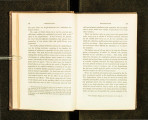
Show 312 ATROCIOUS JUDGES. [A. D. 1685. information concerning hin1. There wa ... the greale t difficulty even to show that IIi ekes had been in 1 he r ebellion, and. tile judge was worked up to a pitch of fury by being obliged himself to cro ·s-exa1nine n. Presbyterian witness, -rvho had showed. a leaning again t the prosecution. Dut the principal traitor had not b een con Yictetl, and ihcrc was not a particle of evidence to show the scienter, i. e., il1at the suppqseJ. accomplice, at the time of the harboring was acquainted with the trca on. Not allowed the benefit of counsel, she her-'elf, .rromptcJ. by natural good sense, took the legal oLjection that the principal traitor ought first to have been convicted, "because, peradventure, he might afterwards be acquitted as innocent after she had been condemned for harboring hirn;" and. she urged with great force to the jury, "that at the tin1e of the alleged offence lw had been entirely ignorant of any suspicion of Hickes haYing p~u.-ti cipatcJ. in the r ebellion; that she had strongly disapproveu of i t, and that she had sent her only son into the ficlu to fight under the royal banner to suppress it." It is saiu by almost nll the contemporary authorities, that r.hricc did the jury refu ·e to ilnd a verdict of guilty, and thrice did Lord Cl1icf Justice J effi·cys .. end t ben1 hack to r econsider their Yerdict. In the account of the proceeding in the State TriaL, which has tile appearance of having been taken in ~hort hand, and of ueing authentic, the repeated sending back of the jury is not n1entioned; but enough appears to stan1p eternal infan1y on Jeffreys, if there were nothing more extant against hi1u. After a n1ost furious summing up, '' the jury withdrew, and staying out a while, the Lord J effreys expre::;sed a great deal of impatience, and said he v.ronder ecl that in so plain a case they would go from the bar, and would have sent for them, with an intimation that, if they did not come quickly, A. D.l6S5.] G EOI~GE .JEFFREYS. 313 he would adjourn, nnu let thcin lie by it all night; but, after about half an hour's :lay, the jury returned, and the foreman addressed hi1nself to the court thus : 'J\Iy lord, we ha,·e one thing to beg of your lordship some directions in before we can give our verdict: we have some doubt whether there be suiTIcient evidence that ~ he knew I-Iickcs to have been in the army.' L. a. J.- ' There iD a., full proof as proof can be; bnt you are judges of the proof; for my part, I thought there was no difficulty in it.' 1/'oreman.- 'J\Iy lord, we are in . orne doubt 'Of it.' L. C. J.-' I cr.,nnot help your doubts ; was there not proved a discourse of tho bn.tLle and the army at supper ti. me ?. ' Foteman.- ' But, 1ny lord, we are not satisfied that she halt notice that Ilickes was in the army.' L. C . .J - ' I cannot tell what would at isfy you. Did he not inquire of Dunne whether Ilickes had been in the army? and when he told ller he did not know, she did not say :he would refuse him if lw had been there, but ordered him to come by night, by which it is evident she su pccted it ..... But if there was no such proof, the circumstances and managen1ent of the thing is as full a proof as can be. I wonder what it is you doubt of.' Lady L~·sze.- 'My lord, I hope L. 0. J.-' You mu 't not speak now.' The jury laid their head· together near a quarter of an hour, and then pronounced a verdict of guilty. L. 0. J.- ' Gentlemen, I did not think I should have had any occasion to speak after your verdict; but finding some hesitancy and doubt among you, I cannot but say I wonder it should come about; for I think in my con.:cience the evidence was as full and plain a, could be, and if I had been among you, and she had been my own mother, I should have found her guilty.' " He passed sentence upon her with great sang froid, and, I 27 |