| OCR Text |
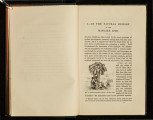
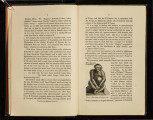
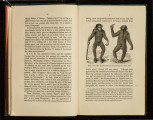
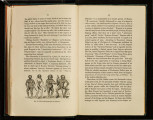
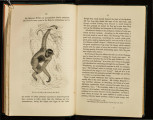
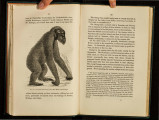
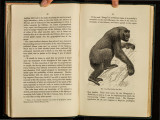
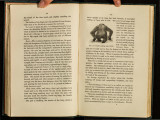
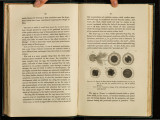
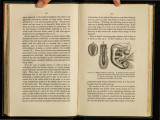
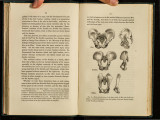
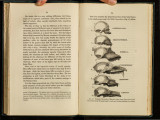
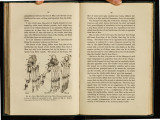
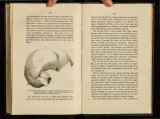
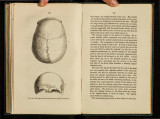
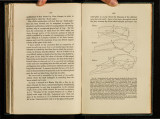
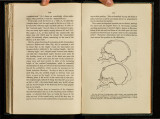
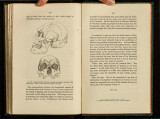
Show 12 the sailors began to teaze it-some loved to see it tear ancl hear it cry; others hated its snotty-nose; one who hurt it, being checked by the negro that took care of it, told the lave he was very fond of his country-woman, and asked him if he should not like her for a wife? To which the slave very readily replied, 'No, this no my wife; thi a white womanthis fit wife for you.' This unlucky wit of the negro' , I fancy, hastened its death, for next morning it wa found dead under the windlass." William Smith's 'Mandrill,' or 'Boggoe,' a hi d cription and figure testify, was, without doubt, a Chi Jpanzce. Linnreus knew nothing, of his own ob ervation, of the manlike Apes of either Africa or A ia, but a di sertation by his pupil Hoppius in the "Amrenitates Academi re " (VI. 'Anthropomorpha ') may be regarded as embodying his views respecting these animals. The dissertation is illustrated by a plate, of which the accompanying woodcut, fig. 6,is a reduced copy. The figures arc entitled (from left to right) 1. Troglodyta Bontii ; 2. Lucifer Aldrovandi; 3. Satyrus Tulpii; 4. Pygmr.eu E dwa'rdi. '!"'he first is a bad copy of Bontius' ficti tious 'Ourang-outang,' in whose existence, however, Linnreu appears to have fully believed; for in the standard edition of the " Sy tema FIG. G.-The Anthropomorphn of Linncrus. 13 N aturro," it is enumerated as a second species of Homo; "H. nocturnus." Lucifer Aldrovandi is a copy of a figure in Aldrovandus, 'De Quadrupedibus digitatis viviparis,' Lib. 2, p. 249. (1645) entitled ''Cercopithecus forrnre rarre Barbilius vocatus et originem a china ducebat." IIoppius is of opinion that this may be one of that cat-tailed people, of whom Nicolaus Koping affirms that they eat a boat's crew, " gubernator navis" and all! In the "Systema N aturre" Linnreus calls it in a note, Homo caudatus, and seems inclined to regard it as a third species of man. According to Temminck, Satyrus T..ulpii is a copy of the figure of a Chimpanzee published by Scotin in 173S, which I have not seen. It is the Satyrus indicus of the " Systema N aturre," and is regarded by Linnreus as possibly a distinct species from Satyrus sylvestris. The last, named Pygmr.eus Edwardi, is copied from the figure of a young ((Man of the Woods," or true Orang-Utan, given in Edwards' 'Gleanings of Natural History,' ( 1758). Buffon was more fortunate than his great rival. Not only had he the rare opportunity of examining a young Chimpanzee in the living state, but he became possessed of an adult Asiatic man-like Ape-the first and the last adult specimen of any ofthese animals brought to Europeformanyyears. With the valuable assistance of Daubenton, Buffon gave an excellent description of this creature, which, from its singular proportions, he termed the long-armed Ape, or Gibbon. It is the modern Hylobates lar. Thus when, in 1766, Buffon wrote the fourteenth volume of his great work, he was personally familiar with the young of one kind of African man-like Ape, and with the adult of an Asiatic species-while the Orang-Utan and the Mandrill of Smith were known to him by report. Furthermore, the Abbe Prevost had translated a good deal of Purchas' Pilgrims into French, in his i Histoire generale des Voyages' (17 48), and there Bufl'on found a version of Andrew Battell's account of the Pongo and the Engeco. All these data Buffon attempts to weld together into harmony in his chapter en- |