| OCR Text |
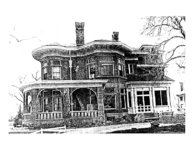
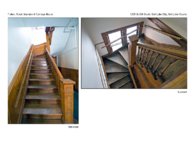
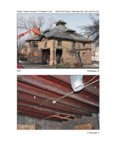
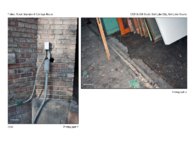
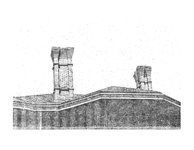
Show ment of the viability of reusing these fireplaces needs to be completed by a building inspector to determine their suitability for safe use. The centralized nature of the original heating source for the first and second floors points to several potential opportunities to make the Fisher Mansion more Originally, cooling was based on the cross ventilation energy efficient and, therefore, more sustainable: and the air movement effects generated by air moving through the interior spaces and the three-story stairwell/atrium. Currently there are several separate mechanical cooling systems in place at the Fisher Mansion. These include several evaporative coolers located on the roof and in windows adjoining the spaces they served. There is also one window air-conditioner serving a room that was created in the enclosed northeast porch. An air-conditioning condenser unit is located on the ground between the parking lot and the north fa~ade. Visual inspection could not reveal what system this unit serves. Non-residential HVAC system: The existing HVAC system is the outgrowth of the original gravity fed warm air furnace system found on large residential buildings in the late-nineteenth century. Through the years various modifications and overlays that reflect the change in use from a single family dwelling to a convent and a halfway house have resulted in an agglomeration of several different systems. Investigation of conversion/ replacement with a non-residentially oriented HVAC system is in order. There appears to be sufficient space in the basement to install a small multi-zone system that could serve all three floors individually as well The original heating system is a centralized configuration with the furnace located in the basement. The centralized nature of this warm air system enabled a variety of filtration and humidification aspects not found in buildings heated by steam or hot-water radiation alone. The building was treated as one large single thermostatic zone that was controlled by one thermostat. What it was not designed to do was to compensate for the stack effect of the buoyant warm air that it generated. Warm air rises like smoke through a chimney stack, hence the term "stack effect:' With the enclosure of the stairwell, the various spaces served by the heating system were isolated floor by floor. From a heating perspective, this trapped warm air at the ceiling level rather than permitting it to flow freely by as providing for mUltiple thermostatic zones on each floor. Further investigation is needed to determine if the original ductwork, at a minimum, could be isolated by floor and also be augmented by extending new ductwork to serve the third floor. In this fashion, the control oftemperature, humidity, and air-filtration could be completed from one single heating/cooling source. This will also allow removal of the various evaporative coolers and window air-conditioners thereby reducing overall maintenance expenses (e.g., number of equipment locations, equipment obsolescence) and improving the visual appearance of the building. A local example of this can be found in several of the formerly residential buildings converted to office space at Fort Douglas. natural buoyancy up the stairwell to the floors above. From a cooling perspective this eliminated the natural convective cooling generated by the air flow into the stairwell/atrium. The numerous additional mechanical cooling systems point towards both a shift in what was expected in terms of comfort and the fact that the natural ventilation system ofthe original construction Ground-coupled heat pump: Replace the existing heating source with a ground-coupled heat pump that can be used to seasonally provide heating or cooling as needed. The piping field needed to facilitate the ground source heat exchange could be located beneath the parking lot located just north of the Fisher no longer was deemed adequate. 64 CRSA |