| OCR Text |
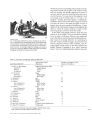
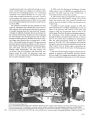
Show Smithsonian, NAA. Fig. 4. Men laying roofbeams for a house, standing on the roofs of the two adjacent houses. Housebuilding follows the standard Pueblo division of labor with women performing the less heavy chores, such as plastering (see "Isleta Pueblo," fig. 10, this vol.). Few individual houses were over 2 stories high, though the dwellings were layered to as many as 5 stories with different families living above one another. Photograph by Matilda C. Stevenson, before 1898. Without the previous knowledge of the prospective bride, he presents himself and his gifts at the woman's home early one evening. His bundle is placed in the center of the room and he is fed, after which the father asks him to state his business. The man asks for the daughter's hand in marriage, and the formal reply is "it is up to my daughter." Usually, the woman makes a "conditional" acceptance after which the two retire. Again the woman can reject the suitor at this point (the gifts are hers to keep) or they can enter a period of cohabitation. A large number of the winter stories (telapna-we) incorporate this theme in which the woman continues to reject suitors until the gods get involved to settle the matter. In the 1970s young people courted in much the same manner as do the Anglos. They are married in a church or by the justice of the peace. Divorce, very simple and easy in the older system, has become complicated by non- Zuni values of ownership. However, it is interesting to note that, except in mixed marriages, there have been no alimony payments between tribal members, and the young people usually remarry in the older common law pattern. Record of marriage is by a tribal "marriage license." Since the children belong to mother's clan and Table 2. Zuni Clans and Subclans, 1916 and 1976-1977 Zuni Name 1976-1977 1. picci-kKe, 500 members la9picci-kKe mula-k*e kw9alasi-kwe 2. k9ak9ali-k*e poskwa-kKe pa9k9oha-kwe 3. yatokka-kKe 4. tonasi-kwe 5. tona-kKe tona k9ohanna-kKe tona k*9inna-kwe 6. towa-kwe towa k9ohanna-kKe towa kw9inna-kwe 1. tekka-kwe 8. k9olokta-k»e 9. suski-kwe 10. 9anse-kwe 11. 9ana-kwe 12. 9ayaho-k*e 13. s~ohhita-k*e 14. poyyi-kwe, 10 members 15. talupc9i-kKe (extinct) Approximate English Translation Dogwood (Stevenson 1904) Twig dogwood Macaw Crow3 Eagle Golden Eagle Bald Eagle Sun Badger Turkey White Turkey Black Turkey Corn White Corn Black Corn Frog Crane Coyote Bear Tobacco Tansy mustard Deer Chaparral Cock (Roadrunner) Yellowwood Families or Lineages in 1916 (Kroeber 1919:table 2) 59 28 20 21 20 15 11 18 10 5 6 7 3 1 1 a Incorrectly translated by some scholars (Eggan 1950:199-201) as 'raven'. NOTE: The clans are listed in order of their size in 1977. 487 Z U N I S O C I A L A N D P O L I T I C A L O R G A N I Z A T I ON |