| OCR Text |
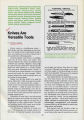
Show pocket knives, skinning knives, bread knives, butter knives, goldbeater's knives, blacksmith's knives, scaling knives, carving knives, corn knives, palette knives, filleting knives, putty knives, cane knives, felt knives, woodcarver's knives, throwing knives, paper hanger's knives, hacking knives, fighting knives, fruit knives, oyster knives, hunting knives, oilcloth knives, chopping knives, butcher knives, survival knives y Knives Are Versatile Tools BY THOMAS J. ZEIDLER Knives come in a bewildering variety - their shapes and sizes depending on their function. You would not use a butter knife to skin a deer, nor would you cut a slice of bread with a circus performer's throwing knife. Ancient peoples made knives or knifelike tools out of stone, bone, and antler. The Anasazi Indians who lived in southern Utah centuries ago carefully chipped a sharp edge on a piece of rock called chert. This stone knife blade was then fastened to a wooden handle with pine pitch. Sometimes sinew, thread, or cord made from animal tendons was wrapped around the handle for extra strength. Utah's ancient Indians also made scraping knives out of obsidian (volcanic glass). Copper was the first metal to be used for knives. More than 7,000 years ago the peoples of western Asia discovered that copper - which occurs in a pure state and does not have to be refined - could be made into tools or utensils simply by hammering it into the desired shape. The American Indians who lived near the Great Lakes also used this method for making copper knives. Thousands of years later it was discovered that if the copper were melted and mixed with tin (about nine parts copper to one part tin), it would form an alloy called bronze. The tools and weapons made with bronze were harder and sharper than ones made of copper. The discovery of methods of using iron over 2,500 years ago was a great advance in the history of tools and weapons. Iron utensils HUNTING KNIVES. All these knives are of the very best quality steel. No. 8641. Deer Foot. No, 9641. Hunting Knife, deer's foot handle, 7 inch clip blade, best steel, leather sheaths, with loops to attach to belt, nickel bolstered, (see cut) .$1 jso No. 8642. Hunting Knife, buck horn handle, 6 inch steel clip blade, leather sheath, with loop to attach to belt; entire length 11 inches; by mail, $c extra 76c. Wo. 8643. Hunting Knife, same description as No. 8642, 6 inches, spear point; by mail. 8c extra 95c. No. 8644. Hunting Knife, same description as No. 8642. 8 inches, spear point; weight, 13 oz $1.65 m 1 1 iiijji.i ru*. • , , 3 CKBvawBBv M-•t -E-'•avS-iB- -a.P •. •'1 (By mail. 8c extra.) No. 8645. Hunting Knives, scored ebony handle, bolstered with guard, best steel blade, 6 inch blades. Each, 50c. eyt inch blades, each. eoc. 7 Inch blades. each 70c. KNIVES SOLD BY SEARS, ROEBUCK, & CO. IN 1897. RICHARD SEARS, FOUNDER OF THE COMPANY, WAS THE SON OF A BLACKSMITH AND CUTLER. are stronger and sharper than those of copper or bronze. Although ironworking is more difficult than copper- or bronzeworking, iron ore is much more plentiful. This means iron weapons and tools can be produced cheaply. Most people think of a blacksmith as someone who shoes horses. But one definition of blacksmithing in the nineteenth century called it "the art of uniting several lumps of iron into one mass, and of forging any lump or mass of iron into an intended shape." Until the beginnings of mass production in the late nineteenth century, the blacksmith's most important function was making tools and weapons. City blacksmiths were expected to be able to make plane bits, chisels, carving implements, auger bits, and files - all the tools used by such skilled craftsmen as cabinetmakers, locksmiths, wheelwrights, carriagemakers, and tinsmiths. Farmers called on the blacksmith to make axes, adzes, plows, and scythes. Both farmers and city dwellers relied on blacksmiths for items like knives and guns. So, some blacksmiths began to specialize as cutlers 30 or gunsmiths. Blacksmiths who only shoed horses were called farriers. Some blacksmiths practiced two or more related trades. James Wells, a blacksmith on Salt Lake City's Main Street in the 1860s, manufactured "Bowie and Butcher's Knives, Edge and Shoemaker's Tools." Wells also filed saws and ground scissors. Another Salt Lake City blacksmith firm - Daft and Hague - engaged in a combination of gunsmithing, locksmithing and the manufacture of cutlery. Modern cutlers use two methods of knife-making: forging and the stock-removal method. Forging is much more difficult but is closer to the way old-time blacksmiths made knives. The steel must be heated to the proper temperature and hammered into shape (forged). Then it is gradually cooled (annealed). Before the easy availability of good steel, forging was the only way to create a sharp, strong knife that held its edge well. Most modern knifemakers use the stock-removal method. The cutler draws an outline of the desired blade shape on a blank piece of steel, then saws it out. The blade is then ground and polished into shape. This is not quite as Handle or Grip Spacers Guard or Hilt Ricasso Back or Spine Swedge, if sharpened Pommel or Butt Cap Spacers Escutcheon Plate Choil -Quillion Choil Finger Clip or Finger Cutout Bevel False Edge Point ANASAZI KNIVES WITH CHIPPED STONE BLADES AND WOOD HANDLES WERE UNCOVERED AT WESTWATER RUIN, NEAR BLANDING, UTAH. easy as it sounds. Curt Croston, Salt Lake City knifemaker, hand-polishes his blades with sandpaper, using five progressively finer grades. It takes hours of grinding and polishing on both sides of the blade to produce the mirrorlike finish of a handmade knife. Such knives can cost from $50 for a plain hunting knife to more than $500 for a custom-made Bowie knife. Why do people spend so much time and money on a handmade knife when they can skin a deer or cut a rope with any kind of store-bought knife? "One reason a handcrafted knife is so popular now," says Croston, "is because no one else in the entire world has one exactly like it. You go to a store to buy one and your next door neighbor might have one just like it, since they manufacture them by the ton." Another reason, though, is the desire to create or possess something of excellent quality. Today, many items from toy cars to giant trucks seem to start breaking down as soon as they have been built. The work of a master craftsman, however, is made to last. Handmade knives can be tools or weapons, but they are also the heirlooms of tomorrow. Mr. Zeidler is assistant editor of Beehive History and associate editor of Antiquities Section Selected Papers. 31 |