| OCR Text |
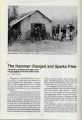
Show •4L' -. :*V™^-X*i.?-*: ' ,-- - - ^ i;i ; :- .•••':• i / - • * ' !..-•„ '..•' ~ - J3PNI%^«:J THE TIDWELL CABIN IN RUNNYRinF UTAH SHOWS MANY TYPICAL FEATURES OF LOG CONSTRUCTION. NOTE DIRT ROOF AND HEAVY CHINKING NEEDED WHEN ROUND LOGS ARE USED. PHOTOGRAPH BY GEORGE EDWARD ANDERSON, COURTESY BRIGHAM YOUNG UNIVERSITY. V Utah's Vanishing Log Cabins WITH A BROADAXE AND A FEW OTHER TOOLS, THE SETTLER COULD QUICKLY MAKE A HOME BY LARRY JONES The ol' log cabin lef alone deserted now an' still Nobody 'pears to care fur it an' reckon never will An' so I keep it fur myse'f, same way it wuz when we Moved over in to our brand new house, like fine sassiety. When families came into an area to settle, they arrived homeless, with only a few provisions and tools with which to gain a foothold in a hostile environment. Swiss, English, Danish, or eastern American - they knew that the first task at hand was to erect a shelter. Since settlers did not bring building materials with them, they had to use whatever a given site had to offer. Often settlers located near sources of water, such as streams or rivers, and in so doing were able to use deciduous trees such as cottonwood, bigtooth maple, and aspen. These trees, although close by and easy to fell with an axe, were often misshapen and twisted, making them difficult to use in buildings. Pine and fir offered the early settler a much more suitable building material. However, these coniferous trees are common only at higher elevations, thus requiring transportation over considerable distances. Where enough suitable wood could be cut, a log cabin could be erected in several weeks by a single competent woodsman using only an axe or adze. Since the logs were notched to form an interlocking structure, nails and pegs were seldom required. So, a person with few tools, little experience, and a strong back could quickly build a reasonably weatherproof home. Historians generally believe that knowledge of how to make the various notching styles was carried to Utah by settlers well-versed in construction techniques common to the eastern United States. The influence Scandinavian and other immigrants may have had on building styles and techniques is unclear, due in part to the melting pot nature of most early Mormon settlements. We do know that many foreign immigrants, coming from settled urban areas, knew little or nothing about log construction. In Utah, log cabins and their two-level counterpart, the log house, were usually considered neither permanent nor attractive. They were simply cheap, utilitarian shelters that could be lived in until something more substantial could be built. As with most frontier communities across the United States, Mormon villages moved quickly to replace log construction, especially in public buildings, with more sophisticated structures that were similar to eastern building types. By making a town more attractive and settled looking, the community might encourage more newcomers to live there. Since log cabins were usually quite stable and sturdy, they were seldom completely abandoned when a new dwelling was built. Often the original old cabin served as the nucleus for the new dwelling. If the exterior log walls were fairly smooth and square, they could be covered with wood siding. Or willow branches could be nailed to the walls to form a lath on which to apply a stucco coating. The untrained eye finds it difficult to tell if a log structure lies beneath such a wood or stucco covering. Some Utahns today may live in renovated log structures without even being aware of it. If a log cabin outlived its usefulness or desirability as a dwelling, it usually served some other function for the owner. Many times cabins were converted to store grain. Since log structures are stable, they can be moved rather easily. Today we can see where small cabins were moved out of the way to make room for newer buildings. Many early cabins can be spotted resting and rotting away behind more modern houses. Sometimes the old cabins serve as storage sheds or playhouses until they reach such a point of disrepair that they are finally torn down and dragged away. Sometimes old log cabins that have historical importance are repaired and put on display in public parks. Such old cabins often have an isolated and bewildered look about them, somewhat like a ship out of water. CONSTRUCTION TECHNIQUES By understanding the various methods of construction and types of tools that early settlers used, we are better able to appreciate the craftsmanship that went into log cabins. The foremost tool to early settlers was the axe. Its importance dates back to the Stone Age! Carpenters' axes were in common use in seventeenth-century Europe. Such light axes failed to meet the needs of the American frontier, however, and the "American axe" was developed. This axe was heavier, weighing seven or more pounds, and was specifically designed for felling trees and cabin-building. With his axe honed sharp and with sufficient talent, a settler could build a cabin using this one tool. Locating the proper site on which to erect a cabin was very important. Inexperienced cabin builders sometimes found to their chagrin that they had built their cabins in the wrong place after the cabin was buried under snowdrifts or flooded by a raging river during the spring runoff. However, most cabins were carefully located. Often settlements were erected as a group effort, which helped to eliminate many problems faced by the individual builder. WILLOW BRANCHES NAILED TO LOGS HOLD MUD STUCCO FOR A "MODERNIZING" FACELIFT. DESERET NEWS PHOTOGRAPH BY W. CLAUDELL JOHNSON. Btt p%£ _ Qi//^ WAK Axt vT^Pof/orWeacJ t/A/v/arz ylxz When logs were hauled to the building site, the first order of business after deciding on the proper length was to notch the ends of the logs. The entire structural system of the log cabin is based on notching, since the notches hold the logs in place as they are stacked on top of each other. The outer bark was usually removed to get rid of ants, termites, and other insects. Generally speaking, early cabins and those built by less-skilled woodsmen were made of round logs. Round or twisted and bent logs required a good deal of chinking to keep out wind, snow, and rain. Chinking is the material placed in the open spaces between the logs. Even those cabins having carefully hewn logs often required much chinking to fill the holes. Chinking material included small wedges of wood or bark, small rocks, mud, clay, adobe, moss, and sometimes even wadded-up newspaper. To achieve a tighter fit, the tops and bottoms of logs could be flattened with the axe. If a woodsman had special tools such as an adze or broadaxe, he could hew the logs on the front and back as well as the top and bottom to form squared logs (actually somewhat rectangular in cross section). Logs were usually hewn before being notched. The more skill and special tools the settlers had at their disposal, the more sophisticated the cabins they could build. By using hewn logs it was possible to stack up a wall that was fairly flat on the interior and exterior. If a handsaw was available, the ends of the logs, projecting past the notches, could be cut off square, mak- CMx/jne Chalk (0 PZEPARIHG /J XOG TO 3£ J3FOAD AXED jf/rst; bark was removed -from l£g and a squarjhgq Gprd was used to snap, a chalk Ime.i ®> &COZWG 7<2 7h/£jC/A/£ " Deep Cufs were made at inizrva/s along line,. /owe- SfAWDXEO 7* KH/CE SDBE (3v£> V/£W Of XOG TOSE M f M ~SQM/?E JBroad Axe was used ibr Smooth hewing. ®/ll>ZED ($U*?FAC£3 l/sed mostly for decora-five- beams. MosT hewed lags ~for cabins were teft-rough with bmadave marks. £x?OAZ> A. has -fiat side, and ch'SeJ J3/?OAZ> AXED axe cats, left- Showing- &X& Clffs smoothed Oat. 3RMO AXED SORFACC ing flush corners. Cabins constructed in this manner could be, and often were, later covered with siding to modernize their appearance. Hewn logs enabled more intricate and sophisticated types of notching to be used, thus creating sturdier walls that could rise higher and support greater loads. To secure more uniform wall surfaces, well-equipped settlers set up pit saws. The pit saw replaced the adze for putting flat sides on logs and for making planks. The pit saw in turn was replaced by the sawmill, powered by water or steam. Cabins were usually situated on flat, hard ground with stones placed beneath foundation logs to keep them from rotting or soaking up ground moisture. Then the walls were made simply by stacking logs on top of each other until the desired height was reached. NOTCHING STYLES Five basic methods of notching the ends of logs were common in Utah. Several variations of these basic notches were also used. The saddle notch seems to be the oldest as well as the easiest notch to cut in a log. It was almost always used with round logs and appears to have been the earliest form of notching used in Europe. The notch itself is rounded, requiring very little complex cutting. Three variations are found: the single notch cut into the top of a log, the single notch cut into the base of the log, and the double notch cut into both the top and bottom of the log. Saddle notching required that the log project beyond the notches for maximum tightness of the joint. Because of the projecting log ends, cabins and outbuildings made with saddle notches were usually not covered with siding. The double and top notch had a tendency to deteriorate faster since water could easily settle in the dished out base of the notch. The saddle notch is the most common one to be found in Utah. inRing ROUNP V /Vorcv The V notch lends itself to being used either on round or hewn logs. The log ends can be cut off, forming a flush wall, or left projecting beyond the walls. A V notch is cut into the bottom of the top log and a V-shaped top is formed on the base log to make the joint. The joints formed by this method are quite tight and tend to shed water rather than hold it. Few examples of this style can be seen in Utah today. Jj£MYl/-M Square notching competes with the saddle notch for simplicity. It is believed to have evolved from the half dovetail joint. Square notching is common to round, hewn, and mill-cut logs and can most easily be cut into the log end using a saw, although an axe and floe or just an axe could be used. Right-angle notches are cut out of the top and bottom of a log, leaving a center projection that meshes with the notched logs above and below. The square notch is a weak and inferior joint with no abili-quently display this type of notching. To notch logs this way requires great skill with an axe. By far the most sturdy log-building method, full dovetail notched logs lock into place in both directions of outward thrust. Because all the sides of the notch slope down, rainwater usually runs off rather than collecting in and rotting the joint. The corners of this type of construction were flush, tight, and square, with hewn logs rather than round being used. To find a full dovetail notch on round logs is Jtaweddi/rface JOP A.VD BOTTOM Cur 77ofa7 ty to resist any outward pressure the walls of a cabin might exert. Unlike other notching techniques, square-notched logs have no way to interlock. An auger was often used to drill holes in square-notched logs. Then, wooden pegs were inserted in the holes to help hold the logs in place. Sometimes these pegs can be spotted between the logs on a cabin where the chinking has fallen out. This style of notching, being simple and quickly done, was used a great deal in Utah. Full dovetail notching is by far the most advanced and complicated type of corner notching. Dovetailing is an old method of joint construction common to furniture and cabinet craftsmanship. Drawers and box corners fre-unusual. The half dovetail notch is an offshoot of the full dovetail, although it resembles half of a V notch. The half dovetail has many of the same characteristics as the full dovetail except that it is easier to make. Half of the top or head of the notch is sloped downward, but the bottom is left flat. Like the full dovetail, this method of notching was used mostly on hewn log dwellings rather than on outbuildings. By closely examining those log structures still standing, we can sometimes spot several styles of notching on the same building. Also, lean-to additions made of logs often had notching techniques different from the original structure. Cut pith aAk< endMo&pseAxe often covered'itfj, narrow Wrvwt&Mts }/A£FJD0VE7>1/£ Jo/tYT c/O/AT AFTER THE WALLS WERE UP As log cabin builders erected the walls, they made no provision for windows or doors. They cut these into the cabin walls when and where desired after the walls were up. Many of the earliest cabins had only one door at first, and windows were added as glass became available. Most early cabin floors were simply packed earth, flat field stones, or wood planking. Sometimes, in better constructed cabins, the floors were supported by log floor joists on which planking was laid. Floors made of logs split lengthwise and laid side by side were often called puncheon floors or "Missouri puncheons." Most early Mormon cabins had dirt roofs, a feature that sets them apart from cabins found elsewhere. Cabin roofs are gable type, having a low pitch or slope that runs off from a center ridge line. To support the weight of the sod roof, the builders lashed small wooden poles tightly together. The poles ran from the eaves on the outer wall of the cabin up to and rested on the ridge pole. On top of these poles settlers placed grass and twigs and then covered them with soil to a thickness of six to twelve inches. Grass or weeds often grew from this soil and helped to hold it in place, as did logs or planks attached at the eaves of the roof where gutters are placed on houses today. During wet weather, mud often dripped into the cabin. So, settlers usually wanted to replace a dirt roof with planks or shingles as soon as possible. Some FULL DOVETAIL NOTCH MARKS THE MOST SOPHISTICATED LOG CONSTRUCTION. DESERET NEWS PHOTOGRAPH BY W. CLAUDELL JOHNSON. cabin roofs were thatched with tightly woven grass, but this kind of roof cannot be seen today. When the cabin was near completion, work on the chimney began. Chimneys on most Utah cabins were centered on the outside of one of the gable ends of the cabin and extended up past the high point or ridge line of the roof. Sometimes chimneys ran up the inside wall of the cabin rather than the outside. Building materials for chimneys often consisted of stones found nearby. Adobe and low-fired brick were also used. Most Mormon log cabins are nearly square with a low ceiling. They range in size from twelve to twenty feet square with fifteen by sixteen feet being the most common size. The main entrance door was placed on the broadside of the cabin and not in the narrower gable ends. This was typical of most American frontier log cabins. Mormon log cabins were often either enlarged by the addition of extra rooms or were abandoned when newer and larger, more comfortable quarters could be built. The log cabins of our Utah forebears are indeed a vanishing species. Each year that passes sees scores of these cabins succumb to the burden of time and neglect. The roofs sag A short- wooden maul Used Yd •strike a 3rot &£7/?O£-^6U/B were used fopplif hewn logs along hheir grain -to tnake shingles /a-fhes Sfaves) and clapboards. called QSPJLITS OX SHAKES'. ffooE A knife edged Wedge, and the walls bulge until they can finally support no more and fall decaying to the ground. Whatever story they could have told about our past is lost forever. Mr. Jones is a preservation architect with the Utah State Historical Society. ^_ *- LOG CABIN AT IBAPAH, UTAH, DISPLAYS SEVERAL DIFFERENT NOTCHING STYLES NOTE ALSO ROWS OF SMALLER LOGS THAT MAKE UP ROOF. |