| OCR Text |
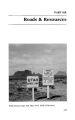
Show PART SIX Roads & Resources Utah-Arizona state line, May 1941. USHS Collections. 225 San Juan County Roads: Arteries to Natural Resources and Survival Jay M. Haymond Since the initial settlement of San Juan County in 1880, roads have been the means to survival in a land that gives up its substance grudgingly. As with other government functions carried on in a vast area by a small number of people, road construction and maintenance has been a struggle. Most San Juan roads have been built because of the need for access to the county's natural resources. These resources have not only been the reason for much road construction but have also been the source of funds to pay for maintenance. Federal funds have also been important in the development and maintenance of roads in the county. Today few, if any, roads would be built without federal funding. After the construction of the Hole-in-the-Rock road from Escalante to Bluff in 1880, San Juan pioneers built roads to the mountains. These one-way or "dead end" roads were built first to reach the much-needed timber, then later as part of the development of water resources in the mountains.1 Of equal concern was the early establishment of roads connecting San Juan communities with other parts of Utah and nearby Colorado. In 1881 the Hole-in-the-Rock was abandoned in favor of a new route to Escalante by way of Hall's Crossing on the Colorado River. However, the Hall's Crossing road was a primitive trail, not much better than the original Hole-in-the-Rock route. Roads were also built northwest from Bluff to Cane Springs, Spanish Valley, and the community of 227 San Juan County Moab on the Colorado River. Pushing east, a road was built to Dove Creek, Colorado. These early roads were built under the direction of George W. Sevey, the county's first road supervisor.2 County efforts were reinforced by those of private business. Some roads were built for business reasons, then donated to the county. An example of such self-interested generosity is found in the 1909 report of County Road Wagon tracks in the sandstone at the head of Cow Canyon northeast of Bluff 1966. Crampton Collection, Marriott Library, University of Utah. 228 County Roads Supervisor M. A. Barton to the newly organized State Road Commission: In order that we could have a better road west of the Navajo Hill into the oil field proper, instead of going up Comb Wash and over Lime Ridge, several men came to me and said if I could have a route marked out they would spend a few thousand dollars on the road and then after it was finished the County Commissioners might accept it as a county road or state road. In order to get the public sentiment, I called a meeting on December 9, by order of the County Commissioner, and the result was very favorable. Three men were appointed by the meeting to designate a better route than the old one and a much more direct one, and I was informed within a week that at least S5000.00 had been raised to improve the way to the oil field and it is expected to be finished by January 1, 1912.3 Until 1909 all roads were the responsibility of the county. Vehicular traffic was light and usually only local in nature. There were few automobiles. The truck, a phenomenon of World War I, would not be seen until the 1920s. Because roads were primarily for local use, the county carried the entire burden for public improvements on them. Modification of this philosophy began in 1916 when "post roads" were subsidized with federal funds to assist counties like San Juan where long distances made the cost of roads, and therefore the transportation of mail, very expensive. With the establishment of the Utah State Road Commission, state officials recognized the growing need for better roads and a state road system. A boon to the isolated rural counties, the developing state concern meant that more money would be spent and attention paid to construction and maintenance of roads located in areas of few people who otherwise could not afford to pay for them. Beyond San Juan County's small population, the nature of the country - rough terrain, loose sand, and long distances from road-building material - created more difficulties and greater expense for road construction. In his 1912 report to the Road Commission, M. A. Barton argued for money to improve the road between Monticello and the Grand County line. Beyond the fact that this section was part of the Utah 229 San Juan County State Road System, Mr. Barton reasoned that the route to Moab "is the only feasible outlet for San Juan County over suitable material for road construction." Barton's plea, and those of his successors, would not be recognized for many years.4 The idea for a centralized road construction responsibility developed from a nationwide "good roads movement" and a national awareness that if the growing American population were to take advantage of the rapidly unfolding technological innovations for travel and conducting business, a more dependable transportation network was needed. Utah was in the mainstream of these concerns for a number of reasons, including a proposed transcontinental road which would pass through the state. Known as the Lincoln National Highway, the road was promoted by the Lincoln National Highway Association, whose members included makers of automobiles and automobile parts.5 Construction of the Lincoln Highway was delayed by disputes, lawsuits, and World War I. Animals were essential in road construction, reservoir building and digging irrigation ditches and canals. Photograph Copyright 1979 Steve Lacy Wild Bunch Photos. 230 County Roads Fortunately the idea of good roads was supported by Congress in the Federal Highway Act of 1916. The act authorized funds to match those of state and local governments for "post" road construction and maintenance. Companion state laws allowed counties to bond to raise needed matching money. The Lincoln National Highway was completed in 1923 but lost its patriotic name in favor of a number as part of the uniformity of a national system. Thus, in Utah the Lincoln National Highway became U.S. 30 and later Interstate 806 The authority to assign numbers and designate routes was given to states in the 1921 Federal Highway Act. This act also increased federal participation in new-road construction from 50 percent to nearly 75 percent in Utah. This percentage corresponded to the proportion of Utah land under federal management. This feature in the law recognized the vast distances in the West over which roads had to be built and the lack of local tax revenues with which to pay for roads. The new formula applied to Federal Aid Project (FAP) roads or those segments of the state system that were "trunk" roads.7 In San Juan County the route 451-7 from Moab to Bluff and later on to the Arizona line was the designated trunk road. In 1924 grading work on the segment between Moab and La Sal Junction was completed. The Road Commission reported the route improved after it was graded in 1928. Though graded, the road was not graveled. Pavement did not come until 1938 when the first three-mile segment of the road to Monticello was surfaced.8 In 1921 San Juan County reported 116.1 miles of state roads, none of which were paved or graveled. However, San Juan County was not alone. That same year twenty-one of Utah's twenty-nine counties reported no pavement of any kind. Fourteen counties stood with San Juan, having no pavement or gravel on their roads. The 1921 report listed 728 miles of San Juan County roads. That biennium $14,549-09 was collected in gasoline taxes. Over $38,000 was spent for road and bridge construction; $45,995.18 to retire part of the 231 San Juan County Owachomo Natural Bridge, Natural Bridges National Monument, 1983. Photograph by G. B. Peterson. Sipapu Natural Bridge, Natural Bridges National Monument, 1979. Photograph by G. B. Peterson, © 1983. 232 County Roads bonded indebtedness; and $45,549.39 to match federal funds, for a total state expenditure of nearly $130,000 for roads.9 The decade of the 1920s was especially difficult for Utah and other western states. After World War I the sharp demand for food products and mineral ores dropped quickly. In San Juan County the wartime demand for beans and vanadium followed this general trend and local tax revenues fell accordingly. Fortunately, when state and local revenues fell short for essential road work, federal government agencies were able to pick up part of the burden. In 1924 the La Sal National Forest, which was established in 1910, built two roads on the forest in San Juan County. One road went from Blanding west to Natural Bridges, and the second east from La Sal Junction to Paradox, Colorado.10 These were not new roads but rather improvements of existing wagon tracks upgraded to accommodate anticipated increased traffic from timber cutting, mining, and automobile sightseers. The primitive nature of these trails was observed by Herbert E. Gregory who made geological reconnaissance trips to San Juan County between 1909 and 1929. Speaking of the route to Natural Bridges he noted: "A few trails are kept open by cattlemen and in many places the topography marks out feasible routes for pack trains."11 During the 1930s road building was integrated into a broader program of improving existing community assets and promoting recovery from the economic depression by putting people to work. Congress poured money into labor intensive projects such as road construction. In the first Emergency Highway Appropriations Act, of the eighty million dollars appropriated, Utah received four million. An important use of these funds in San Juan County was the surfacing of part of its trunk roads. The Civilian Conservation Corps was a prominent recovery program in San Juan County. One of the CCC's primary activities there was road construction. Though records documenting the importance of road maintenance and construction activity by the CCC and others in San Juan County are 233 San Juan County not extensive, a comment by Mr. H. K. Thurber in the Moab Times-Independent on January 9, 1936, sheds some light on the contribution of good roads to the county's economy. Speaking of the new interest in carnotite mining in San Juan, Mr. Thurber observed "the carnotite industry is moving the ore for a tithe of what it did in the past due to better roads." World War II halted road construction all over the country except for roads essential to the war effort. In San Juan County some mine access roads were built but most work was not undertaken on the state road system. After World War II traffic on San Juan's state roads increased as travelers, no longer restricted by wartime gas rationing, took to the roads and as mining activity continued to expand. The increased traffic, especially by the enormous ore-hauling trucks, raised questions of safety on the San Juan roads and brought road engineers to study ways to widen or straighten sections that posed safety hazards. One such hazard was the dugway at Cane Springs which was realigned in 1948. The realignment included straightening the road along the mesa to the top of the dugway, then widening and improving the grade to the Cane Springs rest stop and patrolman's cottage. The contractor used local labor as much as possible on the project. Some of the workers found a "uranium tree" just off the right-of-way and sold the find to an Atomic Energy Commission buyer for ten tiiousand dollars - a fabulous sum in those days. This event was a harbinger of things soon to come as uranium fever would sweep across the Colorado Plateau in the early 1950s.12 Traffic demand is the obvious motive to build roads. In 1949 San Juan County recorded the next to the lowest road use in the state, as determined by the number of cars passing a given point in a twenty-four hour period. Only Garfield County was lower.13 However, the boom in prospecting for uranium during the early 1950s jolted the quiet pace of Grand and San Juan counties into a feverish race. Access roads could not be built fast enough. In 1951 the Atomic Energy Commission, working through the Utah State Road 234 County Roads Commission, "rented" state equipment, operators, and supervisors to build a road from Blanding to Natural Bridges and grade the road from Natural Bridges to the Hite Ferry crossing. These agencies pushed road construction into the wilds of San Juan County without even a preliminary survey.1"1 Such extraordinary measures by the Atomic Energy Commission and State Road Commission are strong evidence of the national and state interest finally paid to isolated and remote San Juan County. Sections of today's U.S. 95 between Comb Wash and Natural Bridges were laid out by Jim Hurst, an inspector for the State Road Commission at Green River, Utah, who flew his airplane down each week and used it to scout the road line, keeping just ahead of the road-building crew working on the road he was inspecting between Blanding and Comb Reef. Construction of a road through Comb Reef was a rigorous challenge. Prior to building that road, the only way west toward the Colorado River from Bluff or Blanding was over the forest road, which passed to the north of Comb Reef, or Early road up east side of Comb Wash. USHS Collections. 235 San Juan County across the Navajo trail west of Bluff near where the San Juan River cuts through Comb Reef. Surveyors chose a place near the halfway point between the two existing passages, possibly because of local stories about the "Posey Trail" and its potential as a route through the north-south running obstacle.15 Comb Reef had a break at the top of its jagged formation where the contractor started a road south by southwest through the first fifty feet of red rock before encountering a smooth and nearly vertical two hundred foot slickrock barrier. While work proceeded on the upper section, a second crew was sent into Comb Wash to push the road from the bottom toward the top. Living in a ranch house in Comb Wash, the second crew cut a road up the talus slope matching the grade of the line coming down from the break at the top of the reef. Both crews then attacked the treacherous slickrock. Drilling and shooting the vertical smooth rock throughout the winter of 1952-53, the crews finally met near the middle. Grading work on the road into Comb Wash was completed that summer, and construction crews pushed west beyond the wash as fast as the broken terrain would permit. The road provided miners with better access into what had been one of the most remote sections of the county. After prospectors found what they were looking for and mines were developed, haulers had a much easier time getting the ore to processing plants. Later, in the early 1970s, another cut was made through Comb Reef to improve the alignment for Highway 95 which, through Comb Wash, passed south of the original road. San Juan's road system and uranium industry was supported by federal funds under the Defense Highway Access Act to provide better access to producing uranium mines. In San Juan County these funds went to the following projects: Bears Ears to Wooden Shoe Buttes Road 16.6 miles Natural Bridges Junction to Red Canyon Road 33.0 miles Red Canyon to White Canyon Road 6.8 miles Utex Mine Road 6.8 miles Montezuma Canyon Access Road 24.0 miles16 236 County Roads The first three projects were for a total of 56.4 miles of graded roads and the last two projects for a total of 30.8 miles of graded and graveled roads. During this period improvements in the main trunk road were completed by the State Road Commission. The dugway at Peter's Hill was changed in 1954; Devil's Canyon realigned in 1953-54; and the road and bridge in Recapture Wash rebuilt. The following report from the State Road Commission indicates the tremendous effort in building and improving roads throughout the county: State Roads County Roads 1948 1954 1945 1954 Oiled surface 36.1 miles 86.9 miles 5.5 miles 156.2 miles Oil treated 1.1 0.0 0.0 0.0 Graveled 85.7 79.3 175.0 338.1 Graded 41.9 59.3 - - Unimproved - - 198.4 406.4 Primitive 74.5 40.3 345.3 56.0 Totals: 239.3 265.8 724.2 946 A17 The next important surge in road building took place about 1964 with the discovery of oil in the Aneth Basin. To provide better access into the new oilfield, the old road from the bottom of the hill off White Mesa to Hatch's trading post was rebuilt. When oil was found near Mexican Hat, the road to the Navajo reservation was improved. In 1964 the road west from Bluff was rebuilt to improve the section through Butler Wash and improve the alignment through Comb Reef into Comb Wash. Butler Wash was especially dangerous because of an old one-way Bailey bridge which spanned the wash. That bridge was replaced by two ten-foot diameter corrugated metal pipes. The road was constructed south of the original right-of-way. A new bridge was built in Comb Wash as part of the contract, which is currently still in use.18 In conclusion, roads in San Juan County were built because of the need for natural resource development. Federal money was an important supplement to private and local 237 San Juan County Early San Juan County road across Grand Mesa near the Bears Ears. Photograph Copyright 1979 Steve Lacy Wild Bunch Photos. government road-building initiatives. In the future, the construction of additional roads will be subject to further demands on the county's natural resources, to include scenic and recreational attractions. NOTES 'Charles S. Peterson, Look to the Mountains. Southeastern Utah and the La Sal National Forest (Provo, Utah: Brigham Young University Press, 1975), p. 210. 2Cornelia Adams Perkins, Marian Gardner Nielson, and Lenora Butt Jones, Saga of San Juan, second edition (San Juan County: Daughter's of Utah Pioneers, 1968), p. 264. 'Public Documents, Highway Department Report, 1911-12 'ibid. ""The Lincoln Highway, Lincoln National Highway Association, 1935. (,Public Documents, Highway Department Report, 1923-24, "Ibid. 238 County Roads "Public Documents, Highway Department Report, 1939-40. 9Public Documents, Highway Department Report, 1921-22. '"Public Documents, Highway Department Report, 1925-26. '' Utah: A Guide to the State (Salt Lake City, 1941), p. 427. ^Interview with Harold Whiting and Melvin Haymond, Utah State Historical Society. '^Public Documents, Highway Department Report, 1939-40. '"•interview with Harold Whiting and Melvin Haymond, l5Ibid. 16Public Documents, Highway Department Report, 1955-56, 17Ibid. '"interview with Harold Whiting and Melvin Haymond. 239 |