| OCR Text |
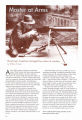
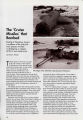
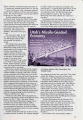
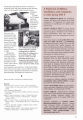
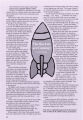
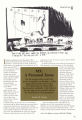
Show The ' Cruise Missiles' that Born bed Rusting at Wendover Airport is evidence of the trial- and-error process involved in developing a weapon. At first it was mostly error. by Dennis Weder ucked away on Air Force proper- Tt y in a far corner of the airport in Wendover, Utah, sits an incon-spicuous concrete pad. At the north-east corner of the i ad stands a small concrete blo'ckhouse, and Wreckage of the JB- 2 litters the ground at Wendover. nearby lies what looks like a pile of old car parts. Closer inspection reveals that, warhead of about 1,800 pounds. The guidance although there are a few old cars rusting in the system included a magnetic compass and gyro-pile, the majority of the remains are actually the scopic control of the rudder and elevator on the remnants of self- propelled " buzz bombs," the tail - not much of an improvement over the relics of failed test trials at the nearby launch pad World War I system. The V- I was still only effec-dating from a brief but significant episode in tive when aimed at densely populated targets World War 11. such as London. The Allies used the first self- propelled bombs The V- 1' s Argus pulse jet engine - which had during World War I, but these were really no more been invented decades earlier by German scien-than explosive- packed biplanes. They were used tists - operated on a ramjet- type principle. First, mostly to intimidate ground troops since their steam pistons, small rockets, or Heinkel bombers simple gyroscopic guidance systems did not propelled the V- 1 to about 200 mph. Once the allow effective targeting. bomb got up to speed, air streamed into the However, the concept of the " cruise missile" engine inlet through a line of inlet valves with did not die out then. After World War 11' s Battle of downstream flaps. When gasoline was injected Britain, which resulted in heavy damage to the into the chamber and ignited by a spark plug, the German fleet of bombers, the Nazi Luftwaffe resulting pressure forced the flaps to close. revived the idea of the pilotless bomb. The Combustion gases escaped out the rear of the Luftwaffe began designing what it eventually engine to supply the thrust that propelled the called the Vergeltungswaffe Eins ( Vengeance bomb. After the fuel had detonated, the pressure Weapon I), more commonly known as the V- 1. in the combustion chamber fell, and the wind About 25 feet long with a 16foot wingspan, the forced the valves open and let in fresh air. This V- 1 could fly some 200 miles with an explosive cycle repeated about eight times per second. The engine could accelerate the V- 1 up to 400 mph as the fuel tank approached empty. The V- 1 acquired the nickname " buzz bomb" from the sound made by the detonations. To measure the flight distance, the nose of the bomb contained a small propeller attached to a counter. When a predetermined number of pro-peller spins had been reached, the elevator on the tail lowered, putting the bomb into a nose-dive. Since the fuel tank outlet was in the rear of the tank, the nosedive cut off fuel to the engine; when the buzzing stopped, it took only about 15 seconds for the bomb to reach the ground from its normal 2,000- 3,000- foot elevation. When people on the ground heard the buzzing stop, they recognized it as a signal to run for cover. In the V- 1 the Germans found an extraordinarily inexpensive alternative to manned bombers, which the Luftwaffe regularly lost in battle. Since it needed to fly only once for about 30 minutes, it could be made of cheap sheet metal and wood at a tiny fraction of the cost of an airplane. It also did not require the expense of a trained crew; in fact, one crew could launch hundreds of bombs with minimal risk ( although occasionally a V- 1 Field on Florida's Gulf Coast. It took nearly 50 JR2 launches to achieve suc-cess. Many crashed on the beach and still lie there on Air Force property. The successful models crashed into the ocean after depleting their fuel. Ironically, these successes forced a relocation of the testing to an inland location so that the crashed weapons could be recovered for evaluation. The military selected Wendover, on the Utah- Nevada state line. The Army Air Corps had been using Wendover as a training base since the early 1940s. The federal government already owned 90 percent of the surrounding land. It lay far enough inland to be safe from attack and was isolated by the salt flats in Utah and the sparsely populated desert of eastern Nevada; yet a major highway and railroad gave it east- west connections. In addition, the weather was clear most of the year. From July 1941 through April 1944, the field at Wendover was used for the training of bomber crews. At its peak, it was the largest World War I1 bomber training facility in the world. Briefly in 1944, P- 47 ( Thunderbolt) pilots also trained at the field. However, the fighter squadron was quickly ments, and a wall of barrage balloons. This system knocked out about 75 percent of the incoming V- ls, but the remaining 25 percent psychological trauma. Meanwhile, the Allies had been working on their own cruise missiles. Northrop Aviation cre-ated the Jet Bomb 1 " Power Bomb," or JB- 1 for short. But it did not perform well in tests. Then, about a month after the V- 1 attacks began, the Allies shipped a wrecked V- 1 from Britain to Wright Field, Ohio. The U. S. military quickly decided to halt all other development of cruise missiles and concentrate on an American version of the V- 1. Northrop began construction of the JB- 2 using original German parts and copies made by Ford Motor Co. By October 1944, the military was testing the first JR2s at Eglin A bunker at the launch site. moved to other bases when Wendover was chosen as the location for Project Silver Plate - the training of a crew to drop an atom bomb. At the same time, the military chose Wendover for continued JR2 testing. Some have suggested that Wendover was selected as the primary JR2 test site to divert attention from Project Silver Plate. The popula-tions of both the base and the town were undoubtedly distracted by the frequent launches of the noisy JR2s. However, the real reason probably lay in the millions of acres of govern-ment- controlled land over which to fly a notoriously errant weapon. In June 1945 the military built a launch pad with two ramps and a bunker off the southwest corner of the field, just inside the Utah state line. The military justified this project because it anticipated a land invasion of Japan. The JB- 2s were to be used as the Germans had used them: to wreak havoc on Japanese installations and the general populace before any Allied ground forces were put in harm's way. Development of the JR2 at Wendover during late 1944 and early 1945 resulted in several signif-icant advances, including a much- improved guid-ance system and a lowering of the required launch speed to 100 mph. Researchers also worked on replacing the rocket booster motors because of the shortage of rocket propellant. Experimentation on flywheel and chemical- reac-tion launching systems and new launch- pad designs, including mobile ramps and reusable rocket- booster assemblies, took place at both Wendover and Eglin. These developments had their difficulties, however, resulting in the aforementioned pile of crashed bombs near the launch pad. Other launch scenarios - aircraft carriers, LSTs ( landing ship transports) and even sub-marines - were investigated. When the war in Europe came to a close in May 1945 and the Japanese surrendered several months later, test-ing of the JR2 slowed but did not cease entirely until just before the program was closed down in March of 1946. The Navy took possession of the remaining JR2s and renamed them " Loons." The U. S. never used the JB- 2s in combat The JR2 buzz bomb. because of the rather convincing impact of the atomic bomb. However, the work and money expended on the JB- 2 did not go to waste. This program became the first step in a long series of guided- missile and guided- bomb projects continu-ing to the present. Many of these weapons sys-tems are still being tested in the area east of Wendover now known as the Utah Test and Training Range. And, occasionally, crews attempt-ing to recover a modern test weapon from the range still encounter one of the old JR2s resting peacefully miles from the nearest road. DENNIS WEDER IS THE RANGE ENVIRONMENTAL COORDINATOR AT THE UTAH TEST AND TRAINING RANGE. Sources: Erik R. Bluhm, " V is for Vendover ...," Great God Pan 14 ( 2000). Roger D. Launius, " Home on the Range: The US Air Force Range in Utah, a Unique Military Resource," UHQ 59 ( Fall 1991). Charles Hibbard, " Wendover Army Air Field Proving Ground for the Atomic Bomb," MS, Ogden Air Logistics Center History Office. Unknown author, " The Development of Guided Missiles," declassified document complied by the Historical Division Intelligence, T- 2, Wright Field, Ohio. Yahoo. com search for " buzz bomb," 2002. Select " World War II Weapons > V- 1 Flying Bomb > " 1 940s Sounds and Music" > " V1 Doodlebug" for a recording of the buzz bomb in flight. |