| OCR Text |
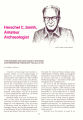
Show Herschel C. Smith Amateur Archaeologist I r ARTIST: BRENT SHAW FOSTER THIS ENGINEER DEVOTED YEARSTO STUDYING AND PRESERVING PREHISTORY FOR ALL OF US BY THOMAS J. ZEIDLER Amateur archaeology has become a popular hobby as more people begin to appreciate our American Indian heritage. Unfortunately, this interest has often resulted in looters, armed with picks and shovels, destroying archaeological sites in a frenzied search for arrowheads and pottery. You do not need a college degree in archaeology to be interested in Utah's ancient past, but there is a right way and a wrong way to be an amateur archaeologist. The life of Herschel C. Smith illustrates the right way, for Smith was an amateur par excellence. Herschel Smith was born on March 27, 1907, in Lehi, Utah. He graduated from the University of Utah in 1930 with a bachelor's degree in civil engineering, Then he moved to Montana where he worked for the U. S. Geological Survey. He also did graduate study at the Montana School of Mining. In between his job and school, Herschel worked as a re-lief pilot for National Parks Airlines [ now called Western Airlines). While surveying the Green River Gap for the Geological Survey, he became interested in archaeology and Pleistocene geology - the history of the earth during the last 2.5 million years. For most of his life Herschel made his living as a construction engineer in San Fran-cisco and Los Angeles. After serving in the Civil Engineer Corps of the U. S. Navy during World War 11, he founded the H. C. Smith Corporation and the Encon Corporation. These companies did construction work around the world. In later years he special-ized in work for the Department of Defense. Although Smith's background was that of an engineer- industrialist, he understood how fragile and beautiful our country's prehistory is. He knew that it should be carefully studied and preserved. Herschel was fascinated, as most of us are. by the beauty of ancient arrowheads and pottery. But he knew that where and how these artifacts are found [ their context) is extremely important to understanding the life of America's prehistoric peoples. Only scientific excavations can accurately deter-mine the ways ancient peoples lived, got their food. provided themselves with shelter, and conducted their religious ceremonies. So, Herschel Smith the amateur joined and even organized scientific expeditions instead of becoming a " Humpty- Dump ty archaeolo-gist" - someone who collects or digs on his own. With Humpty- Dumpty archaeology you can never put all the pieces of the past together again to see what they really mean. Smith's great interest in early man even took him to Africa where he worked with the famous archaeologist and physical anthro-pologist Louis Leakey. An excellent pilot, Herschel liked to play an occasional practical joke on his archae-ologist friends. As one of them wrote: " You never knew when your field camp would tremble and shake as a Piper Aztec roared over a tent level with Hersch at the controls . . . to land neatly on the playa." In the early 1960s. Smith's organizational ability enabled him to bring together individ-uals, labor unions, and private industry at Tule Springs near Las Vegas. Nevada. He was able to talk the U. S. Air Force into lifting restrictions on a bombing range there so that archaeologists could do research before the site was destroyed. Known as Pinewater Cave, this site proved to have been occupied by Indians for 9,000 years. Herschel was not like many amateurs whose activities destroy our cultural heritage. He " was one of those rare individuals whose great interest in a subject inspired others to greater efforts; yet he did not intrude in areas for which he was not bained, relying on spe-cialists in these fields to carry out their work." Herschel C. Smith - member of the Ex-plorers Club, geologist, miner. pilot. and en-gineer - would have agreed that the motto " take nothing but photographs, leave nothing but footprints" should be applied by every-one to our archaeological and paleontological heritage. Mr. Zeidler is associate editor of Antiquities Section Selected Papers. Geologic Time Scale Mammals reach their maximum diversity Dinosaurs coritim abwn; dant # ken vanish First birds; dinosaurs b- ( approximately 80 % of the history of life) 3 billion years ago |