| OCR Text |
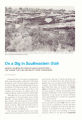
Show FIG. 1. VIEW OF WESTWATER RUIN FROM ACROSSTHE CANYON. IN 1977THE NORTH HALF ( SEE ARROW) OF THE SHELTER WAS EXCAVATED. On a Dig in Southeastern Utah HERE'S A GLIMPSE OF HOW ARCHAEOLOGISTS WORK - THE THINGSTHEY F1ND AND WHAT THOSE THINGS MEAN BY KAY SARGE NT Westwater Ruin is located in southeastern Utah some three miles southwest of Blanding, San Juan County. The ruin lies in a large alcove or niche in the west wall of Westwater Canyon, a tributary of Cottonwood Wash. The alcove is about 20 meters above the canyon floor. Tlle cavelike room measures 15 meters wide by 30 meters long and is approximately 7 meters high. Although ths is an arid to semiarid place, the vegetation in the immediate area is fairly plentiful. Various shrubs, cottonwood, scrub oak, juniper, and pinion grow in the vicinity. Westwater Creek has a more or less permanent supply of water. This must have been quite an attraction to the Anasazi, the aboriginal in-habitants of the area. ( See fig. 1 .) Tb Anasazi occupied south and south-eastern Utah and nearby portions of Colorado and Arizona. [ See fig. 2.) Westwater Ruin, also known as Five Kiva House, lies within the geo-graphic area once occupied by the Mesa Verde Anasazi. From field observations. archaeolo-gists think that there are at least two compp nenis at Westwater Ruin. The firs? represents an eady period of Anasazi development. Bas-ketmaker IIUPueblo I. The second component represents a later phase of Anasazi develop-ment called Pueblo 111. A Pueblo I1 component may also be present. Perhaps a quick explanation of some of the terms used here is in order. Site refers to a loca-tion or focus of prehistoric activity; the place where stone chippings were left from the man-ufacture of hunting tools. the remains of a campsite, the ruins of a dwelling or storage stmcture. When we say that two components [ sequence through time) of Anasazi develop-ment. Although much is already known about the Anasazi. the information from Westwater Ruin and other sites will help to define tlw Anasazi Culture and its development more clearly. So. we can see that archaeology relies a great deal on fitting facts ( such as types of pot-tery, other artifacts, details of building can-struction, and dates of occupation) from a site like Westwater Ruin into an overall pattern of information from many similar sites. That is why archaeologists like to work at sites that have not been disturbed by pothunters and other vandals. Then the order and relation-ships of the artifacts and other information remain intact. The careful notes taken by the FIG. 2. MAP SHOWS THE APPROXIMATE LOCATION archaeologist during an excavation or dig pre- OF WESTWATER RUIN AND THE EXTENT OF THE ANASAZI CULTURE IN UTAH. THEANASAZI ALSO serve the information for any other scientists OCCUPIED NEARBY PARTS OF ARIZONA AND who may want to study it. COLORADO. are present, it means that the site was occupied by two different sets of people - either of dif-ferent cultural groups or of different time peri-ods. At Westwater Ruin occupation was by peoples of two or more different time periods of the same culture. The culture in question, the Anasazi, was based primarily on agricul-tural activity. Cultivated plants included corn. squash, and beans. The development of the Anasazi Culture is divided into a number of periods. Archaeole Exploring expeditions have visited the area of the Mesa Verde Anasazi since the mid- 1800s. But no one knows when Westwater Ruin was first visited by non- Indians. Newspaper re-mains with a date of 1918 have been found at the site. In 1936 dendrochronological ( tree- ring] dates were determined for two wood poles re-moved from Westwater Ruin by W. S. Stallings. The tree rings gave a date of A. D. 1243. well within Pueblo LlI times. More than 30 years gists define a period by changes in the artifact inventory ( tools, pottery, and other material goods used), subsistence ( whether hunting, the gathering of wild plants, or farming was the main source of food), and changes in the arch-tectural style of structures. The Anasazi are also divided geographically. Westwater Ruin. for example, lies in the area occupied by the Mesa Verde Anasazi. In different geographic areas differences in pottery and architectural styles are found. Through its various periods, the Anasazi Culture has existed from about 2,000 years ago to the present. Modern Pueblo Indians are the descendants of the Anasazi. Archaeologists can determine who lived at Westwater Ruin and when they lived there by examining the kinds of pottery found and by studying the architectural details of their struc- FIG. 3. INSIDETHE ALCOVE, LOOKING NORTH. hres. To answer the qumiions who? and FIELD WORKERS ARE EXAMINING ARTIFACTS RECOVERED FROM SCREENING SOIL, ONLY whn? scientists compare information from THOSE DE WSITS FOUND INTACT OR Westwater Ruin with the known chronology UNDISTURBED BY LOOTERS WERE SCREENED. later, in 1967, the Utah Museum of Natural His-tory photographed and mapped Westwater Ruin, The Antiquities Section, Utah Division of State History, began its excavations at West-water Ruin in mid- July 1977 at the request of the Navajo Development Council. The most urgent reason for excavating Westwater Ruin was the continuing destruction of the site. Be-cause Westwater is close to the town of Bland-ing and has a road leading directly to it, pot-hunters have made the site a favorite target of their illegal activity. Nevertheless. the Navajos and the state archaeologists wanted to see if any information could still be salvaged. The northern half of the site was excavated in the summer and fall of 1977.( See figs. 3 and 4). As excavation began. the archaeologisls saw the extent of the damage done by vandab. Recent visitors had scratched and painted names and dates on the shelter walls. Material foreign to the Anasazi - paper, tin cans. gum wrappers, cartridge shells - was found every-where. Thls must be one of the most vandal-ized archaeological sites in the state. As a re-sult, the archaeologists found many artifacts out of context. That is, the looters with their digging had shdted artifacts from their original location in a particular soil level. Artifacts found out of context have little scientific value. The archaeologists dug their first test trench into the midden ( refuse heap] that sepa- FIG. 4. STRUCTURES IN NORTHERN HALF OF WESTWATER RUIN. NOTE ROCK SHELF IN UPPER LEFT OF PHOTO; THIS ONCE CONTAINED MASONRY STRUCTURES TOO. FIG. 5. PHOTOGRAPH AT TOP CLEARLY DEMON-STRATES THE RELATIONSHIP OFTHE TWO COMWNENTS. ARROW A POtNTS TO LEVELOF ORIGIN OF LATER COMPONENT, ARROW B TO MASONRY WALL OF LATER COMPONENT, AND ARROW C TO CLAY FLOOR OF AN EARLIER STRUCTURE. FIG. 6. TAKING ACCURATE NOTES IS ONE OF THE MOST IMPORTANT PARTS OF FIELD ARCHAEOLOGY. rates the south and north halves of the site. A test trench is dug to determine site sbaljgraphy - what soil layers are present and which com-ponents are associated with them. Next, the test hench was extended to the north and to the outside of the central stone masonry struc-tures. This was done to determine the level of o w - which soil layer was on the surface when the structures were built. The archaeolo-gists soon found that there were earlier struc-tures beneath the visible stone and mortar con-structions. These earlier. hutlike jacales were made of wood posts. dried mud and clay. and juniper bark. The posts were set into the sand- FIG. 7. ONE OF THE KlVAS AFTER EXCAVATION, SHOWING AIR CIRCULA-TION SYSTEM. LONG VENT SHAFT, ARROW A, BROUGHT IN FAESH AIR FROM OUTSIDE. AIR HIT DEFLECTOR, ARROW B, AND SO MOVED IN BOTH Dl RECTIONS AROUN D ROOM. DEFLECTOR ALSO PROTECTED FIRE HEARTH, ARROW C, FROM DRAFT. Among t h ~ po ttery found were various plain gray, corrugated gray, and black- on- whi te items. A few plain white, red- on- bIack, and red- on- orange the& or fragments were also unearthed. From these finds the archaeologists cob cluded that these Anasazi depended basically on agriculture. However, they also used wild plants, especially as a source of fiber for tex-tiles. The presence of a large amount of bird stone bedrock. Several postholes a themselves were lined with clay and 7.1 is a circular dwelling, partly is thought to have had reli Several smaller. semirectan add- ons to the kivas - were also All three kivas contained clay- ri hearths, deflectors, vent shafts, plastered walls. ( See fig. 7.)' The Anasazi who built floors into the sloping bedro living surface. They made the walls smaller structures were m rocks and more mortar, form appearance. The clay. pots [ see fig. lo), wo shaped wooden pla spectacular artifacts, were found. The ar and woven textil amount of stone chipping debris. THE EXCAVATION TRENCHES. feathers - including many from turkeys - indicates that these Anasazi probably raised turkeys. From the lack of bones at Westwater Ruin, it appears that the hunting of animals contributed little to the diet of the people who lived there. Although several impressive artifacts were found. we must remember that in mast cases these were items accidently missed by pot-hunters. As a result, some artifacts are of un-certain origin. Their value to archaeologists is less than if the items had been found in context with the other artifacts of the people who made and used them. When the excavation of Westwater Ruin is complete and all the artifacts have been ana-lyzed in a laboratory, archaeologists will be able to teU us more about the life of the Anasazi who lived in this shelta near Blanding, Utah, centuries ago. ~ aS. ar gent is an archaeologist with the Utah bivislon of State History and padcipated in the excavation of Westwater Ruin. FIG. 10. ONE OF SEVEFqnL CORRUGATED POTS FOUND DURING EXCAVATION. SOIL SAMPLES FROM INSIDE THE POT WILL UNDERGO POLLEN ANALYSISTO DETERMINE WHAT IT ONCE CONTAINED. THE STYLE OF THE POT Wlll WHAT CULTURE AND TIME PERIOD IT REPRESENTS. |