| OCR Text |
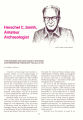
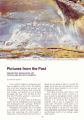
Show Dr. Douglass and the Talking Tree- Rings HIS CALENDAR OF WOOD IS USEDTO DAf E ANCIENT INDIAN SITES IN THE SOUTHWEST BY DAPHNE OVERSTREET In the summer of 1901, during a trip by buckboard through northern Arizona, Dr. Andrew E. Douglass began to hear the trees " talking." It was just a hunch at first - an idea he had that the pines and firs he was passing through might be like living books, jotting down records of how they passed the time. A tree's job is to grow, Douglass reasoned. And in the Southwest the most important event in a tree's life is the amount of rain that falls. Since the pines and firs put on one layer of growth each year, Dr. Douglass specu-lated that in wet years, this growth Iayer, or-tree- ring, should be much wider than a ring put down during a year of drought. If his ideas were right, then one could " read" the messages written about weather during the life of the trees. Trees, then, living in a particular geographical area, were ca-pable of providq a long calendar of rainfall, one ring for each year, that predated any written records kept by man. These ideas that bubbled in the mind of 34- year- old Douglass were the foundation of a new science he was about to pioneer. Later he called the science dendrochronalogy, which means " tree time" in Greek. What he did not know then was that his idea of building a tree- ring calendar would eventually be used for reasons other than studying the weather. His new method would DR. WUGLASS IN HIS OFFICE AT THE LABORATORY OF TREE- RING RESEARCH, UNIVERSIT'r ui ARIZONA, IN THE LATE 1840s. PHOTOGRAPH COURTESY OF THE LABORATORY OF TREE- RING RESEARCH. 8 be used by archaeologists to date ruins and prehistoric events all over the world, but most notably in the American Southwest. Dr. Douglass wag a relative newcomer to the West in 1901, when the trees began to speak to him. He was born in Vermont in 1867 and later studied astronomy in Connec-ticut. When he graduated from college in 1890, he joined a graup of Harvard astron* mers on an expedition to Peru. There they studied Mars from a lofty peak high in the Andes for three years. It was after the Peruvian adventure that Douglass came to Arizona at the request of the famous traveler and financier Percival Lowell, who wanted to establish an observa-tory. Lowell selected the " cool pine oasis" of Flagstaff, Arizona, for the observatory and put Douglass in charge as soon as it was built. For seven years Douglass researched dili-gently under the white dome. But his own interests about sun spots and their effect on weather caused him to look outside the observatory for answers and in-formation. This interest and curiosity Ied him to consider the " talkative pines," as he called them, and the stories they could tell about the years of rain and drought. In 1902 Douglass ran for probate judge of Coconino County. He set off in a buckboard to campaign in the small towns and lumber camps. During his trips through the wilder-ness he would often stop, tie up the horses, and examine the ring patterns of a felled tree in the forest. News of his interest in bee- rings spread through the logging camps, and lumberjacks saved choice stumps for the scientist. In each camp a group of men knotted around Doug-lass and listened to him explain what he saw in the specimens. The election was a landslide in favor of Douglass and he was later reelected. For the next few years, when he was not busy in the courtroom, he could be seen at the Arizona Lumber and Timber Company in Flagstaff, his nose pressed against a log and a hand lens to his eye. Then in 1906 Douglass joined the faculty of the University of Arizona in Tucson where he taught and did research for 55 years. There he pursued his two interests in a lab-oratory where astronomical instruments and treering specimens sat side by side. It was in 1923 that Dr. Clark Wissler of the American Museum of Natural History asked a question on behalf of archaeologists that opened up a new field in dendroehrs nology. Was it possible to build a tree- ring calendar to find out the occupation dates of prehistoric ruins? he asked Douglass. Though archaeologists in the Southwest knew a great deal about the ancient Indians who lived in placed like Mesa Verde and Pueblo Bonito, the tribes left no written lan-guage and no calendars. The archaeologists faced a dilemma. They had truckloads of pottery and prehistoric tools, but they could not determine the occupation dates of the southwestern ruins. The archaeologists strongly suspected Douglass was more interested in sun spots than the age of old ruins, but they asked him to help them find an answer. He accepted the challenge and six years later the Southwest had the most precisely dated prehistory of any area in the world. Douglass began by telling the archaeol* gists that he would have to know more than what living trees could tell if he was going to build a long calendar, or chronology. Speci-mens from living trees usually pushed the calendar back only a few hundred years, but the ruins were much older than that. " When we reach the earliest date which the oldest weather recording tree can tell us about, it becomes necessary to search for roof beams that have been cut and used by man before the now living trees took up the story," Douglass explained. After the beam samples were collected, Douglass said the ring series from the beam WIDE AND NARROW RINGS IN THIS DOUGLAS FIR SPECIMEN HELP DENDROCHRONOLOGISTS UNDERSTAND PAST WEATHER PATTERNS OR BUILD A CHRONOLOGY FOR DATING RUINS. PHOTOGRAPHS COURTESY OF THE LABORATORY FOR TREE- RING RESEARCH. ce, and btatakin. ad even c0Uecte- d ed remainders of at & I1 retained erne " floated" +-@ t ~ U M a n dga d waited for Draudas to """' Y th& infst~ rqo nce and for all. otlglmit md Ms assidants decided lo . ed 1 of a roof timber with Ms shovel. 5 B& d& thi3 chronology, DauglaBs 11~ u - Meid, Bwglass dashed we^ fh mb-wkat h7ca11ad . a '" floating prehista'rlc w,;- ca& fidly ' bobd ths fragile piece in : sC:" r; ng to' keep if" fr& flaking" eqn huii t bay crossdathg 4 $ end he w& mined the find. Through-ltloexa studied his specheo. I.' - " - 3 - - . , .*-+ "- "- ; yfl:+ " ; $ -- A; >^ ** ? A*> extracting every bit of information it held. Then after dinner he was sure of the answer. He sat at a small table lit by a hanging gas lamp. Four archaeologists clustered around him. " I think we have it," he said caMy. Then with characteristic dignity he related the exact occupation dates of the 40 major south-western ruins. His work was a milestone in archaeology. Not only had he turned time back on a grand scale, but he had built an unbroken weather record 1,200 years long. To this day Douglass's tree- ring system is used to date the ruins left by ancient people. The University of Arizona established a tree- ring laboratory in 1937 where Douglass served as director until 1960 when he retired at the age of 92. It is the one facility of its kind in the world dedicated only to tree- ring studies. Today Douglass's work is carried an by a small group of scientists and researchers who are developing new techniques to under-stand and interpret better the language of trees. Though beering information is still being used to date historic and archaeological structures, scientists have been developing new uses. Today tree- rings are used to date geological events in watershed and hydrolog-ical studies, in forestry and botany, and of course for information about climate. Shortly before his death, Dr. Douglass wrote in a letter to a friend, " I believe I have found the cause that profoundly affects droughts and floods. I feel confident that it will be possible to predict these generations ahead, but there are some very complex de-tails that will take immense calculations." Douglass died before his finaI break-through. It is for the next generation of scien-tists to build on his tree- ring work. The study of tree- rings is still quite new, and there are many discoveries and applications yet to be found. What else can trees telI us? In what new ways can we use tree- ring information? The challenge is yours. Ms. Overstreet is associated with the Laboratory of Tree- Ring Research, University of Arizona. Tucson. 1930 1920 1910 19031890 THE RING PATTERNS MATCH AND OVERLAP BACK INTO TIME A A. This tree was cut whlle still living A @ ; f ! l ( t i - ; ' 4' IA e l c I I t ! , . i , q ~ C. This beam c@ a. ( r ! ilc came f rom an older house D@! E I - ( . : : IJD €@ , * 1 , . , , ' I] E Specimens taken from ruins, when matched I CHART SHOWS HOW ATREE- RING CALENDAR CAN BE MADE BY OVERLAPPING OLDER AND OLDER WOE SPECIMENS. BASED ON STALLINGS AND JENNINGS. |