| OCR Text |
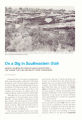
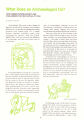
Show What Does an Archaeologist Do? THIS CAREER OFFERS VARIETY AND CHALLENGESTHAT MAY APPEAL TO YOU BY JANETG BUTLER Archaeology! The word evokes images of Egyptian tombs full of mummies and priceless gold jewelry. Or skin divers bringing up ancient treasures from sunken ships. Or a simple Bedouin shepherd stumbling across caves containing the precious Dead Sea Scrolls. Right? Partly. It all has to do with the definition of archaeology and with the person who is practicing it. An archaeologist is, first of all. a scientist. His ( or her) subject is the study of past human life and activities as determined from artifacts. objects made by man or natural objects modi-fied by man for his use. So. Egyptian tombs and Dead Sea Scrolls are worthv of archaeo-logical studv. But these are spectacular finds. Most archaeologists will never uncover any thing that valuable. Everyday work, especially in thls country. usuallv uncovers pieces of pot-tery or arrowheads, often few and far between. And an archaeologist, although he may be adventurous, is primarily a scientist more con-cerned with careful digging and accurate records than with making newspaper headlines. One part of the job of this scientist of the past is to find artifacts made by men of earlier times. Another is to record these items in their context - the order in which they are found and the other objects around them at the time. And. finally, the archaeologist must study all the artifacts and try to understand the type of life lived by the people who made them. If you are interested in the past. or in people of societies other than your own, or in sciences like geology, botany, and zoology - then, archaeology may be the career for you. To become an archaeologist you must be a well- rounded and educated person. You need to have a good understanding of history and of the area of the world you are studving, the natural environment, dating methods, even photographv and artwork. Your office mav be anywhere from a dustv desert to the mountains of Peru. So. vou must be versatile and able to live in uncomfortable surroundings. Are vou still interested? Then let's find out how to become a professional. JRTON Archaeology is part of the field of anthro-pology. the study of man in general. Anthro-pology, in turn, is one of the social sciences. Take as many courses as you can in high school in the social sciences. Learn about people. If you are lucky. your hgh school may offer a course in anthropology - take it. The 22 HIGH SCHOOL VOLUNTEERS HELPED WITH THE SALVAGE DIG CONDUCTED BY THE STATE ARCHAEOLOGIST AT BACKHOE VILLAGE NEAR RICHFIELD. OPPORTUNITIES LIKE THIS HELP STUDENTS DECIDE ON FUTURE CAREERS. peoples of the past were closely involved with their natural environment. So. learn about geology. botany. zoology. even ecology, if you can. All this background will give you a head start in college. Most colleges or universities offer a bachelor of arts or a bachelor of science degree in anthropologv. When vou earn this you will have taken courses in the social sciences, anthropology. archaeology, languages, and the earth sciences. But you can't stop now. Professional archaeologists need their master's degrees and probably their doctoral degrees as well. As early as ~ ossiblein your career, decide on your specialty and choose your schools accordingly. You may be interested in a partic-ular area of the world like the Middle East or the American Southwest. Or, you may choose a special field such as salvage archaeology or modern archaeology. Each college or university 23 has professors who have specialized in an area or field of archaeology - follow their footsteps. The faculties of some schools include special-ists from many different fields, from linguistics to history. Choosing a school like that, which also has a good anthropology department, will greatly broaden your background. Apply for as many scholarships and fellowships as you can. starting in high school. The more honors you win the better quality university you cap hope to attend. Often, through your university, you will be able to attend field schools during the summer. Go on excavations or digs if you can. See what being an archaeologist is all about firsthand. Occasionally, high school students may partici-pate in the summer digs. But take your jeans - this is a working vacation. When you have graduated with a doctoral degree naming you a professional scientist, where will you work? Some archaeologists . . RTt.. .- - . - - - E WEIGHED TO ONE. - - -. - 8UREMEl. -, . _ . . , , TENTH OF A GRAM ON A METTLER ELECTRONIC PART THE COMPLETE DESCRIPTION OF , . BALANCE. ARTIFAG rs. ' PRO4 FUTILE POINTS ARE SORTED BY TVp. ~ A WWZ LE - WREFW LARGE BLACK MINT AT ' IDP W& S. MADE BY AN PIECEUTaGETMER AND |