| OCR Text |
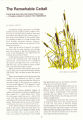
Show The Remarkable Cattail FOOD AND SHELTER FOR PREHISTORIC MAN - POSSIBLE ENERGY SOURCE FOR TOMORROW BY THOMAS J. ZEIDLER It is known as flag, reed mace, and Typha latifolia. but its common name is cattail. It can be found in marshes and by shallow lakes and skeambeds throughout Utah. Most people, if they think about cattails at all, consider them as something to hide in or wade through while duck hunting. American Indians, however, have recognized cattails as an important food plant for centuries. This is not as odd as it seems if we remem-ber that both corn and potatoes were strange and exotic plants to the first Europeans who came to this hemisphere. Yet, today both are common fare on dinner tables. In the spring young cattail shoots can be cut from the rootstmks and. after pulling off outer leaves. can be eaten raw or in salads. If the shoots are longer than one or one and a half feet, they can be boiled for about a half-hour and eaten with butter and salt. When the flower stalks appear later in the season, they can be removed fromtheir sheaths and boiled. They can then be eaten like ears of corn. When more ripened, the pollen- producing flowers can be removed by hand to make muffins, cookies, and pancakes ( see below for pancake recipe). If the flowers are roasted in an oven at 350 degrees F. ( 1 75 degrees C,) until completely dry, they can be stored in a dry, closed container. The Paiute Indians gathered baskets of pollen in the summer to make a breadlike food they cooked in a " cattail dutch oven." They first laid green cattail leaves on a bed of hot coals. Then they made cakes by mixing the cat-tail pollen with water and put the cakes on the leaves. More green leaves went on the cakes, and these leaves were covered with hot coals. Fall is the best time for harvesting the root-stock of the cattail. After the outer peel is Te-moved, the core can be baked or boiled, If the cores are dried, they can be ground with a mano and metate to make flour. One scientist ARTIST: BRENT SHAW FOSTER has figured that one acre of cattads could pro-duce two and a half tons of flour! Rodents, especially muskrats, thnve on cat-tails and were often happed and eaten by Indians. In fact, the Gosiute word for cattails To imp means " rodent plant." The Gosiutes gathered the ripe spikes of the cattail and burned off the bristles, thus freeing and roast-ing the seedlike fruits. Archaeologists found that the cattail was an important food source for ancient Indians as well. The excavation of Backhoe Village near Richfield. Utah has shownthat the gather-ing of wild plants, especially cattails, was more important than hunting or agricui ture as a food source for the Sevier Indians who lived there more than one thousand years ago. The cattail was also used for purposes The following recipe appears in Edible nfood. Thecattail" dawn" co~ ldbe NativePlanEsoftheR~ M0untaiolsbyH. D. tamn orr the spikes and used far padding in Harrington: blankets and pillows. The Paiute Indians used twisted cattail leaves to make rope for building Cattail Pancakes small boats and duck decoys. They also used cattails for matting to cover their willow- frame cups pollen ( or houses. Cattail leaves were especially favored 2 cups wheat flour because their flat surface sheds water like 4 teaspoons baking powder shingles. 1 teaspoon salt Today, scientists at the University of Mi- WF sota are studying cattails as a possible source % cup evaporated milk of energy. A team of botanists and mechanical ' CUPS Water engineers found that processed cattails pr& syrup duced a solid charred substance, a liquid like drippings heavy oil, and a gas. It is hoped that these can Beat eggs, add milk, water, and syrup. Mix be harnessed and converted into energy. It is and add dry ingredients, beating until mixture even possible that someday in the future we is creamy. Add bacon drippings. Fry in a hot may be heating our houses with the same plant greased pan over the campfire. Makes a bout that the Paiutes used to cover theirs. 20 cakes. |