| OCR Text |
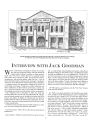
Show Though Goodman's subjects are usually from Salt Lake City or along the Wasatch Front, buildings in rural Utah, such as the Panguitch Social Hall, also catch his eye on occasion. INTERVIEWW ITH JACK GOODMAN hat would Sunday mornings be without the newspa-per, and what would the Sunday Salt Lake Tribune be without Jack Goodman's musings on things architec-tural? His " City View" column has been a weekend favorite with readers since it debuted in 1984. It's architecture, history, reminiscence, and personal opinion rolled into one. And it's always illustrated with a made- to- order drawing by Goodman's own hand. Over 600 columns and he's still out there sketching. Goodman's column has generated a heightened awareness of Utah's built environment. People who wouldn't otherwise care about architecture, let alone historic preservation, read his col-umn. And just maybe they start to pay a little more attention to the buildings around them and the quality of their communities. Jack Goodman, born in Brooklyn in 1913, has lived and worked in Salt Lake City since the end of World War 11. His pas-sion and formal training is in art, though he has spent most of his career in journalism. In addition to writing for the New York Post and the Salt Lake Tribune, his articles have appeared in the New York Emes, Newsweek, and the Saturday Post, and he has worked in radio and television. Utah Preservation recently interviewed Mr. Goodman to learn more about the making of his opinions and articles. litah Preservation: When did you first become interested in architecture? Jack Goodman: I think it was back when I was about 14 years old. A couple of high school buddies and I used to walk all over Brooklyn looking for old Dutch houses or buildings that didn't look like the buildings in our own neighborhood. I think one of my first watercolors was of an old Dutch farmstead in Prospect Park. I knew nothing about how buildings were produced, and I don't think I even knew that there were such people as archi-tects until almost college. Though I sketched some buildings as part of my art training, I usually drew people. And, I have to admit, I was always more interested in ships than buildings. UP: What led to your starting to write the " City View" column in the Salt Lake Tribune? JG: Well, it was almost accidental. I'd retired from any steady work, though I was still freelancing a bit, and was walking down the street one day, it must be 12 or 15 years ago, and I encoun-tered Jack Gallivan; I think he had retired as publisher of the Tribune by then. Anyway, Jack said, " You know, every newspa-per nowadays, every big newspaper, seems to have an architec-tural critic columnist." I said, " So why don't you get yourself an architectural column." He says, " That's the trouble. We can't find anyone to write it. Architects are like doctors." ( Which I had never known.) " They consider themselves professionals who will not criticize or talk about another architect." Then Jack looked at me and said, " Hey, you went to art school. Do you know anything about architecture?" I said, " In a vague, amateurish way." He said, " Why don't you do it?" UTAH PRESERVATION I I And I got a funny notion. I said, " I'll tell you what, if you let me illustrate it 1' 11 try it." UP: How do you select subjects for your column? JG: I come down to the Historical Society and ask, " What's going on?" I also go up to the Heritage Foundation, which has annual or semi- annual tours and find out what they're going to be looking at and try to anticipate that. Most of the time, or at least in the earlier years, I'd drive up one street or down another and, " Gee, there's a handsome house or a decrepit house or that's an oddi-ty of an Italianate style." It's a very hit- and- miss column. I'm not very scientifically minded. The Tribune never tells me what to write. In the beginning I only did specific buildings, but lately I think I've tended to push a little bit toward things such as city planning and zoning. UP: How do you go about actually drawing and writing about your sub-ject buildings? JG: I always do the drawings free-hand, though I do use a T- square at the start to make sure my vertical change if it's work-ing? Then I just lines are vertical. Usually I start with a light lead pencil, sketch the building, then I go over it with a ballpoint pen. You can't shade too well with a ballpoint pen, so I finish it with a lithographic pencil or china- marking crayon. The whole thing takes me about an hour. In good weather I work from the tailgate of my car. I was very partial to Jeep Wagoneers, though they don't make them any more. The rea-learn more about it. 99 become more aware over the years. I don't think it's me JG: I'd hate to see them tear down Brigham Young's Lion House and Beehive House. They're almost the only buildings here that remind me of some of the historic buildings in New York or Brooklyn. I also like the Kearns Building [ on Salt Lake's Main Street] and all the old campus build-ings up at the 17, you know,, on the cir-cle. It's a pretty darn good campus. son I liked them " I guess I was UP: What do you hope to was their tailgate accomplish with your arti-came down flat and cles? had a kind of uphol- surprised at stery on it; you JG: The general goal is to could sit on that. I what we thought get people to look at buildings now have a Ford and think about them and Explorer. I can sit maybe to explain a little bit on it but it's not too WaS worthy about style and what archi-comfortable. tecture is. I don't really have I still use an old of presemation an axe to grind except trying typewriter. Maybe to keep the city alive down- I'll switch to a town and stop spreading out computer some- ~ ntit1! began to into the hinterland. And I day, but why think maybe people have send everything off exactly. I think people have UP: Do you consider yourself a preservationist? in a manila envelope. I've only had one drawing- lost in the mail. UP: Do you have a favorite building in Utah, one you would be especially disappointed to see demolished? JG: Yeah, I guess so; I've never used the term. But I really think there are many, many handsome, well- built buildings that should not be torn down. When I first got here I remem-ber being somehow shocked that, " Gee, they're trying to save such and such a building on Main Street; it's only a hundred years old." All of downtown Brooklyn or Brooklyn Heights dates to about 1800. I guess I was surprised at what we thought was worthy of preservation until I began to learn more about it. been reading editorials or pieces about growth in the suburbs and disasters in downtown neighborhoods. I think that has gotten them to thinking more of buildings and city planning. UP: That's probably true of about everyone. We're just lucky to have you around to enlighten us. Jack Goodman sketches most of his subjects from the tailgate of his car. |