| OCR Text |
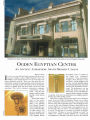
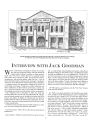
Show Designed by the Ogden architectural firm of Hodgson & McClenahan, the theater is Utah's best example of the exotic Egyptian Revival style. Margaret Marti I fever it were true that the whole is greater than the sum of its parts, it applies to today's Ogden Egyptian Center. The building is more spectacular than even its most ardent sup-porters dreamed it would be. There was a time when they rec-ognized they would be moving mountains if only the facade were restored. Or the hideous pink walls painted. Or the atmospheric ceiling were lighted again. But these people moved more than mountains. They moved volunteers, construction companies, organizations, govern-ments - all in the same & tion until the Ogden Egyptian Center became reality. " I think I fully reali~ Rd what we had accom-plished at the Egyptian while I was attending Utah Musical Theatre's ' Secret Garden'last sum-mer," says Bernard Allen, an Ogden attorney who served as president and 10%- time board member of the Egyptian Theater Foundation and as a member of the Ogden City Landmarks Commission. " That performance brought it home. We had our nine and twelve year- old daughters with us. They were like butterflies fitting about the beautiful theater, enchanted with the whole atmosphere and expe-rience. The performance was top quality. The theater was nearly full that evening, yet it was beautiful, inti-mate, the sound was great, everything was perfect. At the end of the performance, my daughters leaped to their feet, part of the standing ovation." Allen knows well how far the project had to come. During his tenure in the late 1980s, the Egyptian Theater was a forlorn piece of Washington Boulevard real estate where people would break in, sleep, and occasionally set fires. The mortgage payment was met by the sale of Egyptian Theater t- shirts sold from the trunk of Allen's car. The taxes simply went unpaid. Even so, for him the early vision was always " yes, the building was going to be saved." The plan then was to make it once again an operable movie theater. " Perhaps we erred in thinking too small," he reflects now. Simply saving the building was a monumental accomplishment. Although it had been named to the National UTAH PRESERVATION Register of Historic Places in 1978, it was closed December 1984 for health violations. Its owner offered it for sale vvllile he procured the permits for demo-lition. " We'll do whatever it takes to pre-serve the theater," said Van Summerill, who works at Weber State [ Jniversity and is a former doornlan, projectionist aid assistant manager at the theater. In fact, he was to say it over and over dur-ing the next few years as he became the-ater's most dedicated volunteel; histori-an, preservationist and spokc>: p4 erson. " I think Ifu1& In his first lettcr to the edi-tor of a local newspaper, call-realized what we had ing- elr the organization or Friends of the Egyptian, accomfilished at the Suinmerill said: "... the Ogden Egyptian while I was attending Utah Musical Theatre's ' Secret Garden,' and Paramount ( originall) Alllambra) thcuters were destro) ed in the name of progress. The sites of both structures rein. clin as parking lots today. The 1890 Orpheu~ n Theatre ( originall) the Grand Opera house) came to an undignified demise a short time ,@ o... ilnd is a parking lot as last S U ? ~ W ~ Y - " well. The threat of [ the Egyptian] ending up a pile of rubble ... is a very real possibility. I cannot nor will not permit this to happen." A miracle was needed to save the his-toric movie Iiouse. The building's ott- ner, who had been cooperating with volun-teers' efforts to clean nlld rehahili~ dtet he building, found a buyer who wanted to save the facade but make the auditorium into an office building. The Friends had 15 days to respond and they needed about $ 300,000. Althougl~ t he buyer did-n't materialize, the threat was enough for the Friends to keep alive an active public awareness campaign. Summerill's opin-ion that the building was " as strong as a . of Peery's yptian Theater .' , UTAH PRESERVATION battleship and is readily restorable" was supported by a feasibility study commis-sioned by a local citizens group. They estimated more than $ 1 million was need-ed to restore the Egyptian as a site for stage productions and movies. In 1988, again threatened with only days before the owner was expected to receive his demolition permit, a coalition of private groups and donors purchased the Egyptian Theater through the Weber County Heritage Foundation for an undisclosed amount in excess of $ 200,000. The first payment of $ 100,000 was met but finding the money for the second endangered the deal, and new estimates were that restoration would cost $ 2 million. Nonetheless, the theater had been saved from the wrecking ball by a spirited, tenacious few who refused to allow it to end up in the county landfii. Adopting the attitude that the public needed to know " those people were not going to go away," the Egyptian Theater Foundation ( a restructured Friends of the Egyptian) organized volunteers to clean up and restore the facade. The deteriorating marquee was removed, the roof repaired and plywood store fronts were painted with Egyptian images. Looking back over one's shoulder, it may well have been the failure of the $ 2 million bond election in October 1989 that preserved the theater. Until then, the focus had been on raising monies to I and locks were replaced. restore the theater. In a separate ballot It was White who moved the project to item, funding was sought to make a con- a larger scale. His second goal was to ference center at Union Station. Out of raise grant and gift money to sustain the the failed election evolved the combina- building, a job that consumed him for the tion of theater and center to become what next eight years. Today when anyone it is today. For one thing, the bond elec- explains. the complex route the center tion attracted statewide atten- took to existence, White is cred-tion to the building. About this ited with having the vision and time, the Utah Heritage " We'll do the energy to make it happen. Foundation was able to point to " We'd put on our neckties and the successfuI restoration of the whatever meet with anybody who'd lis- Salt Lake City and County ten," he says. But it was the Building, making it easier to it takes to appropriation of $ 200,000 from imagine a restored Egyptian. the 1991 Utah Legislature that UHF placed the Egyptian on its preserve the opened opportunities for the " endangered" list which gave foundation. With that money, the project critical credibility 99 the existing debt was paid and and support. Equally important, the foundation purchased adja-the failure of the bond election cent property. Headlines in made the Egyptian a cause for Rob White I July 1991 read " Theater foundation and Diana Ellis. Together, they devoted 1 repays loan, buys lot." most of their next eight years to making the dream a reality. The day after the failed bond election, businessman White became president of the foundation. Faced by a community that believed the building would have to be tom down. White's first move was to This same legislature established a county option tax on prepared food - the " restaurant tax" - which would net Weber County an estimated $ 800,000 annually. The downtown conference center concept resurfaced when county commissioner and former legislator pay the back taxes, getting the Egyptian Lowell Peterson suggested making the off the deadbeat status. " He taught us two projects one, to be supported with how to be a good neighbor," Allen says. half the annual revenue of the new tax. White saw to it the sidewalk was shov- " The conference center idea laid the eled, broken windows were boarded up, I groundwork for the partnership that The attached conference center complements the architecture of the historic theater and provides much needed convention meeting space. 2668 Grant Avenue Ogden, Utah 84401 Sanders Herman Architec[ s ( 801) 621- 7301 fax ( 801) 621- 1091 email: sharch@ ns. cyber- west. com 1 oused in a renovated bottling works in downtown Ogden, Sanders Herman HA rchitects has quietly produced buildings noteworthy for their sensitivity to their unique circumstances and challenges. The breadth of SHA's work- art centers, homes, offices, schools, stores, courthouses, churches -- is in part a reflection of the firm's recogtuzed ability to find the essential issues of any project and create a wholly unique set of solutions for it. Founded in 1976 by president Michael Sanders, SHA has compiled an impressive body of architectural preservation work, including the recently completed Egyptian Center in Ogden. This $ 22 million conference center and movie palace restoration, designed in association with Fentress Bradbum of Denver, has been recognized with state, national and international awards. The result, in the words of one awards jury, " is a wonderful restoration with harmonious restraint exercised in the addition while still exhibiting the art modeme periods spirit of fantasy." The Utah Trunk Factory, winner of a 1997 Utah Heritage Foundation Honor Award, was a long neglected building located in the heart of Ogden's 25th Street Historic District. The heavily damaged fabric of this small commercial building was carefully stitched together with new elements to make it a whole and integral piece of the historic street wall. The interior was adapted to reflect the traditional planning of side- by- side retail bays, yet expressed in contemporaty materials and detailing. SHA has also led the preservation efforts on 25th Nicholas Market, Ogden's Old Post Office Building, and the rehabilitation and expansion of the historic David and Bertha Eccles Mansion, home to the k l e s Art Center. SHA is also the architect for the $ 17 million renovation of the Val A. Browning Center for the Performing Arts on the campus of Weber State University, to be completed in early 1999. Currently, SHA is providing architectural studies for the proposed Intermodal Transportation Center feasibility plan, a cornerstone to Ogden's gateway district and a link between the city's .. many exceptional historic railroad buildings. SHA's approach to preservation mirrors its environmental approach to all the design work it performs: careful attention to the impact their buildings have on the natural and manmade environment. " Preservation not only maintains critical pieces in the urban landscape," according to Bob Herman, " it is also the easiest and most cost effective approach to environmentalism. By saving buildings, you are reducing expense and waste associated with starting from scratch." This approach not only fuels Sanders and Herman's preservation advocacy, but has also been employed on new buildings like the Ogden Nature Center, which is built almost entirely of redwood and fir timbers salvaged from the trestles of the historic LucinIGreat Salt Lake cutoff west of Ogden, " We are very patient, which helps us find the most appropriate set of responses for very challenging projects," says Mike Sanders. " Where some designers may see one idea, we make the effort to find many." It is this effort that makes the designs of SHA uniquely suited to the special needs of each and every project. The Utah Trunk Factory, built in 1915, was restored in 1995. UTAH PRESERVATION C;;. , - " Crvc built it," White explains. Coincidentally, Weber State University was exploring possibilities for a performing arts center. The Egyptian Theater Foundation formal-ly joined in an active coalition with Ogden City, Weber County and WSU, establishing the hasis for today's gov-erning board. The groups, along with the Ogden- Weher Chamber of Commerce, became the partners who built the Ogden Egyptian Center, a cir-cumstance deemed unique by outside observers who witness preservation projects across the country. The Ogden Egyptian Center was cited as " a classic example of a public and pri-vate project" by Richard Moe, presi-dent of the National Trust for Historic Preservation, during his visit in 1995. But not everyone supported this cooperative plan. Opposition to using the restaurant tax ran loud and high. Volumes were being written in the Ogden Standard Examiner - news stories, f~ ill- pagec olumns of editorials, letters and more letters to the editor. " The pyramids took a little while, too," ; designc ommodate live performan White said in his own public letter, where he assured readers that the Egyptian was not going to be torn down and identified the reasons why. What had been merely a vision became a blueprint, complete with pro-jected operating costs being weighed against revenues. Design and con-struction teams were named: Ogden's Sanders Herman Architects directed the team of Denver- based C. W. Fentress J. H. Bradburn, the center's architects; Conrad Schmitt Studios of New Berlin, Wisconsin, the restoration experts; and Ogden's Big D Construction team led by Rob Moore. In an effort to make the Egyptian the city's centerpiece and its spiritual heart, a fund drive for $ 6.2 million in private funds was launched with Diana Ellis and White at the helm. " Neither of us had ever done anything like that before," Ellis says. " We began certain we could do it, and when it got tough, we knew we could not let go. So many people were working together to see it through; so many were ' believ-ers."' By this time, Ellis was president of the Egyptian Theater Foundation, a position she held throughout the process of huilding the center. The keystone in the drive for pri-vate money came in a $ 2 million chal-lenge grant from the George S. and Delores Dore Eccles Foundation. Announcing the support on a February day in the foyer of the tst-tered, unheated Egyptian Theater, Spencer Eccles gave the Ogden com-munity until Pioneer Day, July 24, to raise a matching $ 1 million, all for a project which had been declared folly and a few years earlier had been receiving no donations. Eccles said he anticipated the convention center would help return the city to " its glory days" he recalled from his youth. Fortunately, times change and the goal was exceeded by some $ 200,000, rep-resenting gifts from about 400 people. To pay the public's bill, a divided Weber County Commission voted to bond for funding, bypassing a public vote. Although their decision guaran-teed that the center would be built, opposition once again surfaced. This UTAH PRESERVATION time 10 citizens filed a lawsuit calling for a referendum. The matter was tossed out by Judge Mike Lyon after a few months, during which the cost of construction rose from $ 16 million to $ 20 million. In this election year, as in others before and after, political careers were being staked- and some-times lost- on positions surrounding the conference center. As 1994 ended, the demolition of buildings to provide space for the cen-ter was making news. " This is a very unusual owner," said Moore, indicat-ing the steering committee represent-ing public and private interests with whom he worked in clearing all deci-sions. White, Ellis and Summerill joined with the engineering and architectural teams, city staff and council members, county commissioners, Weber State University and the Chamber's Ogden- Weber administrators to guide the process of restoring the historic theater, reviewing all preservation considera-tions with the Ogden City Landmarks Commission and the Utah Division of State History. " You know you have succeeded when, in the end, everyone wants to take credit for it," says Ann Millner of Weber State, who skillfully facilitated the endless meetings among " owners." The team's job was to assure the functionality of the historical building in today's high- tech world. Simultaneously, a magnificent confer-ence center was being wedged between the theater and the stately, still- empty Eccles building. Simply storing materi-als beside two busy city streets added to the difficulties. One of their major tasks - as if saving the theater were not enough - was to assure that the con-ference center neither dominated the Colorful terra cotta details accent the facade and interior. smaller, historic building nor appeared to be a garnish added to it. " By its very nature, the members of the community- based project team had multiple agendas. It was my job to tag the issues and determine who needed to be in the room to work through the problems. Nearly every-thing became an evolutionary process. I think we succeeded wonderfully in retaining the integrity of the historical theater as well as meeting the diverse needs of the users." The result - and there's no call to be modest about it now - is that the $ 23 million center weaves the old and new together in a seamless and rational manner to make a new downtown. It's no surprise that the Egyptian's themes echo in the new structure, especially in the asymmetrical, curvi-linear design of the multi- tone sand-colored walls. What is a surprise, and was quite deliberate on the part of the architects, is the blatantly borrowed Art Deco lines and colors from other prominent local buildings such as Ogden High School, the U. S. Forest Sewice Building and the Municipal Building. The exterior of strong hori-zontal bands of limestone and brick-work blend easily and graciously with the theater and the urban landscape. By the end of 1997, the center was responsible for a new spirit in down-town Ogden. The schedule included everything from Ballet West to corpo-rate conferences and high school proms. Allen reflects what others have felt in telling about his UMT experience: " We spilled out onto the late night streets of Ogden with more than 600 culturally enriched citizens. The brilliant and beautiful theater glis-tened in the night, replacing what once was a dark and dreary stretch of downtown Ogden. I felt so proud of my town and an immense gratification for everyone who had contributed to the completion of this project." *:* Margaret Marti is a wordsmith by pro-fession and a preservationist by heart. She serves on the Egyptian Theater Foundation and is a member of the Weher County Historical Foundation. Hansen Quality Stone Quarries: 6600Qr ualily comes Natllrally'' Hansen Quality Stone Quarries 8809 South 700 West Sandy, UT 84070 C ontinuing the tradition of " art beyond craft" begun by his grandfa-ther in 1935, Wes Hansen, owner of Hansen Quality Stone Quarries , likes to say that " our quality comes naturally." Hansen Quality Stone Quanies does its own quany-ing from eight Utah sites, including the original Pioneer Quarry. Choice cuts of GTE Headquarters, Dallas, TX; the Little Red Courthouse, Dallas TX; the John Moran Eye Center; and the Deaf and Blind School in Colorado Springs. Hansen's work on the Salt Lake City- County Building restoration spans a peri-od of more than 17 years. The range of masonry work has included structural cor-rections, reconstructive cosmetics, dupli-cation of ornament and imaginative inter-pretive work. Burtch Beall, architect on the project for many years, says of Wes Hansen and his shop, " Wes has become a creative artist in areas where stone detail was so eroded that there was no way to reconstruct an image of its appearance, and sculptural interpretation was essen-tial. The building was originally designed and constructed by artists who produced images interpretively. Wes was able to make composites that restored life to the ( 801 ) 255- 291 1 Fax: ( 801 ) 562.9597 stone include red, buff and pink sandstone from southern Utah, two gray and tan sand-stones from eastern Utah, Manti limestone and Utah granite. Among the many build-ings for which Hansen has provided the stone are the Salt Lake LDS Temple annex and chapel; the restoration of the Cathedral of the Madeleine; the Hogle Zoo; the Devereaux Mansion; St. Mark's Cathedral: 14 structure, by what amounts to an artist's study of the styles and sculptural detail." Both a skilled artist and a dedicated crafts-man, Wes Hansen unequivocally stands behind his stone and his stonework. During its 65 years of quarrying, fabricat-ing and carving, Hansen Quality Stone Quarries has consistently placed the needs of its customers first. |