| OCR Text |
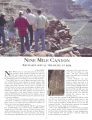
Show ARCHAEOLOGITCRAEALS URE AT RISK Luy~ ylze Millel-ine Mile Canyon is attracting tourists in increas-ing numbers. Each summer, people from all over Utah and, indeed, from around the world visit there. The past fivc years have been very trying as a group of dedicated people has worked to preserve this treasure. Nine Mile Canyon is one of those rare spots where his-tory and prehistorq- corue together in grand fashion. Add easy access, promotion by the local county officials and rapidly increasing visitation and ~ O L Ih ave a f o r m ~ ~ floar trouble. Rock art styles and archaeological evidence indi-cate the canyon has been used as home as well as a thor-oughfare by Indians and other settlers for thousands of years. Researchers have found Barrier Canyon, Desert Archaic, Rasketmaker, Fremont and Ute Indian rock art styles ill the canyon alongside axle grease signatures made by historic freighters. The clilfs arc home to hundreds of Indian ruins, and the valley floor is still home to hard working ranchers growing their crops on the land ~ rsed by prehistoric Indians for their corn, hems and squash gardens. A Bureau or Land Management ( BLM) archaeologist has esti~ nated there are, conservatively, 10,000 archaeo-logical sites in Nine Mile Canyon. Carbon County, using small mat. ching grants from the Division of State History, has been inventorying the canyon's historic and prehis-toric resources, spending ten days each year with ten to 20 volunteers. The survey has cov-ered only four miles in nine years and has documented more than 800 sites in the 40 mile canyon. Local residents are con-cerned that the canyon may be loved to death and that it is sometimes abused by those not aware of the valuable resources it contains. The ELM estimates between 100 and 300 cars visit the canyon each day. On Easter this past spring, over 600 cars visited the canyon just on Saturday alone. Five years ago a group of us went to the BLM to find out what it would take to build a public toilet in the canyon. We were greeted by a list of " have to's" and " can'ts" and were told we would also have to pay for the requested facility. Not being easily deterred, we plunged ahead as if we kne\ v what we were doing. Five years and $ 70,000 later, \ vork has been co~ npleted on a picnic facility which contains the t\ vo toilets and a pavilion with covered picnic tables. A small amphitheater is also planned. The site contains a historic cahin and work is under\ vay to restore it. & Rock Art Site Etic A uette F. \. I_. 7% 4lgl roups and indivzduals who visit rock art sizes need to r-~ alit~ lzcer t an) I rb1t i ~ noviz clrrr7grr the wch and the ovcmll site. Rock art expert Cluy Johii~ un liaa deveiopuil u llrt oj do's oiid do11 7' s after E.:- na n)) years of studying rock art and rock art sites: 3 % 4 Minimlze thc number of vehicles going to Do not apply any substance including the site. liquid, powder, plastic, cloth, paper, or even strong floodlights, to or over rock art. Stay on existing roads. Do not allow pets, children, or careless Do not pioneer vehicle trails or assoc~ atesto behave improperly around parking areas. the rock art. Do not camp or build fires within one Follow the rules of the 5ite landowner quarter mile of rock art. or public land manager where they are more restrictive than above. Do not disturb lithics, firep~ tsr, o ck arrangements, or other artifacts and Use binoculars to study, and telephoto site feature\. lenses or freehand sketches to record panels and panel details. Study the panel as an At rock art sites. stay on trails where they integral part of the slte. exlst. Do not d~ sturbro cks, vegetation, or microb~ ot~? co il crust. Be constantly aware of the effects of your actions at rock art sites. Make your Do not hike or climb above rock art panels. beha\ ior a model. Speak out when needed to prevent damage to rock art. Where posable, stay at least 10 feet from the rock art. Do not attempt to remove graffiti, chalking, lichen or bird droppings from rock art. ----- -- - . , .,--- - - . I I W~ ZFTINMEI LE)' CANYON? No one really knows how Nine Mile Canyon got its name, given that it's forty miles long. One version Ir redits the nine- member Miles family - seven daughters plus the parents - who reportedly lived in the canyon in the early years. Another more plausible explanation relies on an 1869 John Wesley Powell report. Powell noted that a member of his crew " did a 9- mile triangulation along what was named Nine Mile Creek," one of the creeks running through the canyon. I UTAH PRESERVATION Why is all this necessary? Three words: impacts, impacts, impacts. Toilet paper blossoms are springing up everywhere. Illegal excavations are still taking place on some archae-ological sites, and visitors continue to camp in the green alfalfa fields owned by locals. Local county and travel bureau officials have agreed not to further promote the canyon until there are facilities to help alleviate the impacts. A new canyon brochure will educate and introduce visitors to what makes the canyon special. It is not a ' promotional' piece, nor is it a Local residents are concerned that the canyon may be " loved to death." guide to the canyon. There are I already several guides for the canyon I and this new brochure is an attempt 1 to educate and help visitors under-stand why this is such a special place. The canyon was probably abandoned by about 1100 A. D. Historic Ute Indians left their petroglyphs on the canyon walls, and modern farmers moved in during the late 1800s. By 1905 a freight route had been established by a group of " Buffalo sol-diers," Black soldiers sent to live at Fort Duchesne when the Utes were gathered and sent to the Ute Reservation at the Uintah Basin. Things changed little in the canyon until rock art became a favorite study of many, and word spread on how easy it was to access the phenomenal num-ber of petroglyphs and pictographs in the canyon. To discuss the problems facing Nine Mile Canyon, the Nine Mile Canyon Coalition was formed. A board of directors, representing archaeologists, historians, landowners, and BLM management, works to direct the future of the coalition. Public mem-berships are available. The group faces all of the growing pains normally encountered in such groups: lack of funding, too much work and not enough time to do what we should do. Priorities include signing selected rock art and archaeological sites, providing turnouts for those exploring the canyon, developing water for the picnic facility and simply main-taining order and a working relation-ship among the board members. The issues are complicated and sometimes explosive, but we are win-ning and accomplishing what we set out to do. With the help of the Utah Travel Council, Carbon County, Utah Statewide Archaeological Society, Utah Rock Art Research Association, Carbon County Travel Bureau and even the student council from Sally Mauro Elementary School in Helper, we have all joined to help the coalition reach its goals. . a Layne Miller is a journalist and photog-rapher and currently selves as board chairman of the Carbon County Travel Bureau. He has a long- held interest in Nine Mile Canyon and Americnn Indian Trained volunteers, under the direction of professional archaeologists, have contributed over culture. 18,000 hours documenting rock art panels and other sites in the canyon. |