| OCR Text |
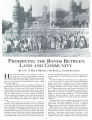
Show PRESERVINTHGE BONDSB ETWEEN LAND AND COMMUNITY BLUFF: A ROLE MODEL FOR RURAL CONSERVATION istory runs deep in Bluff. Utah, and people care about it. Our cultures are diverse and the landscape is stunning. This small cornlnztnity of about 290 people has mrcintuined rural values for the past century. Bluff is zcniqzte and the need to preserve its rich natut- a1 and cultzcral heritage is urgent. -- Bluff Land Trust Initiative In 1995, aftcr nineteen years of community initiative, the Bluff Historic District was listed on the National Register of Historic Places. At first glance Bluff's stately Victorian- style homcs, dating to the early century, speak of the town's pioneer heritage. However, the historic district reaches farther back in time to include Navajo, Ute, and Ancestral Puebloan ( Anasazi) landmarks and signs of the earliest hunter- gatherers in the region. Here on the banks of the San Juan River, humans and landscape have shaped one another for 10,000 years. Bluff City's historv is much more recent. ' li- ail- worn IClor~ non pioneers founded the settlement in remote southeast-ern IJtah in 1880. Their arduous winter trek-- the Hole- in- the- Rock expedition-- through almost impassable slickrock wilder-ness is legendary. The fledgling town prospered only after it abandoned farming in favor of livestock raising. Substantial sandstone houses reflect that turn- of- the- century prosperity and givc thc town a sense of perlnanence borrowed from the surrounding bluffs where the stone was quarried. These hous-es anchor the Rluff Historic District, which also encompasses Cemetery Hill, Cow and Calf canyons, and the bluffs them-selves. The historic district is not only the heart of a deeper histo-ry, it is but one piece of a much larger cultural landscape that endows Blufl with its singular sense of place. Deborah Westfall, chairpcrson of the Bluff City Historic Preservation Association ( BCHPA) and co- owner of Abajo Archaeology, says, " Historic preservation needs a broader perspective. It is not enough to simply preserve buildings as museum pieces. Bluff's historic resources are linked to significant landscapc features - canyons, farms, and the river - that have shaped traditional land- use patterns. Bluff's cultural landscape ernbodies the contributions of an entire communitJ, of people to its history." Recognizing that the town might easily lose lands of critical value to the community topography, BCHPA, a non- profit organization that helped shepherd the town to National Register status, has launched the Bluff Land Trust Initiative. Bluff typifies one of many southern Utah towns that are experiencing the strains of increasing tourism and residential and commercial growth, pressures which threaten the very amenities - open space, rural values, wild country - that draw people to the area in the first place. Like many of her neighbors, Liza Doran, a BCHPA trustee and local business UTAH PRESERVATION In addition to the community based consewation efforts in Bluff, individual homeowners have restored many of the turn- of- the- century houses. owner, worried that such threats could quickly change Bluff's unique rural fla-vor. " After the creation of the historic district, we all had a false sense of secu-rity that certain key elements of the landscape would always be there," she said. " But they won't always be there, and it's too late to save them after the fact." The land trust idea appealed to BCHPA for several reasons. It meant that the group could purchase and hold easements, a vital tool for defining land use and encouraging sensitive develop-ment. Nearly all of the properties would remain in private ownership, with compensation for development rights as well as tax breaks and other benefits for the landowners. In short, the land trust alternative allowed landowner and community to together preserve private prqperty rights and Bluff's key open spaces. Such admirable goals do not come cheap. For the past three years, BCHPA has faced the daunting task of raising funds for its project. Cooperative efforts blessed the Bluff Land Trust Initiative with early suc-cess. Jenepher Stowell, a BCHPA trustee, has used conservation ease-ments to preserve her property in a small slickrock canyon on the town's north edge. Preservation of the Bluff Great House, an 11th- century Anasazi pueblo and kiva with a cultural associ-ation with New Mexico's Chaco Canyon, came from the Southwest Heritage Foundation, a group dedicat-ed to archaeological preservation, research, and education. Over the past several years, portions of Cemetery Hill had been preserved by joint efforts of BCHPA, Southwest Heritage Foundation, San Juan Historical Commission, San Juan Foundation, and other groups. In 1997, a final piece of the hill was purchased and placed into a cemetery district, with help from a challenge grant from Utah's Eccles Foundation and a fundraising cam-paign led by Bluff's pioneer descen-dants. BCHPA is now working with four other landowners who have chosen open- space protection rather than high-intensity development. Specific proper-ties include a historic, working farm; a redrock canyon with exceptional archaeological sites and recreational potential; a nature preserve on the San Juan River; and communitv access to a historic pond and trail to adjacent pub-lic land. The 120- acre Curtis Jones Farm, one of the last working farms in Bluff, spreads along the San Juan River, growing alfalfa hay and melons for a local market economy. A descendant of one of Bluff's pioneer families, Jones has farmed the land for over 30 years. He has entered a partnership with another farmer, who hopes to purchase the agricultural operations, and BCHPA, which would hold the farm's development rights in trust. Easements would ensure that the farm remains in agricultural use in perpetuity. The Jones Farm exemplifies a land-human relationship in this river valley that dates back to the 19th- century Mormon settlement and beyond. The farm is also a threatened species: According to the American Farmland Trust, poorly planned development destroys 50 acres of prime U. S. farm-land every hour of every day. Says BCHPA trustee Gene Foushee, " In a community established for agriculture, don't you think it's important to pre-serve at least one farm?" BCHPA is working with the Guymon family of Blanding, Utah, to protect Cottonwood Wash, a major tributary canyon that drains the desert highlands north of town. Animal and plant communities typical of canyon and stream habitats flourish here. A Navajo and Puebloan presence is apparent in rock art and remnants of dwellings, granaries, and prehistoric roads. Much of the adjacent cliffs and mesas are public land, with a rich potential for recreation. The Guymons have offered BCHPA the option to pur-chase the development rights on 280 acres, which would be placed under a conservation easement for recreation, culturdhistoric preservation, and agri-culture. The Howe property, an important gateway to Cottonwood Wash, lies between the Wash and the Great House- Cemetery Hill tracts. The land includes sandstone bluffs, floodvlain habitat, and a historic artesian- fed pond and wetland. BCHPA is trying to raise funds for pond and wetlands con-servation, agriculture, and public access trails. Limited development with affordable housing is being investigated as one means to fund the land pur-chase. Many in Bluff think of the San Juan River as their town's lifeblood. No one recognizes this fact as well as Jim and Luanne Hook, outfitters and owners of Bluff's Recapture Lodge. They have set aside nearly a hundred acres of their property as the Bluff Nature Preserve, with easements to protect its integrity as a riparian ecosystem. The Hooks plan to reclaim critical habitat for endangered native species and other UTAH PRESERVATION floodplain creatures. The preserve would include foot trails and interpre-tive sites and the opportunity for resi-dents and visitors to enjoy glimpses of waterfowl and wildlife. While the trust properties are indi-vidually diverse, together they com-bine the best of Bluff's multicultural heritage and open lands. BCHPA believes that such land uses nourish a local economy largely dependent on tourism, recreation, the arts, and small businesses. Carol Brinkerhoff, a planner with the Utah Division of Travel Development, wrote that Bluff's land trust can help the commu-nity " preservc those characteristics that make a place a honze for residents and different from anyplace else for visitors." BCHPA has communit) support for the preservation of the Jones Farm, Cottonnlood Wash, river pre-serve, and pond wetlands, but it urgently needs a broader base of donations. Those contributions tnust come from Utahns and others who treasure southeastern Utah's unique cultural geography. Unless money can be raised for three of the proper-ties before their options expire, they will likely be sold for commercial and residential development. A successful fundraising campaign would rein-force landowner- com~ nuntyp artner-ships and represent a victory for threatened desert ecosystems, fragile archaeological sites, and a continuing agricultural legacy. Writer, naturalist, and RCHPA trustee Ellen Meloy said, " It is not hard for any town to identify its most cherished places. We all know them. They embody the very character of a community -- its history and its human as well as ~ vildlifei nhabitants. Everyone who remembers such places also remembers what happened to them. They disappeared. When they did, something about the town itself changed. Bluff is not resistant to change. We want to reach forward as well as back." 0 This article is a joint effr~ lpt of tlze BCHPA trustees: Liacr: Doran, Geize Foushee, Ellen Melny, Deborah Westfall, and Jenepher Stowell. Anyone who loves lzistory and 2- ztral southeastern Utah can help the Bluff land trust project. Please request information 01- send donations ( they are tax deductible) to the Blzcjjf City Histoi- ic Preservation Association, PO BOX 76, B l ~ f fU, T 84512 ( 43,5- 672- 2208 or 435- 672- 2291). Preservation of the Curtis Jones Farm on the eastern edge of town is a current priority. It is part of the long- term effort to retain the character of the community while adapting to new development. Smith- Hyatt Architects Smith- Hyatt Architects 845 South Main Street Bountiful, UT 8401 0 ( 801) 298- 1666 FAX: ( 801) 298- 1677 I believe strongly in the value of our profession and the kinds of services we offer," states Kim Hyatt, co- owner of Smith- Hyatt Architects. " I don't believe in just turning over a handful of drawings to an owner, and then wishing him or her good luck. The services we provide include planning, design, creation of con-struction documents and construction administration. We want to assist the own-ers through the entire process, until they occupy their building, and even beyond." favorite preservation projects was the restoration of a 100- year- old log house in Torrey, Utah. I get just as excited about projects like this as I do about a $ 10 rnil-lion renovation, because even though it is on a smaller scale, it requires just as much thought. Also, we truly enjoy working directly with the owners who will occupy the building." Smith- Hyatt's dedication to preserva-tion is evidenced strongly in their past-project list, which includes work on such historic buildings as the Ogden Municipal Building, the Isaac Chase House in Salt Lake City's Liberty Park, the Ogden Union Station, the Van Fleet Hotel in Farmington and the Great Basin Environmental Education Center at Snow College. " Awareness of the value of historical buildings is growing," Hyatt explains, and new historic districts are being created in larger cities all the time. With the tax cred- - - its available for restoration, it can cost far " Utah has a very good tradition of pre- less than some might imagine. And serving history," Hyatt adds, " and we're whether a client is restoring a historical proud to be a part of it. I, personally, have property or starting from scratch with a always loved old things, starting with my brand new building project, we are here to childhood stamp collection. One of my see them through it every step of the way." |