| OCR Text |
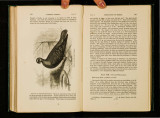
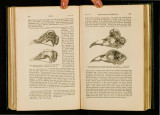
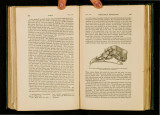
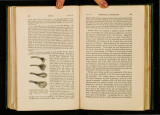
Show 150 DOMESTIC PIGEONS. CHAP. v. UACE VII.-TUMBLERS. (Tu.. 011nlei·, or· Burzol-Taubcn: Culbutants.) During .flight, tumble baclcwm·ds; body genera.lly small; bealc gene~·ally slwrt, sometimes excessively short and conwal. This Race may be divided into four sub-races, mtmely, ~~rsian, Lotan, Common, and Short-faced Tumblers. TheRe sub-races rnclude m.::my varieties which breed true. I have examined eight skeletons of v~rwur,; kinds of Tum blors : excepting in one imperfect an~ doubtful ~pee~ en, the ribs are only seven in number, whereas tho rock-p1goon ~as ~1ght nbs. Bttb-mce I. Pe1'sian 'l'umbler-s.-I have recoivocl a pau dn·?ct from Persia from the Iron. C. :M:urray. They were rather smaller bU'ds. than the wiid rock-pigeon, being about the size of tho comm~n dovecot-p1g~on, white and mottled, r,;lightly feathered on the feet, w1th tho beak Just perceptibly horter than in the rock-pigeon. II.l\1:. Consul,. :M:r. ~eith Abbott, informs me that the difference in the length of beak IS so shght, that only practiRed Per. ·ian fanciers can distinguish these Tumbl~rs from the common pigeon of the country. He informs mo that they fly rn flocks high np in the air and tumble well. Some of them occasionally appear to become giddy anU. tumble to the ground., in which respect they resemble some of our Tuml,lcrs. 8nb-race J 1. Lotan, or Lowtnn: Indian G1·onncl 'l'nmblers.-These birds present one of tho most remarkable inherited habits .or instincts which.havc ever been recorded. The specimens sent. to me from :M:adras by Sn· W. Elliot arc white, slightly feathered on the feet, with the feathers on the head reversed; and they are rather smaller than the rock or · dovecot pigeon. The beak is proportionally only Rlightly shorter and rather thinner than in the rock-pigeon. These birds when gently shaken and placed on the ground immediately begin tumbling head over heels, and they continue thus to tumble until taken up and soothcd,-the ceremony being generally to blow in their faces, as in recovering a person from a state of hypnotism or mesmerism. It is asserted that they will continuo to roll over till they clio, if not tttkon up. Thero is abundant oviclenco with respect to these remarkable peculiarities; but what makes the cru o the more worthy of attention is, that tho habit has been strictly inherited since before the year lGOO, for the breed is distinctly described in the 'Ayeen Akbcry.' 15 1\Ir. Evans kept a pair in London, imported by Captain Vigne; n.nd he assures me that he has seen them tumble in tho air, as well as in tho manner above described on the ground. Sir W. Elliot, however, Wl'ites to me from :M:adras, that ho is informed that they tumble exclusively on the ground, or at a very small height above it. He also 15 English translation, by 1<'. Gladwin, 4th edition, vol. i. 'fho habit of the Lotan is also described in the P rsian treatise before alluded to, published about 100 years ago : at this elate tho Lotans were generally white and crested as at present. Mr. Blyth describes these birds in ' Annals and Mag. of Nat. Hitit.,' vol. xiv., 1847, p. 104 : he says tlmt they "may be seen at any of the Calcutta bird-dealers." CHAP. v. DESCRIPTION OF BREEDS. 151 mentions another sub-variety, called the Kalmi Lotan, which begin to roll over if only touched on the neck with a l'Od Ol' wand. . S·t£b-race 11 J. Common lt'nglish .'litmblers.-These bmls have exactly the samo habits as tho Persian Tumbler, but tumble bettor. Tho English bu·d is mthcr smaller than tho Persian, and the beak is plainly shorter. Compared with the rock-pigeon, and proportionally with tho size of body, the beak is from ·15 to nearly ·2 of an inch sbortel', but it is not thinner. Thoro 'arc several varieties of the common Tumbler, namely, Baldheacls, Beards, and Dutch Rollers. I have kept the latter alive; they have differently shaped heads, longer necks, and aTe feather-footed. rl'hey tumble to an extraordinary degree; as :M:r. Brent rcmarks/6 "Every " few seconds over they go; one, two, or throe summersaults at a timo. " Here and thoro a, bird gives a very quick and rapid spin, revolving " liko a wheel, though they sometimes lose their balance, and make a " rather ungmceful fall, in which they occasionally hurt themselves by " striking some object." From :M:adras I have received several specimens of the common Tumble1~ of India, differing slightly from each other in the length of thou· beaks. :M:r. Brent sent me a dead specimen of a "Housetumbler," 17 which is a Scotch variety, not differing in general appearance and form of beak from tho common Tumbler. :M:r. Brent states that these bu·ds generally begin to tumble" almost as soon as they can well " fly; at three months old they tumble well, but still fly strong; at five " or six months they tumble excessively; and in tho second year they " mostly give up flying, on account of their tumbling so much and so " close to tho ground. Some fly round with the flock, throwing a clean " summersault every few yards, till they are obliged to settle from giddiness " and exhaustion. These are called Air Tumblers, and they commonly " throw from twenty to thu·ty summersaults in a minute, each clear "and clean. I have one red cock that I have on two or three occasions "timed by my watch, and counted forty summersaults in the minute. "Others tumble differently. At first they throw a single summersault, "then it is double, till it becomes a continuous roll, which puts an end " to flying, for if they fly a few yards over they go, and roll till they " reach the ground. Thus I had one kill herself, and another broke his log. " :M:any of them turn over only a few inches from the ground, and will " tumble two or three times in flying across then· loft. These are called " House-tumblers, from tumbling in tho house. The act of tumbling seems " to be one over which they have no control, an involuntary movement "which they seem to try to prevent. I have seen a bird sometimes in his " struggles fly 11 yard or two straight upwards, the impulse forcing him " backwards while he struggles to go forwards. If suddenly startled, or "in a strange place, they seem less able to fly than if quiet in their aeons" tomeclloft." These House-tumblers differ from the Lotan or Ground 16 • Journal of Horticulture,' Oct. 22, 18Gl, p. 76. 17 See the account of the Housetumblers kepi ot Glasgow, in tho 'Cot-tago Gardener,' 1858, p. 285. Also M~. Brent's paper, • Journal of Ilorticulturc ,' 18Gl, p. 76. |