| OCR Text |
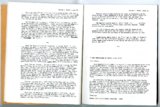
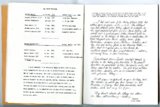
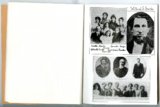
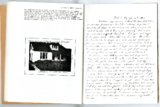
Show Willard G. Smith - page 10 They were_not_house dogs; they lived out doors during even the coldest weather with Just a blanket t o lie on and a partially enclosed p::>rch to protect them fTI?m the wirrl and snav. 'lbpsy , our bravn eyed rrother dog, was ve:ry affectio~t e and was knavn and petted by all the children in the si:ra11 tavn. Old Tige wa~ a large brindle-haired dog, not always friendly with eve:ry<;>ne, but e~pecially devoted to rre. He always went with IIE as I rode back into~ hills to get the cavs. Often he would flush out a coyote and chase it as far as he dared or until he was a certain distance from rre and the horse, then he v.0uld turn and run back. The coyote then would chase ~e dog until he decided I was too near. They never tangled, but the chasmg_garre would go on for quite awhile before the coyote v.0uld gallop out of sight. They had countless soch encounters." Another story the family enjoys is one about the new coat This was best related to rre by Lorraine Hatch Miller, daughter of Aunt Georgia who says, "It does ~t write-up very well, but they tell us grandfather always told the story ~ith much glee. Apparently he had worn the sarre plaid overcoat for_nan:y wmte7s and the girls thought it looked shabby, so they helped him_with a gift of rroney to buy a new one. He went down tavn and carre back ma new coat of alrrost the exact plaid, style and color! Hav they laughed--probably to cover chagrin. Grandfather told them how the storekeeper ~d noth~g he liked in stock, but after awhile he rerrerrbered he had sorrethmg of his description in the storeroom. He went up and loca~ed the very coat grand~ather had in mind--alrrost an exact duplicate of his long-worn coat the girls had conspired to get rid of!" Grandfather was deeply loved by the people he had presided over for rrore than 2 8 years and even though worn out and broken in heal th at the age <?f 66, was reluctant to be released as Stake President. His life of farrru.ng had always ~en a difficult one due to the terrible hernias he had suffered from, smce they developed in the t-bmon Battalion march when rren had to drag cannoi:is and wagons up, over and davn rugged rrountains, as there were not even trails t? follow. M:::dical treatment in that age was unknown and the poor bandaging efforts gave little relief. His two sons left horre rather early, and the daughters were of little assistance except for ~ r t a , who was only 12 years old when she becarre his rrain ~elp and contin~ to serve as his right hand "nan" until she was sent mto Ogden to live for a year with Aunt Delia and attend school. In the following year Grandrrother Cordelia Smith rroved into Ogden so the four youngest girls could attend school . Aunt Georgia remained 1 at horre to keep house for her father for rrost of the three winters. In turn she_was a l l ~ to speD?- the surmer in Ogden studying millinery and dressrrakmg, as she was considered too old to fit in with the children in winter school terms. Alberta and her three younger sisters taught school at least two or. rrore years be~ore they married. They were certified by special exams.in Salt Lake City. ":1 those days this was the only requirement, and the girls had to p::>se as bemg 18 years old in order to take the exam All we:e rated as outstanding teachers, and Gertrude in later life--after.her chi~dren were gravn--requalified and spent several years teaching in lewist<;>n and Og<;Ien, Utah. When Frances died at age 23 in Idaho Falls, following.the birth of her son, the teachers of the Iogan schools published a reso~ut~on of condolence and appreciation for her work, and the schools were dismissed for the day in her honor up::>n receipt of the sad news. Willard G. Smith - page 11 In 189 3 when Grand£ ather was 66 years old, President W'.:>odruf f realized he needed to be released after 28 years of presiding over a stake. He knew grandfather's health was not good, but also that he loved the work, and was at a loss as to how to gracefully le~ him out: . 'Ihen the Church presidency hit upon a way ••• they called him on a nu.ssion to the southern states! The following copy is the letter which followed shortly after the "call" letter. Of course Willard was unable to pass the required physical examination, and a third letter expressing their 'surprise' and synpathy followed shortly. After all, re had five daughters still at horre to be reared and a farm to be worked to supp::>rt them. He struggled on until 1902 when he suffererl a severe stroke from which he never recovered fully, although he lived until Noverrber 21, 1903. 'Ihey sold their property in r-brgan and noved to Idaho where Georgia and Estella had located, but he was not able to work a farm and was unhappy there, so grandnother went to Logan, Utah, where she located a horre directly across the street from the west gate of the terrple. Several of his old Battalion frierrls lived nearby and he was able to visit frequently with them and live over the old days. He was . able to go to the terrple for a session occasionally, which consUITEd the better part of a day. His last days were serene, happy and peaceful ones. He · died three days after suffering a second stroke. In the first day foll~ing_it ~e rallied and talked to rrerrbers of his family. He told Cordelia, his wife, that he was leaving on a journey "at four o'clock on Saturday and could not take his girl with him." He later lapsed into a corra which lasted~ days and then he quietly left this life at exactly 4 p.m. 01; Sat1;IT'da:y, November 21, 1903. He had been gentle and kindly in all aspects during his life. My rrother relates how he hated contention, loud talk arrl profanity intensely. When canpletely exasperated his terse expression was, "Good Land of Goshen!" Aunt Delia ended her biographical sketch as follCMS: "We took him back to the people and place he loved so devotedly and buried ~im in the little cerretery on the hill just above and back of the o~d ~anu.ly h~ •. My father was a nan of sterling worth, broadminded~ patriot~c and religious, very conscientious, just and honorable. Perhaps his predomment characteristic was his respect for and unquestioned obedience to constituted church authority. 'Ihere was sorrething so deep arrl fine in his splerrlid soul that I find it difficult to express 11¥ full appreciation to this nost wonderful father." An obituary published in the Logan Journal concltrled with this: "Willard Gilbert Smith was exceptionally kind in dis:p::>Sition; earnest and , unwavering in devotion to principles; wise, though firm in council; ~trictly honest in his dealings with God and nan; possessed a personal rragnetism that endeared him in the hearts and cornnanded the utnost respect of all who knew him. In his passing, the light of a noble life has passed from earth. His church will miss his valiant labors in the cause of truth. The state has lost an Errpire Building, and the nation a high-minded arrl patriotic citizen. He was buried in the family plot in MJrgan on a site overlooking the valley and people whom he loved and served." My rrother, Estella Smith Mulliner, concltrles her sketch o~ his_life by telling hCM in SacranEnt, Fast and Testinony rreeting follc:Mmg r:us death, a sister rose and began talking in tongues. At the canplet1.on of |