| OCR Text |
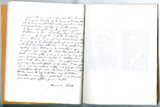
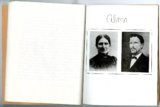
Show Amanda B. Smith - page 8 "'Could you dress a fat hog if one was laid at your door?' " 'I think we could! ' was my answer. "And then they went and caught a fat hog from a herd which had belonged to a now exiled brother, killed it and dragged it to my door and departed. "These rren, who had corre to murder us, left on the threshold of our door a rreat offering to atone for their repented intention. "Yet even when my son was well, I could not leave the state, nCM accursed indeed to the saints. "The rrob had taken my horses, as they had the drove of horses, and the beeves, and the hogs, and wagons, and the tents, of the nrurdered and exiled. "So I went dCMn into Daviess County (ten miles) to Captain Comstock and demanded of him my horses. There was one of them in his yard. He said I could have it if I paid five dollars for its keep. I told him I had no rroney. "I did not fear the captain of the noo, for I had the lord's promise that nothing should hurt rre. But his wife swore that the rrol:::bers were fools for not killing the v.Urren and children as well as the rren--declaring t.1-iat we would 'breed up a pack ten tirres worse than the first.' "I left without the captain's pennission to take my horse, or giving pay for its keep; but I went into his yard and took it and returned to our refuge unnolested. "learning that my other horse was at the mill, I next yoked up a pair of steers to a sled and went and demanded it also. "Constock was there at the mill. if I had any flour. He gave rre the horse, and then asked " 'No, we have had none for weeks. ' "He then gave rre about fifty pounds of flour and sorre beef, and filled a can with honey. "But the mill, and the slaughtered beeves which hung plentifully on its walls, and the stock of flour and honey, and abundant spoil besides, had all belonged to the nrurdered or exiled Saints. "Yet was I thus providentially , by the very murderers and rrobocrats themselves, helped out of the state of Missouri. "The lord had kept his v.Urd. The soul who on Jesus had leaned for succor had not been forsaken even in this terrible hour of ma.ssacre, and in that infanous extermination of the "1-bnrons" from Missouri in the years 1838-39. "One incident rrore, as a filling close. Arranda B. Smith - p ge 9 "Over that rude grave --that well--where the nineteen martyrs slept, where my murdered husband and boy were entorrbed, the rrobbers of ~ssouri, with an exquisite fiendishness, which no savages could ~ave con~ived, ~ad constructed a rude privy. This they constantly used, with a delight .which derrons might have envied, if derrons are rrore wicked and horribly beastly than were they." It was in the depth of winter that Arranda Smith thus was compelled to leave the state of Missouri in an open wagon, and she had to travel hundreds of miles through snow, frost, mud and storms, with no help but that of an eleven-year-old son with three other children, one of them the wounded lad, suffering untold hardships. "I felt the loss of my husband, but not as I should if he had apostatized· he died in the faith and in hopes of a glorious re3urrection. As for ~self, I felt an unshaken confidence in God through it all. I had been personally acquainted with the Prophet Joseph for ma.ny years; had seen his walks and knew him to be a Prophet of God that buoyed rre up under every trial and privation. "I went from Missouri to Quincy, Illinois. There I found friends who ·took rre in and supplied my wants for a season .. I sho~ly went to keep~ng school, which gave rre ample support for my family until the f';ll of thirtynine when I married another Warren Smith, but no kin to the first. Shortly after we rroved to NauVCX). He was a blacksmith by trade and got along well . . • . Shortly after arriving in this city, her husband, who had been for sorre tirre dilatory in his duties, apostatized from the faith, and they separated. She took the children with her and provided for herself. On the 24th of January, 1854, a number of ladies rret together to. consider the irrportance of organizing a society for the purpose of making clothes for the Indians and other charitable work, which was properly organized on February 9th. Sister Smith was one. of the off~cers of the society, which resulted in much temporal good being accomplished. In consequence of the ma.ny hard.ships she endured throu<Ji:1 the persecutions in Missouri which were heaped upon her and her family by a relentless nob her health was undermined, and as years increased, infinnities se~tled upon her ¼hich rendered her unable to retain the position she had held in the Relief Society. She was honorably released and will ever be re:rrerrbered by the bishop and hi~ counselors and the rrerrbers of the ward. for her benevolence and self-denial in ministering to the unfortunate. Sister Smith has much to rejoice over even in her present affliction, for she has raised her family in the principles of the gospel of Christ and the fear of God, and they remain true and steadfast to the faith of the latter-day work. A good woma.n, who has reared to rranhood and woma.nhood a large family alrrost without a father's help, is certainly worthy of comrendation and must have great satisfaction in her life and labor. She has been for rrore than fifty years a rrember of the Church of Jesus Christ of Latter-day Saints. |