| OCR Text |
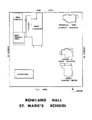
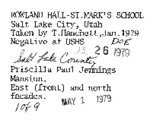
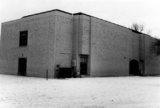
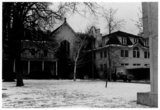
Show SIGNIFICANCE PERIOD AREAS OF SIGNIFICANCE -- CHECK AND JUSTIFY BELOW -PREHISTORIC _ARCHEOLOGY-PREHISTORIC -COMMUNITY PLANNING -LANDSCAPE ARCHITECTURE ^.RELIGION -1400-1499 -ARCHEOLOGY-HISTORIC -CONSERVATION -LAW -SCIENCE -1500-1599 -AGRICULTURE -ECONOMICS -LITERATURE -SCULPTURE -1600-1699 _ARCHITECTURE X.EDUCATION -MILITARY -SOCIAL/HUMANITARIAN -1700-1799 -ART -ENGINEERING -MUSIC -THEATER X-1800-1899 ^COMMERCE -EXPLORATION/SETTLEMENT -PHILOSOPHY -TRANSPORTATION X-1900- -COMMUNICATIONS -INDUSTRY ^POLITICS/GOVERNMENT -OTHER (SPECIFY) -INVENTION SPECIFIC DATES BUILDER/ARCHITECT STATEMENT OF SIGNIFICANCE Rowland Hall-St. Mark's School occupies a distinct niche in Utah's educational and religious history, and its significance as an institution has additional merit because of the individual architetural and historical interest of the buildings: that comprise the campus. Rowland Hall-St. Mark's has antecedents that make it one of the oldest established religious schools in Utah. The Episcopal Church has never been numerically strong in Utah, although it was among the first non-Mormon religious to assign clergymen in the area. Unlike the other Protestant churches, however, the Episcopal Church has never adopted a program of evangelizing the Mormons. Their school program was established to serve the needs of Episcopal communicants and of those seeking a superior college preparatory education for their children. By contrast, the Presbyterian and Methodist Churches established mission schools that subsidized the education of Mormon children. The intent, openly avowed, was to wean the children away from Mormonism. Episcopal educational and religious policy was to maintain a low profile in the Mormon/Gentile conflict, and to concentrate on providing education for the middle and upper classes. ' Episcopal education commenced with the arrival of George Foote and Thomas W. Haskins, in May 1867. Taking over a Sunday School program from a departing Congregationalist, minister, they moved on, to create the St. Mark's Grammar School of Boys, Which met in a bowling alley. This was followed by the St. Mark's School of Girls, which was operated independently for ten years. In 1880 an Episcopal lay woman, visiting in Salt Lake City, felt that there was a need for improved educational facilities, especially for girls growing up in mining camps and on 'ranches. So a boarding school for daughters of the nouveau riche entrepreneurs of Utah's mines and ranches was endowed and named for her husband, Benjamin Rowland. For a time the two schools operated separately, with Rowland Hall being exclusively for boarders and St. Mark's School for Girls serving day students. Economy eventually determined that the two schools merge, and Rowland Hall continued on to serve both types of student. Its generous endowment also allowed,it to flourish even during those difficult years when free public education became generally available throughout Utah in 1896, causing the demise of most religious schools. The St. Mark's School for boys did not survive this period, and was not re-established until 1956. The two schools have now been combined, and offer some of the finest private education in the state. The Rowland Hall-St. Mark's Campus has four houses, a classroom section, a chapel and a new classroom building. The homes were originally built as single family residences and belonged to several prominent Utahns. The other buildings and numerous additions to the original home were built for the school. |