
Contents | 134 of 217





Page 134


| Publication Type | Technical report |
| School or College | College of Engineering |
| Department | Computing, School of |
| Creator | Barsky, Brian A., 1954- |
| Title | Beta-spline: a local representation based on shape parameters and fundamental geometric measures |
| Date | 1981-12 |
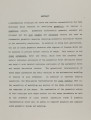
| Description | Abstract: A mathematical technique for curve and surface representation has been developed which reflects an underlying geometric, as opposed to algebraic nature. Elementary differential geometry concepts are reviewed and the unit tangent and curvature vectors are used as fundamental geometric measures replacing parametric derivative vectors in the continuity constraints. In addition to being more appropriate, the use of these geometric measures adds degrees of freedom which can be captured to provide further control of shape. This control is via shape parameters, beta1 and beta2, which have the property that beta1=1 indicates continuity of the parametric first derivative vector and beta1=1 with beta2=0 indicates continuity of the parametric first and second derivative vectors. The geometrical interpretation of these shape parameters and their relation to the mathematical modeling of tension is also presented. In addition to inherent tension capability, the Beta-spline representation has local control; that is, the capability of modifying one portion of the shape without altering the remainder of the shape. The combination of the geometric nature of this technique with shape control via the shape parameters as well as the presence of local control capability forms a powerful representation which will be useful in computer graphics and computer aided geometric design and modeling. |
| Type | Text |
| Publisher | University of Utah |
| Subject | beta-spline; geometric curves; geometric surfaces; shape parameters |
| Subject LCSH | Curves--Computer simulation; Surfaces--Computer simulation; Computer-aided design; Computer graphics--Research; Three-dimensional imaging--Research |
| Language | eng |
| Series | University of Utah Computer Science Technical Report |
| Relation is Part of | ARPANET |
| Format Medium | application/pdf |
| Format Extent | 238,152,680 bytes |
| File Name | Barsky-The_Beta_Spline.pdf |
| Conversion Specifications | Original scanned with Kirtas 2400 and saved as 400 ppi uncompressed TIFF. PDF generated by LIMB™ for CONTENTdm display |
| ARK | ark:/87278/s64f49w4 |
| Setname | ir_computersa |
| ID | 105814 |
| Reference URL | https://collections.lib.utah.edu/ark:/87278/s64f49w4 |
Page Metadata
| Title | Page 134 |
| Setname | ir_computersa |
| ID | 105730 |
| OCR Text | Show |
| Reference URL | https://collections.lib.utah.edu/ark:/87278/s64f49w4/105730 |