| OCR Text |
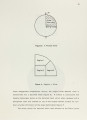
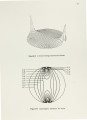
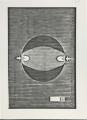
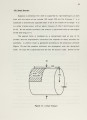
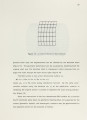
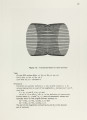
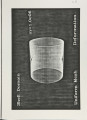
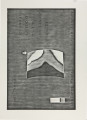
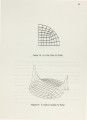
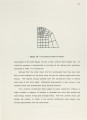
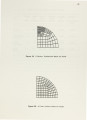
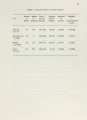
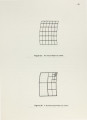
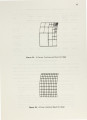
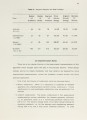
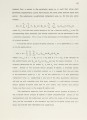
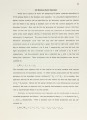
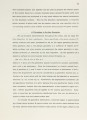
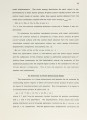
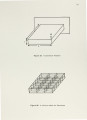
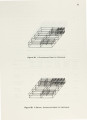
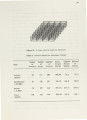
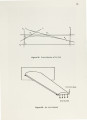
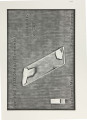
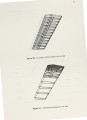
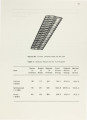
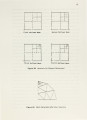
Show 65 4.5.2 Air Foil In this example, a structural analysis is performed on a cantilever beam which is topologically identical to the last example except that it is in an exterior shape similar to an air foil. The cross section is constructed by four curves (Figure 32). The leading edge is a circular arc tangent to three lines: L1, L2 , L3 . Similarly the trailing edge is a circular arc tangent to three lines: L4, L5, L3 . The top curve is a cubic 8-spline curve with four control points: P1, P2, P3 and P 4. The bottom curve lies on L3. A tensor product 8-spline surface (cubic by quadratic) is constructed for the cross section surface by taking the boolean sum of these four curves. The cross section surface at the wing tip is constructed by reducing the scale of the first cross section surface to 70%. The entire air-foil-shaped beam solid is formed by taking the boolean sum of two cross section surfaces and four ruled surfaces between them. An experiment is conducted to demonstrate that the attribute modelling technique is also valid for distributed loads. Therefore two analysis cases are performed, one is subject to a concentrated load and one is subject to a distributed load (Figure 33). The geometric deformation of the latter is shown in Figure 34. The strain energy distribution of the former is shown in Figure 35. An automatic zoning process performs the preliminary subdivisions with respect to the aspect ratio, it decomposes the original domain solid into six subsolids as six regions. A uniform mesh (Figure 35) is automatically generated by subdividing each region into element solids. A criterion solid is constructed as a four-dimensional, vector valued, trivariate parametric function. The maximal nodal strain energy (MSE) of the initial mesh is calculated (MSE = 2070.0). An adaptive subdivision of this criterion solid subject to .4 of the MSE yields a synthesized mesh (Figure 37). A finer, uniform mesh is generated for comparison (Figure 38). The evaluation of these results is included in Table 4. Derived from the initial mesh, the synthesized mesh has only 70% as many degrees of freedom of the finer mesh and yet it attains more than 200°/o of total strain energy than the finer mesh. Furthermore, the highest nodal strain |