| OCR Text |
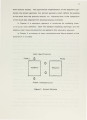
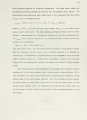
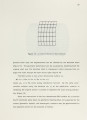
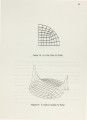
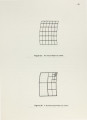
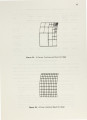
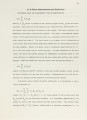
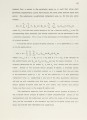
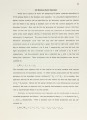
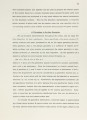
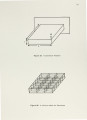
Show 52 mapped from a square in the parameter space (u, v) such that along each parameter isoparametric curves have exactly the same order and the same knot vector. The subdivision is performed component-wise, i.e., for the very same surface, N u 13(u, v)= ~ i=O Nv Nu { ~ P. . 8 k (v) } ~ k (u) = ~ j=O I,J J, v ' u ,=Q M v { ~ m=O where oi,m's are the new control polygons for the v direction and Bm,k 's are the v corresponding basis functions, and further subdivision can be performed in the u direction separately. This is one of the advantages of formulating it in terms of a tensor product. A trivariate tensor product 8-spline solid a(u, v, w) in parameters u, v and w can be expressed as: Nu Nv Nw a(u, v, w) = ~ ~ ~ Pi,j,m Bm,k (w) Bj,k (v) Bi,k (u) i=O j=O m=O w v u where { Pi,j,k I 0 ~ i ~ Nu, 0 ~ j ~ Nv and 0 ~ k ~ Nw } are vertices of the control frame and Bi k (u), B. k (v), Bm k (w) are the basis functions. It is ' u J, v ' w . uniquely determined by its orders ku, kv and kw, knot vectors and the control frame. Similar to the bivariate tensor product 8-splines, a trivariate tensor product B-spline solid is inherently cubical, i.e., it is mapped from the unit cube in the parametric space (u, v, w). As for the subdivision, it is also performed component-wise, i.e., subdividing in any one of the three parametric directions will end up with subsolids such that every subsolid is a well-defined trivariate tensor product 8-spline solid with its own orders, knot vectors and control frame, and their union is the original 8-spline solid. The theoretical extension from the bivariate tensor product 8-spli nes to the trivariate tensor product 8-splines is rather straightforward. Deta ils of the representation and the subdivision are not within the scope of this discussion. They can be consulted in the literature, e.g., [24] for B-spline curves and surfaces and [ 12] for their refinement and subdivision. |