| OCR Text |
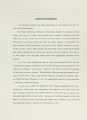
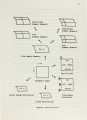
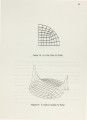
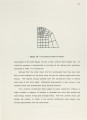
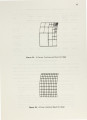
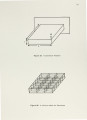
Show 54 This trivariate boolean sum operator can be used to produce the interior points of the control frame for a convex trivariate tensor product B-spline solid such that those points are positioned in a way which reflects the natural correlations to the boundary surfaces. Thus by the boundary representation, a trivariate tensor product B-spline solid can be created when the user specifies only its six bounding surfaces, each of them a bivariate tensor product B-spline surface. 4.3 Paradigm in Surface Examples We use B-spline representations throughout this thesis, and we apply the Oslo Algorithm for their subdivision. More specifically, only tensor product asplines surfaces have been considered so far for the region geometry and element geometry, that is, the domain geometry is a collection of regions as Bspline surfaces, and when meshes are generated, the region geometry is subdivided (uniformly or otherwise) by the Oslo Algorithm. Let the geometry of a region (a surface) be some bivariate tensor product 8-spline, i.e., a{u, v) = ( X(u, v), Y(u, v), Z(u, v) ), where X, Y and Z are the parametric (scalar) functions for position coordinates, and u and v are parameters. Since the displacement is a (vector-valued) function of positions X, Y and Z which in turn are functions of parameters u and v, hence the displacement can also be considered as a parametric function, 6(u, v). Similarly the stress values and the strain energy can be regarded as parametric functions, i.e., cr(u, v) and 1r(u, v). Furthermore, the displacement constraints can be regarded as functions of u and v because they are specified by means of the local orientation induced from the parametrization of the respective region surface. Similar arguments may be applied to the loading specifications. Especially in case they are nonuniformly distributed loads, they can be defined as a (scalar) surface over the loaded surface area. To simulate the geometric deformation, a distorted region is approximated by a linear tensor product B-spline surface with the control mesh obtained from the finite element mesh (finite element nodal points) of the region offset by the |