| OCR Text |
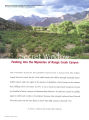
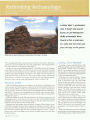
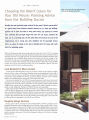
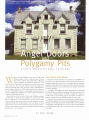
Show ngel door that once acess~ en it came to building a home, most of Utah's early Mormon settlers tried to recreate the types of homes they had left behind. Thus Utah's early architecture tends to resemble the architecture of the rest of the w nation during the last half of the nineteenth century. There are excep-tions, to be sure. The Greek Revival Style remained popular here after it had become passe in the rest of the country, probably due to Utah's isolation through the 1860s. Adobe homes were common at first, but Utah builders returned to more familiar materials when they became available. Here and there you can find a hint of Scandinavia or another homeland left behind. More distinctive than the style of Utah's early buildings, perhaps, are the stories we tell about these buildings. You certainly won't find tales of " angel doors" and " polygamy pits" in other regions of the country. Most of these stories arise from oral traditions and were passed inforinally from one generation to the next. Today, we often accept them as truth, in part, because they are so much fun to believe. But how well do these stories reflect the original uses of the features they describe? Let's investigate. U T A H ' S A R C H I T E C T U R A L F O L K L O R E Two Doon, Two Wives? The house with two front doors is one of the most identifiable forms of Utah's early residential architecture and can be found in many com-munities throughout the state. Known as a double- cell house, it is distin-gushed by a floor plan with two equal- sized rooms across the front. Each room has an exterior entryway, and the rooms are typically connected by an interior doorway. According to Utah folklore, the double- cell house type was developed by early Mormon practitioners of polygamy. This premise seems to make sense since a double- cell house is basically arranged like a duplex. It could provide a separate living space for two families, yet allow occu-pants to circulate between households through the interior door. How does this story hold up to historical scrutiny? Though the dou-ble- cell house appears to be an obvious local design adaptation for func-tionality, it was actually developed in the Mid- Atlantic and Southeastern United States. Early Mormons who moved to Utah continued building double- cell houses because they were famhar with them and they were convenient. B Y C O R Y J E N S E N 62 UTAH P R E S E R V A T I O N So \ vIly habe m; o hol. lt. doors in the fist plilcc.? I: o~~\~ e~~ iehn. acs . eal readb- been mm~ io13e. dL. hlotjnei: r eason ur~ sto provide a syr1111le. trical appraj: a~ cero the. 1- lrLll: a:: y facade. Fal! o\ vil~~ tl ie lI< r, s: o! udonar~ \ Vat-, & ssicdl. ideology pervaded ill1130sr. 2 \ ~ : ) - msller of ilmesi~ mtl 10~~ 17( tI. ) ITCo f the pr1mal. y celllets of dass~ c~ smis bal. ance slid. ordex in r~ ie.~:~ tli1i1~ cn1u~ d, i a. ga rcll~ tcct~~ arpaple iiran. ce. Because the do~ lble- c. elhl ause h. as an i~ iceriorw aU. dividiug rile hi:(? primay rooms down rlie center: of the building, tJ2ee xtel- i~ o~ pre nj~ lpsh ad to be p!~ r. e. do n ather side in order To nlajlitain a balanced appexance: a tic> or am1 21 \ vin. dixxt oil onr half of the f'lcade and a door ancl a windour ( 111 h eo ~ llrhr alf. l ~ i ~ tnhrr d otlblc- cdl louse did not evolve here in ' Cjr. ali as a lliealis of I. loLI~ l~ 3g 111nltj~ Iei! a~ nilics in. a polvgi~~ i~ l~ oo~ u~ sdsl oldT. iJr and cmlsus re. c. ords I- weal lrhat many ol: rhe origb2. d OTXTIIo~ f. Id: Sou bl, r.- cd!. boilses ume nor pol~; g~ ui~ iHs~ O: s\ U. F. Vth: Vat. C I, d. o . e s nor me. an I, olv.. n. ainists did not use rl~ ish ouse r, ype. Pol yp~ nousf kmljljes fou~ ld double- cell l ~ ( x u~; e~ ll.- esu~ ite d fc~ rh oushlg multi. ple fali~ ilies.' T hese hollses : d( l\ iied The Frederick & Anna Maria Rebel' House in Santa Clara was constructed in the reuararc families t. 0 1j1; t. in a single, functjonal hlildlllg Lirl~ etj~ ia: l l UI Separari'. houses: mid- 1860s. Th. e house has two doors, but Anna aria was ~ redericl(' so nly wife. a: lvch \~ o,~ lhdav e heen more espa~ siveO. f course. this upas nor 1he o111y type of house l~ ulyaamotf~ i~ sl lmiliezu sed, but it aias prohal~ lt. h e mvst practical. T11e nrxt. ti~ nr> i ( > u see an earl. y [! t: dl house with tnic? fr: onr. doors yo11 \?; dlk nou; rile rrutl~ r: h esse 11011ses\ rere noc ~ lesigncdb y p ~ l ~ g a n ~ ibsunl: . p ol! ga~ nists dj. d use them. Cold Storage or Hideout? The pract, ice of polygamy has 111spire. d anod3e. r. p~ ece. of ljrall arch~: rctual fc~ l. kloreO. ~ i epe i~ i. st. ent. s tory llulcls that polvga~~ iisdrs ~ pgits 111 dieir base~ ila~ ts or cellars as hjdjng places. ilccol: ding t o f(? lklore, a " pol~ iga~ p~ ilt\" i was a hole ~ JI a dirr floor cove. re. il by a \ xiood.~ n dool: J. f fede~: al ma!- shals came. se~ xcl~ ing a ool.~. ' i~ r arnoush usl? and, he c n ~ ~ hl dde in the pic unril the searchers left. The. idea of pc, lyga~~ p~ iyts seerus logical enough.; howe.~~ e: hri srori~ nsh ave had dj. fficulty decermmj. ng the o a l i d i ~~ i this story. Eal: l~ 1 . lrahns illso conirn(> 11l! used I'Bu ilt in ,869, the George w~~~~~~~~~ H~~~~ in ~~~ d~~ is example pil: s co\ irred by u; oodel~ doors iu, cellal: floors for cold stclrage. hlorro\ ier, the1: e of a double- cell house that did not house multiple wives. - - ha L Can- Rbarson Housa in Ephralm b reputed ( o hove two polylpAly piLT dug In rtr ( loor whm Rttmn could hide if M a d mnhak sought hIs rvrrst as pdwpmlsl Is..?. . ' r- . w -. .- b- The lens Christian Jensen House in Ephraim ( demolished) featured an ornate angel door with a Federal Style door surround. The nailer board directly below the doorway running the full width of the house may have once supported a porch roof. are no known primary written records of the construction or use of polygamy pits. Like most folklore, the stories about them have been passed down through oral traditions. A few purported polygamy pits have been examined by historians with inconclusive determinations. Folklorist and architectural historian Tom Carter, however, believes he may have found a polygamy pit in the Canute Peterson House in Ephraim. The Historic American Building Survey drawings of the house note two polygamy pits, one to hide Peterson and one to serve as a more conspicuous diversion. According to Carter, the pit under the floor of the rear parlor was just big enough to contain a single person and seems impractical for any other purpose. It also seems likely that Peterson would have been a natural target for arrest since he was prominent in Sanpete County religion and politics, had three wives, and lived in one of the largest houses in the valley. This is one case where the evi-dence tantalizingly suggests a polygamy pit dug specifically for hiding a polygamist. So what is the verdict on polygamy pits? Although it is possible the pits were excavated to conceal a wanted polygamist, most of them were probably dug to preserve food items. It is also possible the pits were used for both purposes. Lacking sufficient evidence, the jury is still out on this case. or two windows on either side. On the second story, windows are arranged over the lower- level openings. However, on houses with angel doors, the center upper- story window is replaced by a door. The odd thing about these doors is there is nothing to stand on once you step outside. Why would a builder go to the trouble of putting in a doorway where it serves no apparent purpose? The name " angel doorsn implies that these doorways were a portal through which heavenly messengers could enter a house. However, we don't know of any recorded accounts of these visitations, so this use of angel doors remains in the realm of legend. Another story about angel doors claims polygamous husbands used them to evade federal marshals during the polygamy raids of the 1880s. The husband would hide in the upper story of the house and, when the marshals ascended the stairs, jump from the doorway to the ground below to escape. While it is possible angel doors were used as an escape route, it is not likely they were constructed for this purpose. The two explanations we know of for the construction of these doors are both rather utilitarian compared to the folklore surround-ing them. The first and most obvious use is as a means of accessing a porch roof terrace. Covered porches became much more prevalent and elaborate with the rising popularity of Victorian- influenced architecture in Utah in the 1880s. On larger, two- story houses, the roof of the porch often served as a terrace. Frequently, the terrace was accessed through a second- story door. Where are these porches today? Some porches were never built, usually because of lack of money or time. In other cases, the porch became deteriorated and was removed and never replaced. With a little detective work, you might still be able to see signs of the exis-tence of a porch in the past, or the owners' intention to build one Doors for An@ or Armoires? Like the double- cell house with two front doors, another arrange-ment of two front doors is surrounded by Utah folklore. In this case, one of the doors leads to nothing but thin air. These so- called " angel doors" or " angel landings" are found in most areas of the state, par-ticularly in rural towns retaining many of their original residences. Angel doors typically occur on early classically- influenced homes with symmetrical fa~ ades featuring a central door flanked by one 64 UTAH P R E S E R V A T I O N eventually. If you look closely at early brick and stone houses you might notice blocks of wood imbedded at intervals above the doorway and perhaps over the windows as well. These blocks are called " nailers" and were laced in the wall to allow a porch to be attached to the house. So if you see an angel door on a house with nailers, it's a safe bet the door accessed ( or was intended to access) a porch roof at one time. What about houses with angel doors but no nailers? There is another practical explanation for angel doors: to facilitate bringing furniture to the second floor of a home. Many homes of this era had nar-row hallways and steep, narrow staircases. Moving even a small sofa or dresser up to the second floor would have been difficult at best, especially when making a tight turn on a stairway. An exterior door that opened directly into the second- floor hall was very convenient. Families could have hoisted furniture up to the second story with a block and tackle attached to an armature and then brought it through a wide exterior doorway into a hall or room. Exactly when the terms " angel landing" and " angel door" originated is not known, but it was probably not when these houses were constructed. It is highly unlikely the people who built these doorways thought about receiving angelic hosts in their home. Perhaps those who started using the terms didn't mean it literally; maybe it just seemed an appropriate description for a second- story door that leads to nowhere. So the folklore around angel doors does not reflect their original uses. But, who knows, maybe there were other uses for these doors, practical or mystical, which we don't know about yet. The stories we tell about Utah's early architecture probably say more about us as Utahns than they do about our buildings. As a folklorist will tell you, folklore helps a group maintain its identity and pass on a shared way of life. These stories, more than our buildings, set us apart from other Americans. And whether your ancestors crossed the plains with a handcart or you just arrived in Utah last month, it's fun to share an " insider's knowledge" that helps bind us together and make this place feel special. So the next time guests come to visit, be sure to show them some angel doors and tell them all about how polyga-mists used to hide in pits. a Cory Jensen received a MS in Historic Preservation at the University of Utah and worked as a preserva-tion consultant documenting buildings throughout the state before joining the staff at the Utah State Historic Preservation Office in 1998 as the National Register and Survey Coordinator. I Solid ii~ oodz ueathemtl" ippirzgf o I" dooi- s, casemeat wiudows, crttir doors7 double hlrng wizzdaws, .. . Do- it- Yourself Installation Kits Creates Weather- tight seal even in older doors - Reduces Heating Bills . Long Lasting . Much more efective than other weather strip- type materials Atnrricat~ Het i tage Windo>\ Rebuilder5 46 East Herbert Avenue Salt Lake City, Ut 841 11 Vintage Upmdow- The 1889 George H. Wood House in Cedar City ( demolished) is an unusual example of a small, single- cell house with an angel door. The Wood family probably planned to double the house in size. UTAH P R E 5 E R V A T I O N 65 |