| OCR Text |
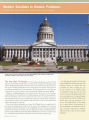
Show - bough it appears solid and immovable, the Utah Sta the building vulnerable to serious damage during an earthquake. The day after Christmas in 1912 ~ orkmenan c{ clipitar~ esg athered on Salt Lake City's r- lrsenal HiU to for~ nallyb egin excavations for the foundation of Utah's long- awaited Capitol. UTork progressed rapidly and concrete columns were visible above grade by May 1913. One year after breaking ground, the Sour- story concrete fran~ ew as complete, with colun~ l~ fosr the tall dome reaching skyward during that winter. The final structural n~ orl< o n the dome was colllpleted by July 1914 as worlmien covered the body of the building with granite cladding. Despite the unyielding appearance of its granite exterior, the structure of the Utah State Capltol B~ ddingis rife with deficiencies. The original designers and bcdlders of the Capitol prob-ably had no kno\ vledge ofthe seisinic potential of the region. Moreore4 designing structures to resist e'lrthquake forces was not even a consideration in the early twentieth century. ~~ eseissues, cotlpled with the condition of the building's reinforced concrete, create a serious hazard at the Capitol a~ hichc annot be overlooked. Recent studies indicate earthquakes occur along Utah's LX'asatcl~ Front on a regular basis. In fact, sejsrnic monitoring stations typically record in excess of 700 earthqualtes 111 the state each year. Though nlost of these earthqualtes are not perceptible by humans, the balance serve as harsh reminders of the seismicity of rhe region. Along the Salt Lake City region of the X'asatch Fault. a ground- rupturing earthquake ( approximate Rchter Magnitude 6.7 or gseater) occurs about once every 1,300 years; the last such event is believed to have occurred about 1,300 years ago. 52 UTAH P R E S E R V A T I O N So, what does this mean for the Utah State Capitol Building? Potential catastrophe. The Capitol's proxinlity to a known lault only exacerbates the risks, increasin. g the pen1 for the occupants of the building during an earthquake. Setting aside the life safety concertis, the loss of the building itself \\ rould m e no sm;~ ll misfortune. The Capirol's design-ers and builders intended the building to be handed do\ vn froin one generation to the next as " The People's House," a living legacy of our culture, history, and government. To lose this building to a11 earthquake u7ould be tragic, especially considerii~ g the building's rich historic fabric which cannot be feasibly duplicated. - - -- -- - - - - Hidden Problems Extensive engineering studies of the Capitol's ability to withstand an earthquake have discovered many deficiencies with the building's structure: The structural concrete frame is inad-equate for resisting the forces of a moderate to large earthquake. Almost all the building's concrete is inadequately rein-forced and varies in strength and condition. The masonry backing for the granite cladding is unreinforced and the anchor. age of cladding, rooftop parapets, pedi-ments, and balustrades is inadequate or deteriorated. The dome could experience severe acceleration and damage due to its height and lack of adequate support. Window penetrations at the base of the dome further weaken it. During an earthquake, seismic loads would tcnd to conccntratc at thc four large rotunda piers that support the dome. Their foundations could be subject to uplift and/ or overturning. Because of the stiffness of the rotunda piers, the building would have a tendency to twist about its center rather than move uniformly. This problem is further com-plicated by the large openings in the third, fourth and roof levels for the large atria. Based on this analysis, engineers concluded the building has only a fraction of the capacity needed to resist the seismic loads that could be generated from a large seismic event. Mitigating hazards to life and property by addressing these structural deficiencies is a major focus of the current Capitol ren-ovation project led by the Utah Capitol Preservation Board. " When the project is finished, the Capitol will be safer than ever before," explains Capitol Preservation Board Executive Director/ Capitol Architect David Hart. The project structural engineers, Reaveley Engineers & Associates, in col-laboration with the ~ roiecta rchitects. Ca~ itol * , . A Restoration Group, and the general con-tractor, Jacobsen Hunt Joint Venture, have designed new building systems to reduce the potentially disastrous effects of a large earthquake. " Protecting the Capitol from a 7.3 magnitude quake in many ways is more complicated than any seismic retrofit project to date, including work done on San Francisco's City Hall or the Asian Arts Museum." notes Hart. Brute Force vs. Base Isolation Engineers often use a " brute force" approach to strengthen the structure of an existing building by adding a system of new concrete shear walls or steel frames and filling openings. This approach stiffens and strength-ens the structure to withstand expected earth-quake forces, but has a major drawback. Stiff structures generally tend to experience higher levels of horizontal acceleration ( force) than do more flexible structures and must be designed to resist a higher level of force for a given earthquake. At the Utah State Capitol Building, the " brute force" approach was deemed unac-ceptable due to the amount of sensitive ornamentation and other features which would likely be damaged in an earthquake. ro I eplnce the ioric~ ct e tnlumn: pr. f: voir: ly , , I I I ~ ~ J \ I ! ~ d~ tnhgc ~ r ) t ~ i r ~ d , ~ dri~ mK. l PCC) i: r~~ r~-<: ntli/ f. r- leiiI ' TI 1r1b; I. I? W pl,~ nt-c r i t t , ~( ol~ rmn;, tornplrtr with thc or- ign, il I c: tot i% d r r~ p~ tr~ tol :, b e ho~: tc~ dh iqh on thc r~ rpol,. i ~ lor~ wr: i th tho h,~~ r d. , rt 11 ~.; t.~ ll, itcri~ f t~ h v UTAH P R E S E R V A T I O N 53 , . a INDICATES S* K BOLATOR nINDICATES SLIDE BEARING ( Figure I) Utah State Capitol Isolator Plan. ( Figure 2) Typical Isolator Configuration and Behavior. Crews excavated tons of soil from around the existing footings for the Capitol's new mat foundation. 54 UTAH P R E S E R V A T I O N Increasing the level of force on these elements only aggravates an already serious concern. To effectively improve life safety, every potential falling hazard at or near paths of egress would require some form of anchoring, a daunting task in this highly- ornamented structure. As opposed to the " brute force" approach, a base isolation system dramatically reduces the expected seismic forces on a building. Base isolators allow the building to move independently of the ground there-by filtering out much of the horizontal force from an earthquake. This approach reduces the potential stress on sensitive ornamentation and other features and eliminates the need for most of these elements to be anchored. A Smooth Ride Because base isolators can more effectively address life safety issues and better protect the building, the Capitol Preservation Board selected a base isolation system for the Capitol. During the renovation, the Capitol will be placed on a network of 280 seismic base isolation bearings at its foundation ( Figure 1). A seismic base isolator is a cylindrical device consisting of alternating layers of laminated rubber and steel. The Capitol's isolators are between 36 and 44 inches in diameter, approximately 20 inches high, and weigh 5,000 to 6,000 pounds each. Many of the isolators have a solid cylindrical lead core in the middle to further dissipate seismic energy. The isolators are very stiff vertically, enabling them to support the massive weight of the structure, but relatively limber horizon-tally, enabling the building to rock gently from side to side as the earth beneath moves ( Figure 2). The effectiveness of base isolation is enhanced when a structure is very stiff above the isolators. This reduces the potential movement within the structure and concentrates the distortion in the isolators. A series of new concrete shear walls will be added to the Capitol to provide stiffness against distortions within the building. Adding these new walls to the superstructure is a very complex task. Since one of the key project objectives is to maintain the Capitol's historic appear-ance, the new walls must be strategically located in inconspicuous areas. The original designers of the building incorporated a series of vent shafts directly adjacent to each column at the exterior of each level. New concrete shear walls will be placed in roughly half of these abandoned shafts. Other inconspicuous locations at the interior of the building, such as the abandoned interior vent shafts, rotundaldome SUD-port piers, and the boundaries of new elevator and stair shafts, will also house new concrete shear walls. The Capitol's isolators will have the capacity to distort 24 inches horizontally in any direction from a neutral resting position. With new concrete stiff-ening walls added to the superstructure, horizontal movement between adjacent stories is expected to be approximately one- eighth of an inch. Hence, the structure above the isolators will behave as a rig- i d body while the isolation system experiences the bulk of seismic movement. The result is roughly equivalent to changing the site from a high seismic zone ( i. e., Zone 4) to a moderate to low seismic zone ( i. e., Zone 2) or like moving the Capitol from Salt Lake City to St. George where earthquake forces are much small-er. The final expected seismic force on the structure is expected to be less than one- fourth that of force prior to the retrofit. Installing the isolation bearings at the base of the building is a monumental task that requires the complete removal and replacement of the existing footings and foundations. First, the columns, which bear the loads of the building, are temporarily sup-ported on a system of deep micro- pile foundations. The building loads are carried from the existing columns to the new foundations by a network of concrete load transfer beams. These beams, mea-suring five feet wide by 30 inches high, are cast around and engage the existing columns. After the temporary transfer of loads is complete, the existing foundations are removed and replaced with a new 24- inch- thick concrete mat foundation. The isolators are installed between the new mat foundation and the transfer beams, de- coupling the building from the mat foundation and enabling the base isolation system to mobilize. The project engineers anticipate the critical de- coupling of the Capitol will take place in October 2006. Stopping the Toppling In addition to the base isolation system, scores of other structural and architectural revisions will improve life safety and help protect the Capitol. For example, the 56 massive granite columns that form the distinctive peristyle and porticos on the south, east, and west elevations of the Capitol will be strengthened. These columns measure nearly four feet in diameter and consist of a stack of solid cylin-drical segments. Other than mortar and a single one-inch diameter, eight- inch long steel pin, friction is the only mechanism holding these columns together. Analysis indicates the columns will likely buckle dur-ing a large earthquake. To correct this deficiency, the individual segments of these columns will be joined with an epoxy adhe-sive injected at the joints. The outer six- inch ring of mortar will be removed and replaced with five inches of adhesive. The outer one- inch of replacement mortar will match the original mortar to maintain the columns' historic appearance. Moreover, the columns will be better connected to the granite lintels above them. High But Not Mighty Though strengths of the existing structural mate-rials for the Capitol are quite variable, engineers discovered one consistency: the concrete used for the drum and dome increasingly worsens with elevation. At the base of the drum concrete specimens indicate very high concrete compressive strengths. However, near the top of the drum the concrete is of very low, questionable strength. In fact, at some locations concrete specimens could not be cored because they TV camera crews documented the installation of the Capitol's first base isolator in May 2005. Members of the renovation team duck beneath the edge of the Capitol. The building is temporarily supported by pile caps wrapped in blue insulation. Massive new concrete load transfer beam cast around the Capitol's columns will rest on the base isolators and support the Loads of the buildings. UTAH P R E S E R V A T I O N 55 UTAH DIVISION OF STATE HISTORY OFFICE of PRESERVATION Committed to protecting Utah's historic resources ( for a very loi~ gti me) The renovation team installed a titanium mesh anode on the inner surface of dome as part of a cathodic protection system to prevent the further corrosion of the dome's structural steel. fell apart. The weak concrete at this area could be the result of too much water and not enough cement in the original concrete, improper handltng of the mixed concrete, or bad weather condi-tions at the tune of placement. The problem of weak concrete at this region is exacerbated by several other factors that increase the seismic risk to the dome and drum. The drum is laced by a series of windows at two different elevations that create two extra- weak locations in the drum structure. Seismic stress would concentrate at these regions resulting in more distortion. In addition, seismic loads are typically proportional to building height. This means the seismic demand at the dome and drum is increased simply because it projects high above the main building structure. As a remedy to the weak concrete, window penetrations, and seismic amplification due to elevation, a new six- inch reinforced shot- crete wall has been added to the interior of the upper domddrum surface. The existing concrete was prepared to adhere to the new wall and then the reinforced shot- crete layer was applied directly over it. The new shot- crete will: Strengthen and stiffen the dome/ drum structure, Confine the existing weak concrete and prevent it from becoming projectile, Act as a substrate for anchoring new and existing cladding elements, and Protect the existing concrete and steel froin deterioration and corrosion. A Current Runs Through It Historic correspondence indicates the Capitol dome has experienced water infiltration problems since shortly after it was completed. The longterm consequences have proven severe: concrete, steel reinforcement, and structural steel have severely corroded and deteriorated. Because much of the structural steel is encapsulated by concrete, repairing the corrosion or completely replacing the corroded members would be very difficult and exceptionally costly. Studies determined an active cathodic protection system would be the most viable alternative for lengthening the life of the dome structure. ( Simple cathodic systems protect residential water heater tanks from corrosion.) A system of electrical anodes is being installed throughout the dome structure. These anodes will induce a very small artificial current into the structural steel and concrete reinforcement, altering the electrolytic cycle and arresting the corrosion process. This innovative system has been designed to halt the corrosive process in the dome for at least 50 to 100 years. When the Utah State Capitol Building re-opens in 2008, it will be a much safer place to work and visit. The seismic retrofit will also help insure the restored Capitol serves future genera-tions as a symbol of Utah's culture, heritage, and government. The Capitol will be recognized as an outstanding feat of architectural and engi-neering design, not only for the current work being performed, but also for the impressive orlginal building bequeathed to Utah's citizens from an earlier generation. r jerod G. Johnson is a structural engineer with Reaveley Engineers & Associates and an associate professor in the Department of Civil and Environmental Engineering at the University of Utah. jerod has worked as the project engi-neer for the Utah State Capitol Building base isolation and restoration for five years. 56 UTAH P R E S E R V A T I O N |