| OCR Text |
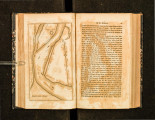
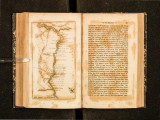
Show Lewis and Clm·kc's E.I.]Jedilion two hundred yards, that of the south is tht·ce hundt·ed and sm·cnty-two. The north, aHhough nat·rower and with a gentler current, is decpet• than the south: its waters too are of the same whitish brown colour, thielmess, and tm·bidness: they run in the same uoiliug and •·oiling manner which ba!l uniformly characterized the l\fissouri; and its bed is composed of some gt·avcl, but principally mud. The south fork is dct'pcr, but its waters arc perfectly transparent: its current is rapid, but the surface smooth and unru1Hed; and itn bed too is composed of round and flat smooth stones like those of rivers issuing ft·om a mountainous country. 'rhe ait· and character of the north fork so much resemble those of the Missouri that almost all the party believe that to be the true course to be pursued. We however, although we have given no decided opinion, are inclined to think otherwise, because, although this branch docs give the colour and clwracter to the Missouri, yet these very circumstances induce an 011inion that. it rises in and runs thL·ough an open plain country, since if it. came from the mountains it would be clearer, unless, which ft·om the positiGn of' the country is improbable, it passel\ through a vast extent of low ground after leaving them: we thought it probable that it did not even penetrate the Rocky mountains, but drew it sources from. the open country towards the lower and middle parts of the Saskashawan, in a direction north of this place. What embarrasses us most is, that the Indians who appeared to be well ~Clluaint~d with the geography of the country, have not men boned this northern river; for "the r.ivcl' which scolds at all others," as it is termed, must be according to their account one of the rivers which we have passed; and if this north fork be the Missouri, why have they not designated the south branch which they must also ha Ye passed, in orde~ to ~each the great falls which they mention on the Missouri. In the evening our parties returned after ascending the rivers in canoes for some distance' then continuing oa foet, just leaving themselves time to' return by Up tlte .M.itssouri. wight. 'fbe north fork was less rapi•l, and therefore afforded the easiest navigation: the shallowest water of the north was five feet deep, that of the south six feet. At two and a half miles up the north fork is a small river coming in on the left or western side, sixty feet wide, with a bold current three feet in depth. The party by laud had gone up the south fork in a straight line, somewlaat north of west for seven miles, where tllCy discoYered that this little river came within oue hundred yards of the south fori~, ami on returning down it found it a handsome stt•eam, with a! much timber as either of the larg6r t~ivers, consisting of the narrow and wide-leafed cottonwood, some birch aml box-alder. and undergrowth of willows, rosebushes, and currants: they also saw on this river a g•·eat number of elk and somr beaver. All these accounts were however Yei'Y far from deciding the important question of our future route, and we therefore determined each of us to ascend one of the rivers during a day and a half's march, or farther if necessary, for our satisfaction. Our hunters ldlled two bufraloe, six elk, and four deer to-day. Along the plains ncar tho junction, are to be found the prickly pear in great quantities; the clwlieeherry is also very abundant in the I·iver low grounds, as well as the ravines along the river bluffs; the yellow an<l red l~urrants are not yet ripe; the gooseberry is beginning to I'ipen, and the wildrose which now covct•s all the low grounds near the rivers is in f'ull bloom. The fatigues of the last few -lays have occasioned some falling off in the appearance oi' the men, who not having been able to wear moccasins, had their feet much bruised ami mangled in passing orer the stones and rough ground. 'l'bey are bowm'Cl' llcrfcetly cheerful, and have an undiminished ardour for the eXllcdition. Tuesday, June <1. At the same hout• this morning captain Lewis and captain Clarlw set out to explore the two rivers; captain I .. ewis with six m~n croq~t·d thr north fork |